Menu & categories

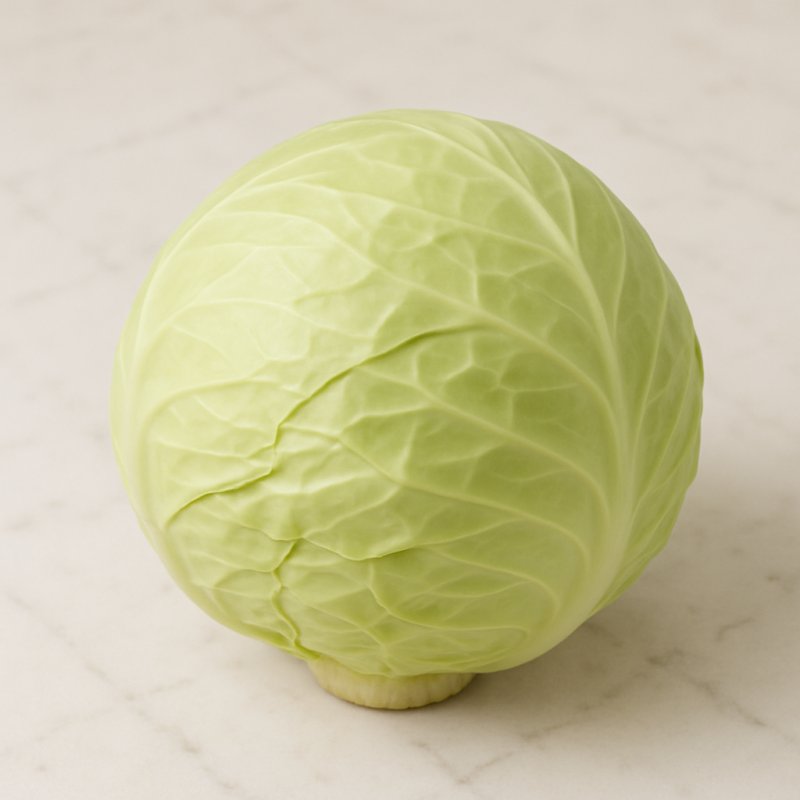
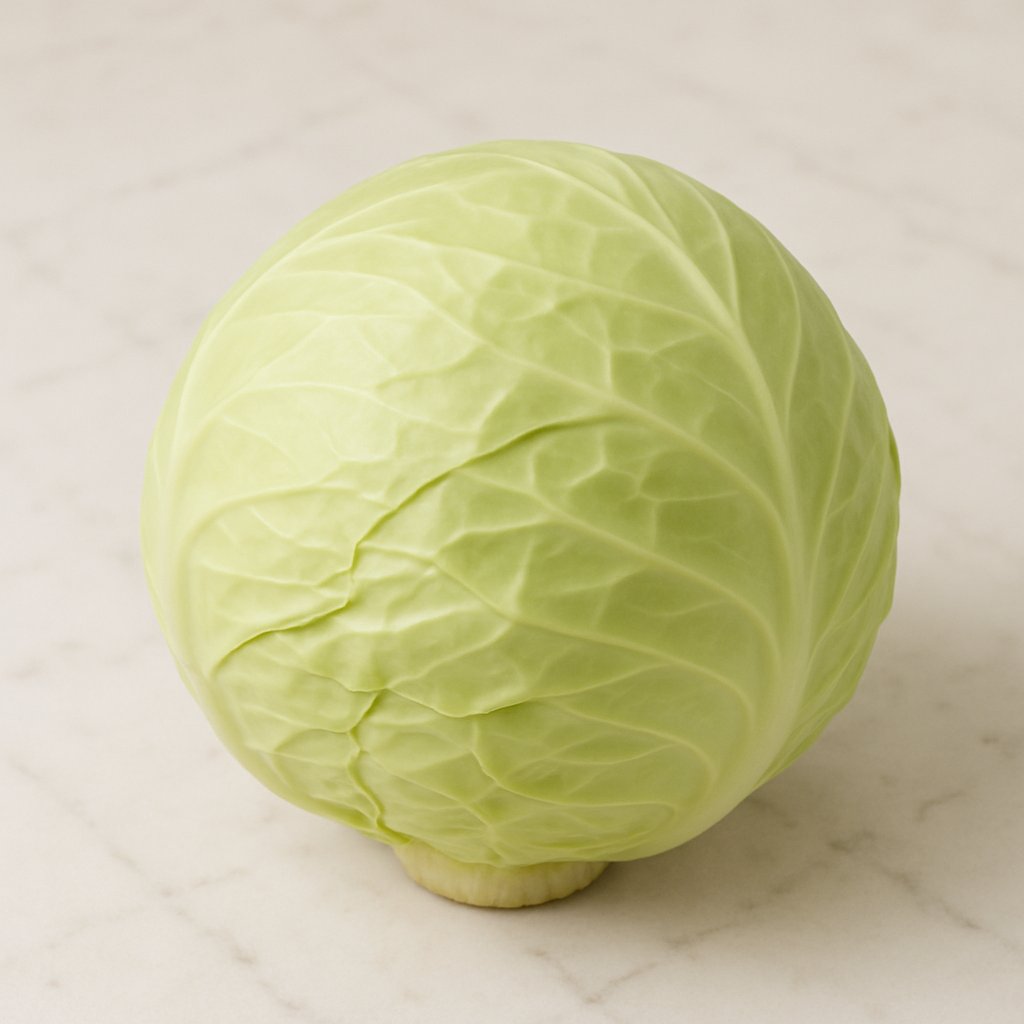
White cabbage

Crisp cabbage vegetable, mild in flavor and versatile in use.

Wiki about white cabbage Nutri-Score A Vegan Yes Gluten-free Yes Lactose-free Yes Nut-free Yes
NUTRITION / 100 g
25 kcal 1.3 g Protein 5.8 g Kohlenhydrate 0.1 g Fett

Introduction

Fresh white cabbage head
White cabbage, to me still a little miracle from the garden, is one of those ingredients that simply belongs as soon as the air turns cooler. I still remember walking home from the autumn market with a friend as a child, the head of a shiny white cabbage giving off its scent in my bag. Since then this vegetable has never quite left me: raw in a crunchy salad, slowly braised alongside potatoes or fermented as sauerkraut to accompany savory sausages.

What I particularly love is the versatility. A simple head of white cabbage can take on so many roles: it can be fresh and sharp when I finely shave it and dress it with a squeeze of lemon. It can become velvety and slightly sweet when I cook it for a long time with apple and onion. And it can be surprisingly complex when I ferment it and the acidity completely transforms the dish.

Practical tips: I have a few basic rules that make life easier for me, and I like to share them.

  • Storage: Keep a whole head preferably in the vegetable drawer or in a dark, cool place.
  • Preparation: Remove the outer leaves and cut the core out in a wedge shape, then the cabbage is easier to slice.
  • Combinations: Butter, caraway, apple, juniper and bacon are classic partners, but a splash of soy sauce or chili makes it modern.
  • Fermenting: A jar, salt and time – and suddenly you have your own sauerkraut.
I often tell colleagues that white cabbage is like a blank notebook: you can leave it plain and nourishing or fill it with bold flavors. Once I served caramelized white cabbage with roasted nuts at a casual dinner; the surprise in the room was almost as great as my pride. For me, white cabbage remains a loyal ingredient that enriches both everyday meals and celebrations.

Availability & types

Availability and types of white cabbage / head cabbage

Origin: White cabbage originally derives from a wild plant that grew on the coasts of western Europe. Over many hundreds of years people have bred this wild cabbage plant until the round, firm heads developed that we know today as white cabbage. You can imagine it like a tree from which, through care and breeding, different varieties grow – but here they are small heads of leaves.

Growing areas: White cabbage grows almost anywhere the climate is not too warm. In Europe, Germany, Poland, the Netherlands and France are major growing regions. Large amounts are also grown in North America, China and other parts of Asia. Farmers plant it in fields, and because it likes cool temperatures, autumn and early spring months are often the main harvest times.

When is white cabbage available?
Fresh cabbage is mainly available in autumn and early winter. Because cabbage is very hardy, it stores well – cellars or cold rooms keep cabbage fresh for weeks to months. Therefore you often find it year-round in supermarkets. Cabbage is also sold pre-cut, vacuum-packed or as sauerkraut in jars and cans, which further extends its availability.

Important varieties and types (simply explained):

  • Round white cabbage: This is the classic headed cabbage most people know. It is firm and has smooth leaves. It is suitable for stews, coleslaws and sauerkraut.
  • Pointed cabbage (spitzkohl): It tapers to a point, is more tender and milder in flavor. Because it has less firm leaves, it is great for raw dishes or quick stir-fries.
  • Savoy cabbage: It looks crinkly and has wavy leaves. Although it belongs to the cabbage family, savoy is somewhat softer and is often cooked or braised.
  • Mini or baby cabbage: Small heads that cook faster and often taste sweeter. Good when cooking for few people.
  • Varieties for sauerkraut: Some cabbage varieties are particularly dense and firm. These are best for fermenting – i.e. for sauerkraut – because they remain crisp.
Forms sold: White cabbage is available whole, halved or already cut (e.g. into strips). There are also vacuum-packed cabbage, frozen cabbage and pickled or cooked cabbage preserves. At farmers' markets you often find freshly harvested cabbage directly from the farmer – especially aromatic.

Tip for selection and storage: Choose heads that feel heavy and have firm leaves. Avoid cabbage with brown spots or wilted leaves. At home cabbage keeps longest in the vegetable drawer of the refrigerator or in a cool cellar – much like an apple that stays juicy longer in the fridge.

So white cabbage is very versatile: it is grown in many countries, comes in different shapes and varieties for raw use, cooking or fermenting, and through storage or preserves it is available almost year-round. This way everyone – for salad, soup or sauerkraut – finds the suitable variant.
Details & nutrition

Property Value
Unit g
Average weight per piece 1200
Calories per 100 25
Protein per 100 1.3
Carbohydrates per 100 5.8
Sugar per 100 3.2
Fat per 100 0.1
Saturated fat per 100 0.02
Monounsaturated fat 0.01
Polyunsaturated fat 0.05
Fiber per 100 2.5
Vitamin C (mg) per 100 36
Vitamin D (IU) per 100 0
Calcium (mg) per 100 40
Iron (mg) per 100 0.5
Nutri-Score A
CO₂ footprint 0.2 kg CO2e/kg
Origin Germany/Europe (seasonal)
Gluten-free Yes
Lactose-free Yes
Nut-free Yes
Vegan Yes
Note Nutritional values refer to raw white cabbage; cooking may reduce vitamin C content.

Technical & scientific information

White cabbage (also head cabbage, botanically Brassica oleracea var. capitata) is a cultivated form of cabbage from the Brassicaceae family. It forms compact heads of thick, mostly pale green leaves and is widespread worldwide as a vegetable. As a cultivated botanical crop it is a variety of the species Brassica oleracea that through breeding has developed pronounced head formation and storability.

Chemical composition and nutritional values
Fresh white cabbage consists of over 90% water and provides only little energy per 100 g. Typical nutritional values (approximate for raw white cabbage) are:

  • Energy value: approx. 20–30 kcal
  • Water: approx. 92 g
  • Protein: approx. 1–2 g
  • Carbohydrates: approx. 5–6 g (of which approx. 3 g sugars)
  • Fiber: approx. 2–3 g
  • Fat: < 0.5 g
  • Vitamin C: approx. 30–40 mg
  • Vitamin K: approx. 50–80 µg
  • Folate: approx. 30–50 µg
  • Potassium: approx. 150–200 mg; calcium and magnesium in small amounts
Secondary plant compounds
White cabbage contains a range of bioactive compounds, including glucosinolates (e.g. glucobrassicin, sinigrin), phenolic compounds and small amounts of flavonoids. Through the enzyme myrosinase, released during disruption, glucosinolates are converted into biologically active products such as isothiocyanates and indoles. These breakdown products are investigated for their potential effects on cancer prevention and inflammatory processes, although findings from laboratory and epidemiological studies are heterogeneous.

Processing and storage
White cabbage can be eaten raw, cooked or fermented. Typical processing methods include:

  • Raw consumption: coleslaws, finely sliced cabbage sides – here myrosinase remains active.
  • Cooking/blanching: reduces vitamin C and can inactivate myrosinase; steaming preserves more nutrients than prolonged boiling.
  • Fermentation (sauerkraut): lactic fermentation by Leuconostoc and Lactobacillus species lowers pH, preserves the product and alters nutrient availability and the microbiota.
  • Preservation: cool storage (near 0 °C, high humidity) extends shelf life; vacuum or film packaging reduces water loss.
Health aspects
Regular consumption of white cabbage provides vitamins, fiber and secondary plant compounds that can positively affect digestion and the microbiome. Fermented products additionally offer live lactic acid bacteria that can contribute to the intestinal microbiota. In vitro generated isothiocyanates show antioxidant and modulating effects on detoxification enzyme systems; the transferability of such effects to humans depends on dose, preparation and individual metabolic pathways. Very high consumption of raw cruciferous vegetables can cause goitrogenic effects that impair iodine uptake; in a normal diet these effects are rarely clinically relevant.

Organoleptic and biochemical changes during cooking
Heating produces sulfur-containing compounds (e.g. dimethyl sulfide) that cause the typical odor. Heat alters texture by breaking down cell walls (pectin degradation) and affects the bioavailability of certain nutrients and secondary plant compounds.

In summary, white cabbage is a low-calorie, water-rich vegetable with relevant contents of vitamin C, vitamin K and fiber as well as characteristic glucosinolates. Preparation and storage methods markedly influence chemical composition and nutritional properties, so the type of processing plays a central role in health effects.

Wiki entry for: white cabbage
Active now: 18 visitors of which 2 logged-in members in the last 5 minutes