Menu & categories

Watermelon

Refreshing summer fruit with high water content.

Wiki about watermelon Nutri-Score A Vegan Yes Gluten-free Yes Lactose-free Yes Nut-free Yes
NUTRITION / 100 g
30 kcal 0.6 g Protein 7.6 g Kohlenhydrate 0.2 g Fett

Introduction

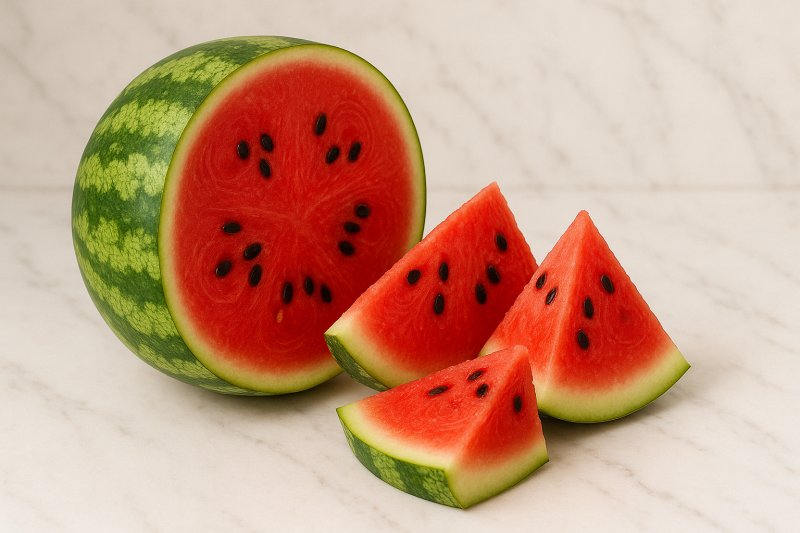
Fresh watermelon
I have a weakness for watermelon, probably developed during hot summers at weekly markets when the scent of ripe fruit still smelled of adventure. I still remember an afternoon when a colleague brought half a melon and we laughed crowding around a knife as the juices made our fingers sticky. This fruit has something archaic: large, bright and yet refreshingly simple.

Watermelon is for me more than just a snack. It is a conversation starter at barbecues, a surprising partner in salads and an uncomplicated ingredient for drinks. I love how its sweet, slightly floral aroma harmonizes with salty flavors. A small experiment I never tire of recommending is watermelon with feta and mint, because the contrasts work so wonderfully.

I value practical aspects as much as the romance around the fruit. When shopping I listen for the sound when tapping the rind, check the yellow spot on the skin and that the melon feels heavy. When I cut a melon at home I store leftovers airtight in the fridge and use them within a few days because they quickly draw water.

  • Nutrients: watermelon provides a lot of water, vitamin C and lycopene.
  • Texture: juicy and slightly grainy, ideal for cold dishes.
  • Uses: salads, sorbets, gazpacho, cocktails and grilled slices.
  • Storage: whole in a cool dry place, cut closed in the refrigerator.
I remember a trip when in the evening I ate pieces of watermelon with sea salt and suddenly tasted the sun of the day again. Such small rituals make the ingredient special to me. Try watermelon in different combinations, surprise guests with unexpected pairings and enjoy the lightness it gives to any plate. I promise that a small piece of watermelon on the table often brings the biggest smile.

Availability & types

Availability and types of watermelon

Watermelons are refreshing fruits seen mainly in summer. They originally come from Africa, where people ate wild melons long ago and later cultivated plants to get larger and sweeter fruits. Today watermelons grow in many warm regions of the world.


Growing regions

  • The largest producers are countries with warm climates: China (a lot), then Turkey, Brazil and Iran.
  • Watermelons are also grown in North America (e.g. USA) and Southern Europe (e.g. Spain, Italy, Greece).
  • In colder countries melons grow outdoors only in summer; in greenhouses or through imports they are often available for longer.
Because the world is so connected, you often find watermelons almost year-round in supermarkets. Still, the time when they taste best is usually summer — then they are especially sweet and juicy. Out of season many melons come from countries where it is summer at that time, or from greenhouses.


Available varieties and variants

  • Seeded vs. seedless: some melons have many black seeds that you spit out while eating. Seedless melons have no large black seeds, but sometimes only tiny white dots. These are more convenient to eat.
  • Flesh color: The most well-known is red flesh. But there are also pink, orange and yellow varieties. Taste can differ slightly — yellow melons often taste a bit milder.
  • Size: There are very large melons, often halved, and mini or personal melons that weigh only a few kilos and are practical for one or two people.
  • Shape: fruits can be round or elongated (oval). Shape and size sometimes help identify the variety.
  • Processed variants: in supermarkets you often find pre-cut melon pieces, cubes in trays or processed into drinks (e.g. melon water or smoothies).
  • Special varieties: some breeders have created melons that are particularly sweet, crisp or disease-resistant. When shopping the variety name is often shown on the label.
Simply put: think of watermelons like jeans — there are different colors, cuts and sizes, but they are all still "watermelons." Some are convenient (seedless), some are colorful (yellow or orange), and some are large enough to serve an entire picnic. In the store you can check origin (which country), size and whether the melon has seeds — that way you find the one that suits your needs.

Details & nutrition

Property Value
Unit g
Calories per 100 30
Protein per 100 0.6
Carbohydrates per 100 7.6
Sugar per 100 6.2
Fat per 100 0.2
Saturated fat per 100 0.0
Monounsaturated fat 0.05
Polyunsaturated fat 0.05
Fiber per 100 0.4
Vitamin C (mg) per 100 8.1
Vitamin D (IU) per 100 0
Calcium (mg) per 100 7
Iron (mg) per 100 0.2
Nutri-Score A
CO₂ footprint 0.03 kg CO2e/100 g
Origin Seasonal, e.g. Spain, Italy, Turkey
Gluten-free Yes
Lactose-free Yes
Nut-free Yes
Vegan Yes
Note Nutritional values may vary slightly depending on variety and ripeness.

Technical & scientific information


Watermelon (Citrullus lanatus) is an annual herbaceous plant of the Cucurbitaceae family, grown globally for its large juicy fruit. Botanically it belongs to the cucurbit group and originates from Africa. Modern breeding forms include red, yellow or white flesh colors and low-seed or seedless (triploid) varieties. Harvest occurs at maturity because the fruit ripens little after harvest.

Physical and chemical composition
The flesh consists of about 90–92% water, giving watermelon a very high hydrating effect. Dry matter consists mainly of carbohydrates (mainly monosaccharides: glucose, fructose; and in riper fruits also sucrose), small amounts of protein and almost no fat. Other important constituents are organic acids (mainly citric and malic acid), soluble and insoluble fiber and secondary plant compounds such as lycopene and carotenoids.

Nutritional values (approx. per 100 g, rounded)

  • Energy: about 30 kcal
  • Water: 90–92 g
  • Carbohydrates: 7–8 g (of which sugars 6 g)
  • Fiber: 0.3–0.6 g
  • Protein: 0.4–0.7 g
  • Fat: <0.5 g
  • Vitamin C: ca. 8–10 mg
  • Vitamin A equivalents (carotenoids): variable, depending on variety
  • Minerals: mainly potassium, small amounts of magnesium, calcium and iron
Specific bioactive compounds
Particularly noteworthy is citrulline, a non-essential amino acid found especially in rind and flesh, which can be converted to arginine in metabolism. Arginine plays a role in nitric oxide synthesis and may have hemodynamic effects. Lycopene is the dominant secondary plant antioxidant in red varieties, known for its radical-scavenging properties.

Processing and technical aspects

  • Fresh consumption: mainly raw as fruit pieces or salad ingredient.
  • Juice and smoothie production: contains a lot of water, so concentration technology or mixtures with other juices are common; pasteurization for preservation.
  • Drying and freeze-drying: for production of powders as food ingredients or snacks.
  • Seed processing: seeds are rich in protein and fat; roasting or cold pressing can produce edible oils (rich in unsaturated fatty acids).
  • Rind use: rind contains pectin and citrulline; used in preserves, pickled products or as animal feed.
Health aspects
Due to its high water content and moderate calorie content, watermelon is considered a hydrating, low-calorie fruit. Lycopene and other antioxidants may help reduce oxidative stress; epidemiological studies suggest possible benefits for cardiovascular disease, but evidence is not conclusive for causality. Citrulline is investigated in sports nutrition and some studies for improved circulation and recovery; clinical evidence remains limited. People with diabetes should watch portion sizes because of the sugar content. Because of the relatively neutral pH and high water activity, hygienic processing is important since contamination-related illnesses are possible.

Ecological and breeding aspects
Breeding goals include increased sugar content (Brix value), higher lycopene concentration, disease resistance (e.g. to Fusarium) and transport stability. Seed techniques such as producing triploid seedless varieties rely on chromosome manipulations (crossing diploid and tetraploid parent lines).

Overall, watermelon is a technically and nutritionally versatile crop with high water binding, notable bioactive components and various processing possibilities, whose benefits continue to be the subject of intensive research in food technology and science.

Wiki entry for: watermelon
Active now: 11 visitors of which 2 logged-in members in the last 5 minutes