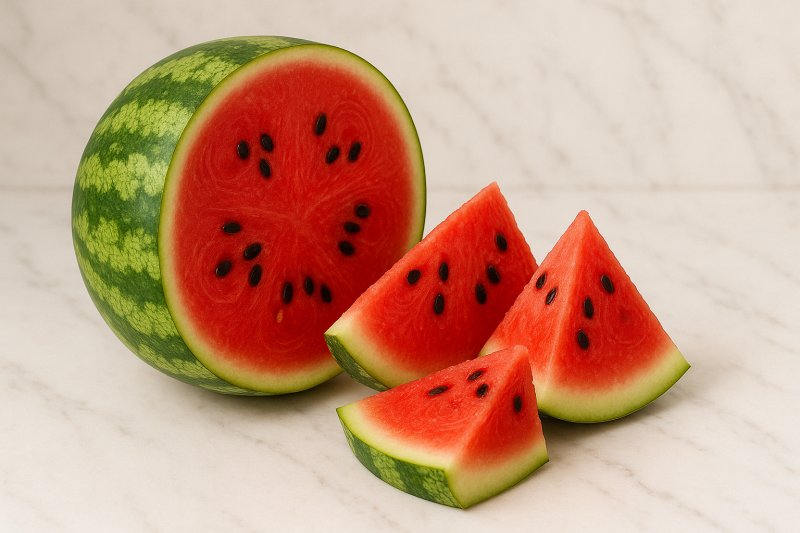
Availability and types of watermelon
Watermelons are refreshing fruits seen mainly in summer. They originally come from Africa, where people ate wild melons long ago and later cultivated plants to get larger and sweeter fruits. Today watermelons grow in many warm regions of the world.
Growing regions
- The largest producers are countries with warm climates: China (a lot), then Turkey, Brazil and Iran.
- Watermelons are also grown in North America (e.g. USA) and Southern Europe (e.g. Spain, Italy, Greece).
- In colder countries melons grow outdoors only in summer; in greenhouses or through imports they are often available for longer.
Because the world is so connected, you often find watermelons almost year-round in supermarkets. Still, the time when they taste best is usually summer — then they are especially sweet and juicy. Out of season many melons come from countries where it is summer at that time, or from greenhouses.
Available varieties and variants
- Seeded vs. seedless: some melons have many black seeds that you spit out while eating. Seedless melons have no large black seeds, but sometimes only tiny white dots. These are more convenient to eat.
- Flesh color: The most well-known is red flesh. But there are also pink, orange and yellow varieties. Taste can differ slightly — yellow melons often taste a bit milder.
- Size: There are very large melons, often halved, and mini or personal melons that weigh only a few kilos and are practical for one or two people.
- Shape: fruits can be round or elongated (oval). Shape and size sometimes help identify the variety.
- Processed variants: in supermarkets you often find pre-cut melon pieces, cubes in trays or processed into drinks (e.g. melon water or smoothies).
- Special varieties: some breeders have created melons that are particularly sweet, crisp or disease-resistant. When shopping the variety name is often shown on the label.
Simply put: think of watermelons like jeans — there are different colors, cuts and sizes, but they are all still "watermelons." Some are convenient (seedless), some are colorful (yellow or orange), and some are large enough to serve an entire picnic. In the store you can check origin (which country), size and whether the melon has seeds — that way you find the one that suits your needs.
