Menu & categories

Watercress

Pungent-spicy leafy vegetable with a high vitamin C content

Wiki about watercress Nutri-Score A Vegan Yes Gluten-free Yes Lactose-free Yes Nut-free Yes
NUTRITION / 100 g
11 kcal 2.3 g Protein 1.3 g Kohlenhydrate 0.1 g Fett

Introduction

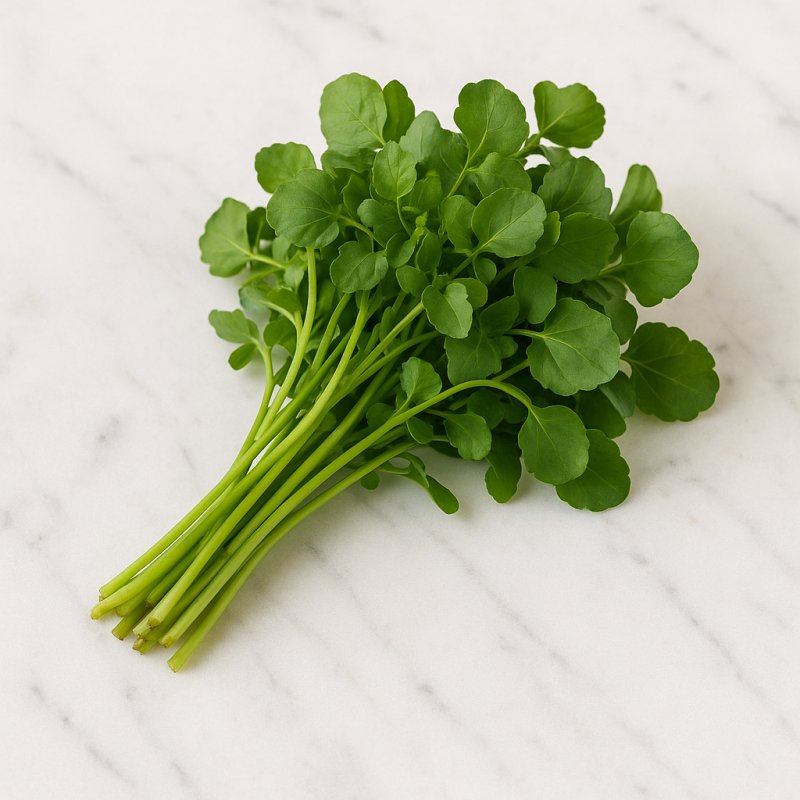
Fresh green watercress leaves on a wooden board
Watercress is for me one of those small green wonders that do more in the kitchen than their unassuming appearance suggests. I still remember the first time I discovered a bunch of it at a weekly market: the smell was sharp and fresh, a little like sea air and peppered grass at the same time. A colleague of mine boldly claimed back then that it was the secret weapon against boring salads. I tried it, mixed it with yogurt and a squeeze of lemon — and was immediately convinced.

What I particularly appreciate about watercress is its versatility. It works wonderfully as a base for salads, gives soups and sauces a piquant note and pairs surprisingly well with soft cheese. The leaves are tender, the stems crisp, and that slightly peppery taste brings dishes to life right away. In my pantry it often sits next to fresh herbs and citrus fruits, because it can quickly brighten a dish.

Health-conscious cooking is also rewarded with watercress. It is rich in vitamins and minerals, contains valuable antioxidants and adds a good portion of green to the plate without feeling heavy. I have often used it as a quick nutrient boost in smoothies or as a compact addition to sandwiches when life was busy.

I also have some practical tips: when buying, look for bright green, firm leaves and avoid wilted ends. Before use I wash it thoroughly, because it often brings sand from wet spots. Lightly sautéed it loses some of its sharpness but remains aromatic — ideal for warm dishes. Used raw, it shows its character best. Those who prefer a milder taste can combine it with mild salad leaves or creamy dressings.

And then there are the little stories from my kitchen: once I served guests a watercress pesto on toasted bread, and the astonished faces said it all. Another evening ended with an improvised watercress soup after the supermarket didn't have the ingredient I had planned — sometimes the best recipes come from small shortages. Even though it is often underestimated, watercress is for me one of the indispensable ingredients that achieve great effect with few moves.

Availability & types

Availability and types of watercress

Watercress is a green plant with a fresh, slightly peppery taste that is used in many kitchens as a flavoring or side. It grows naturally in certain places and is also cultivated intentionally. To help you find and distinguish it, I explain origin, growing regions and the different varieties here as simply as possible.

Where does watercress come from?
Watercress originally comes from the wet areas of Europe and parts of Asia. It loves watery places such as streams, springs or standing water — which is why it is called "watercress." In the past people collected it wild along such water edges. Today watercress grows not only in nature but is also farmed so it reaches the table safely and cleanly.

In which regions is it cultivated?
Watercress is mainly cultivated in regions that have lots of fresh water and mild temperatures. These include:

  • Europe: especially in the United Kingdom, the Netherlands and parts of Germany there are many watercress farms.
  • North America: it is also commercially grown in the USA and Canada.
  • Asia: in some countries there are local cultivations, often in fresh watercourses.
The packaging in the store sometimes states where the watercress comes from. If you buy it fresh at the supermarket, it often comes from specialized operations that use clean water and ensure the plants are healthy.

What varieties or types exist?
Watercress can be divided into different types that differ slightly in appearance or taste. Here are the main variants explained with simple examples:

  • Wild watercress: This grows in open waters like streams. It often has a strong flavor and sometimes firmer leaves. You can think of it like apples from the forest — varying in size and intensity of flavor.
  • Cultivated watercress: Farmers grow this variety in controlled water beds or even in greenhouses. It is usually milder and more uniform in shape and size. It's like comparing supermarket apples to wild apples: the supermarket apples usually look nicer and more regular.
  • Babyleaves / young shoots: These are very young, tender leaves of watercress. They are soft and mild in flavor — good raw in salads or as a garnish.
  • More mature plants: Older leaves are larger and have a stronger, sometimes sharper taste. These are often used for cooking because they retain their flavor well.
Fresh, packaged or as seeds?
You will usually find watercress fresh in bunches or packaged in trays at the supermarket. Sometimes it is also available in small pots you can grow at home. Those who want to garden themselves can buy watercress seeds and sow them in a moist bed or a small water container. It's like having a mini-pond in the garden or on the balcony.

When is it available?
Watercress grows best in cool, moist months, so it is particularly easy to get in spring and autumn. Thanks to cultivation and storage, however, it is often available year-round in markets, especially in regions with professional agriculture.

In summary: watercress is available wild or cultivated, as young tender leaves or more mature plants, fresh at the supermarket, in pots or as seeds. It grows where there is lots of clean water and is found in many countries in Europe, North America and parts of Asia. Depending on taste and use you can choose the appropriate variety.
Details & nutrition

Property Value
Unit g
Calories per 100 11
Protein per 100 2.3
Carbohydrates per 100 1.3
Sugar per 100 0.2
Fat per 100 0.1
Saturated fat per 100 0.02
Monounsaturated fat 0.01
Polyunsaturated fat 0.05
Fiber per 100 0.5
Vitamin C (mg) per 100 43
Vitamin D (IU) per 100 0
Calcium (mg) per 100 120
Iron (mg) per 100 1.3
Nutri-Score A
CO₂ footprint 0.2
Origin Western Europe, Central Europe
Gluten-free Yes
Lactose-free Yes
Nut-free Yes
Vegan Yes
Note Nutritional values refer to fresh, raw watercress. Values may vary slightly depending on cultivation, season and freshness.

Technical & scientific information

Watercress (Nasturtium officinale) is a perennial, herbaceous aquatic plant in the family Brassicaceae. It prefers to grow in cold, oxygen-rich freshwater streams and springs and forms dense mats of pinnate, glossy leaves. Botanically the species is characterized by hollow stems, alternate leaves and small white flowers with four petals. Due to its rapid reproduction and adaptability, it is regionally considered an important aquatic and riparian plant that contributes ecologically to bank stabilization and nutrient uptake.

Chemical composition and constituents
Watercress contains a wide spectrum of secondary plant compounds as well as essential macro- and micronutrients. Important constituents include:

  • Vitamins: particularly rich in vitamin C and vitamin K; notable amounts of provitamin A (carotenoids) and various B vitamins.
  • Minerals: potassium, calcium, iron and magnesium occur in significant concentrations, along with trace elements such as manganese and zinc.
  • Glucosinolates and isothiocyanates: characteristic sulfur-containing compounds of the Brassicaceae that are converted into active isothiocyanates by myrosinase when the plant is disrupted; these compounds are associated with antimicrobial and possible cancer-preventive effects.
  • Flavonoids and phenolic compounds: these include quercetin and kaempferol derivatives, which possess antioxidant properties.
  • Fat and amino acid profile: watercress is low in fat; the fatty acid composition is of secondary importance due to the low fat content. Protein content is moderate for a leafy vegetable.
Nutritional values
Fresh watercress has a low energy density per 100 g and provides mainly vitamin C, vitamin K and mineral nutrients. Typical nutritional values are approximately: 11–20 kcal, 2–3 g carbohydrates, 2–3 g protein, <1 g fat and a high content of water-soluble vitamins. Exact content varies depending on location, harvest time and storage conditions.

Processing and culinary use
Watercress is used in the kitchen mainly fresh, for example in salads, as garnish, in soups or purees. Heat partially reduces heat-sensitive vitamins such as vitamin C and alters glucosinolate profiles; therefore many dishes are preferred raw or only briefly heated. Careful cleaning before preparation is important because the plant grows in natural waters and microbiological contamination as well as pollutant uptake cannot be excluded. Industrial processing includes gentle pasteurization in ready-to-eat spreads or freezing, which minimizes nutrient losses.

Health aspects
Due to its content of vitamin C, carotenoids and antioxidant polyphenols, watercress contributes to the supply of important micronutrients. The presence of glucosinolates and the resulting isothiocyanates makes the plant interesting for research into cancer-preventive mechanisms; however, human epidemiological evidence is limited and effects depend on dose, bioavailability and individual metabolism. Exact vitamin K contents are relevant for people on oral anticoagulation because a marked intake can affect the balance of therapy.

Safety and ecological notes
Watercress can take up pollutants from the water, including heavy metals and organic microcontaminants; therefore harvesting from unknown or polluted waters should be avoided. Also, raw consumption carries a risk of foodborne infections, so pregnant women, older people and immunocompromised individuals should pay attention to hygiene. Ecologically the plant can contribute to bioremediation in suitable habitats, while excessive spread can displace local species.

In summary, watercress is a nutrient-rich leafy vegetable with characteristic secondary plant compounds that provides nutritionally valuable vitamins and minerals. Scientific studies on health effects are ongoing, particularly regarding the biological activity of glucosinolates and isothiocyanates. With responsible choice of origin and hygiene, watercress is a valued ingredient for various fresh preparations.

Wiki entry for: watercress
Active now: 15 visitors of which 2 logged-in members in the last 5 minutes