Menu & categories

Walnuts

Crispy nuts with a high content of unsaturated fatty acids.

Wiki about walnut Nutri-Score C Vegan Yes Gluten-free Yes Lactose-free Yes Nut-free No
NUTRITION / 100 g
654 kcal 15.2 g Protein 13.7 g Kohlenhydrate 65.2 g Fett

Introduction

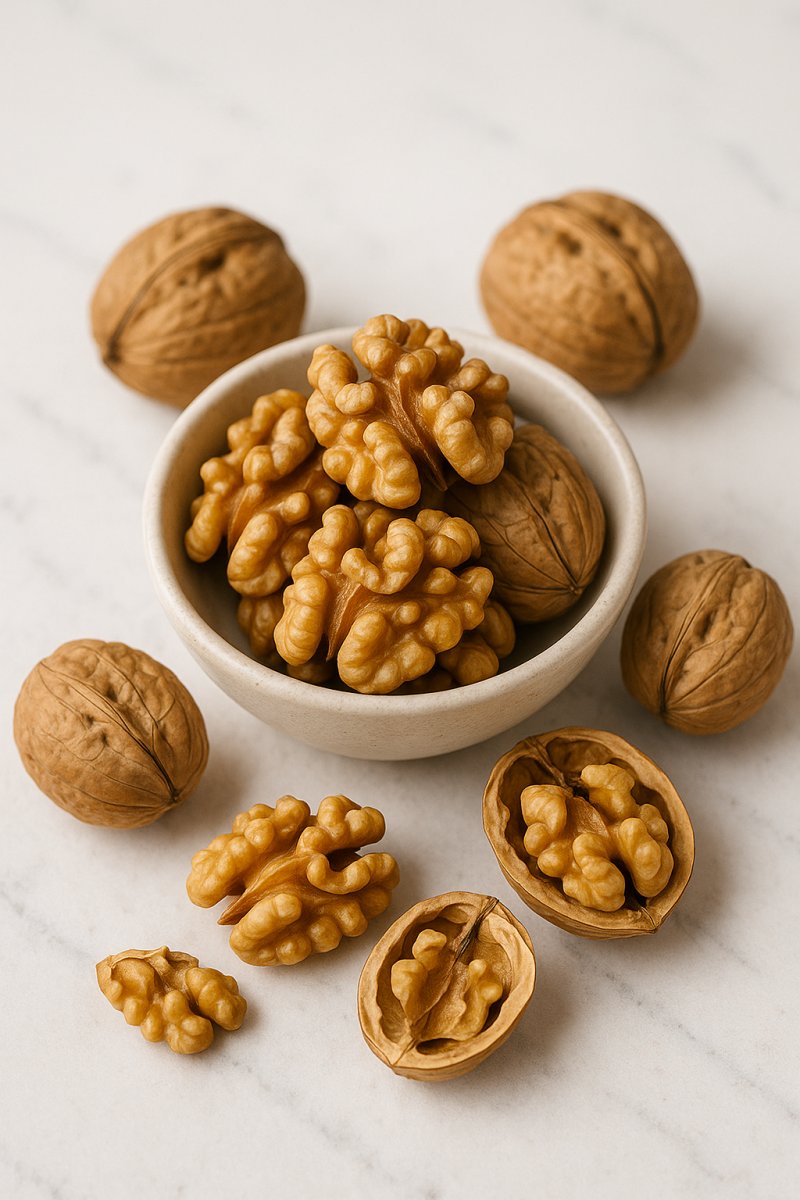
Walnuts in shell and kernels

I still remember as a child running home in autumn with a bag full of walnuts from a neighbor's garden. The smell of freshly cracked shells and the slightly bitter aroma of the kernels stuck with me. To this day the walnut is one of those ingredients that mean both home and adventure: sturdy in its shell, surprisingly tender inside.

Walnuts are so culinarily versatile that they rarely stay alone long in my fridge. I toast them briefly in a pan when I want to deepen their nutty flavor, or roughly chop them over a winter salad. A colleague of mine swears by walnut oil as a secret ingredient for marinades — a drop is enough to transform a simple dish.
Their texture ranges from buttery to crunchy, depending on whether they are used raw, roasted, or caramelized.

It's worth keeping a few basic rules in mind. Fresh walnuts smell slightly green, not fatty. It's best to store them cool and dark, preferably in the refrigerator, so they don't go rancid. When chopping I recommend a coarse hand, because if ground too fine they often lose texture and character.

  • Usage: Salads, bread, pesto, desserts, yogurt toppings.
  • Tips: Roast briefly for more aroma; not too long or they become bitter.
  • Storage: Cool, airtight, freeze if in doubt.
  • Health: Good source of plant-based omega-3 fatty acids and antioxidants.
I love pairing walnuts with strong cheese or pureeing them into a simple dressing. Sometimes in the evenings I make a bowl with warm goat cheese, honey, and coarsely chopped walnuts — a small ritual that delights guests and me alike. For me walnuts are more than an ingredient; they are a piece of the seasons and an invitation to take your time in the kitchen.

Availability & types


Availability and types of walnuts are easier to understand than they sound. Walnuts grow on trees and are harvested in many countries around the world. You can find them fresh in the shell, as kernels (shelled) or as processed products like chopped, ground or in oil. Here I explain origin, growing regions, different varieties and which variants you'll see in shops – so that even a 12‑year‑old can understand well.

Where do walnuts come from?
Walnuts originally come from regions around the Mediterranean and Central Asia. Today they are cultivated in many parts of the world. The largest producers are countries such as:

  • China – a lot of walnuts come from there.
  • USA (especially California) – many varieties found in supermarkets grow there.
  • Turkey and Iran – traditional growing areas with a long history.
  • Europe – countries like Romania, Ukraine or France also grow walnuts.
You can picture the distribution like apples: some countries are large plantations with many trees, others have only a few farms and supply regional nuts.

What types of walnuts are there?
There are two main species you often hear about:

  • English walnut (Juglans regia) – this is the variety most people know. It has a milder, nutty flavor and the kernels are often light and easy to eat.
  • Black walnut (Juglans nigra) – this one is rarer in commerce but has a strong, spicy aroma. It is often used in cakes or as a special ingredient.
Within the English walnut there are many cultivars (varieties), similar to apple varieties. Well‑known cultivars include, for example:

  • Chandler – popular in California, produces large, attractive kernels.
  • Hartley – a traditional variety with good flavor.
  • Franquette – common in Europe, a bit crisper.
  • Serr – another variety grown in plantations.
Which variants will you find in the shop?
In the supermarket or market you see walnuts in different forms:

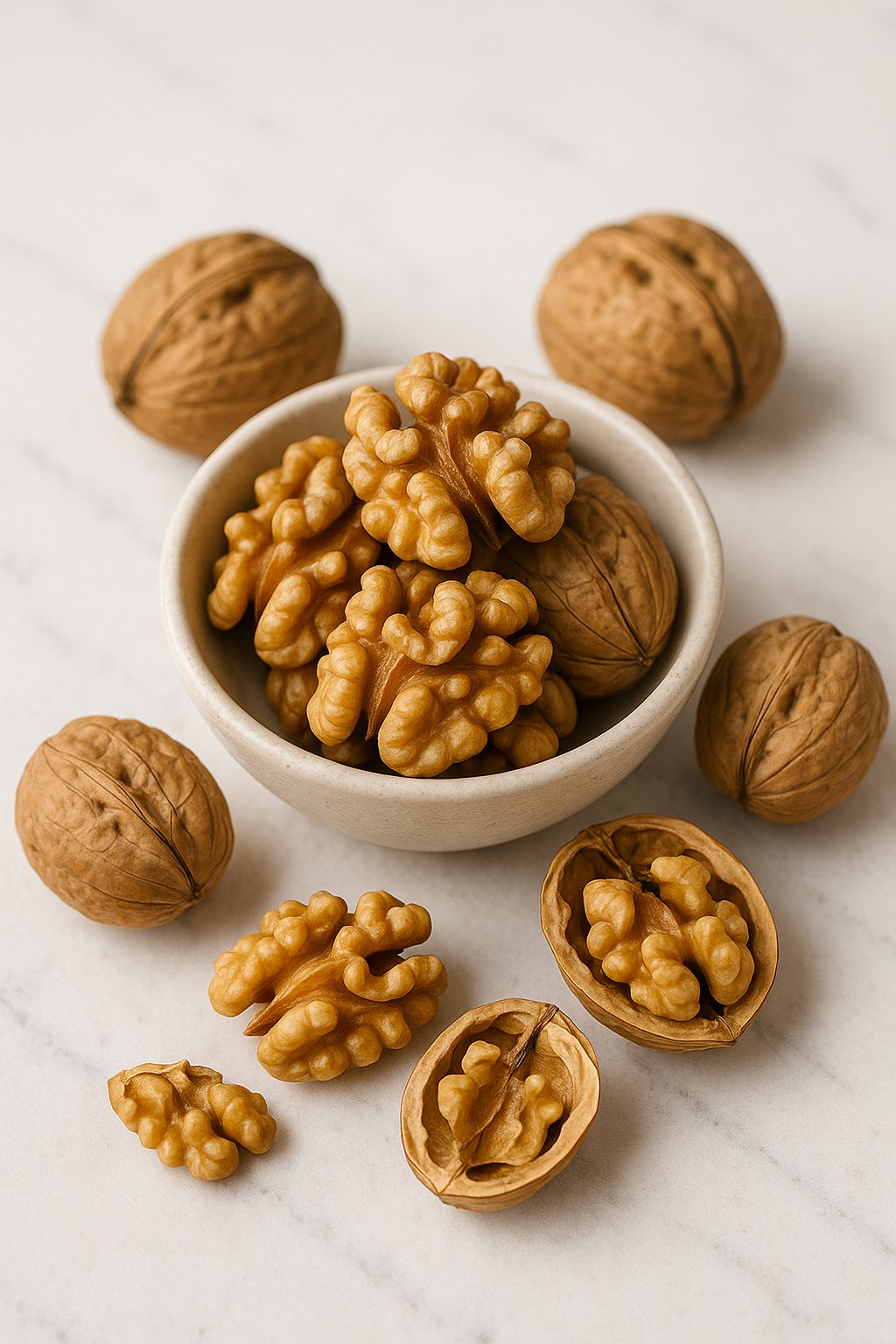
  • In shell – like small brown eggs. They keep long but are a bit tedious to crack.
  • Chopped or whole kernels – already shelled, convenient for snacking or baking.
  • Halved kernels – look nice on salads or cakes.
  • Roasted, salted or candied – sweet or savory snacks.
  • Walnut oil – pressed from the kernels, good for dressings or flavoring.
  • Organic vs conventional – organic walnuts are grown under strict rules without certain pesticides.
Walnuts are available year‑round because they keep well. Fresh in‑shell nuts are often especially easy to find in autumn after the harvest. Shelled kernels are packaged and remain fresh for a long time if stored cool and dark. So you can almost always get some in the shop, no matter the season.
Details & nutrition

Property Value
Unit g
Average weight per piece 4
Calories per 100 654
Protein per 100 15.2
Carbohydrates per 100 13.7
Sugar per 100 2.6
Fat per 100 65.2
Saturated fat per 100 6.1
Monounsaturated fat 8.9
Polyunsaturated fat 47.2
Fiber per 100 6.7
Vitamin C (mg) per 100 1.3
Vitamin D (IU) per 100 0
Calcium (mg) per 100 98
Iron (mg) per 100 2.9
Nutri-Score C
CO₂ footprint 0.30 kg CO2e/100 g
Origin Depending on the batch, e.g. USA, Chile or France
Gluten-free Yes
Lactose-free Yes
Nut-free No
Vegan Yes
Note Values for raw, unsalted walnut kernels; natural variations possible depending on variety and harvest.

Technical & scientific information


Walnut (Juglans regia) is the edible seed fruit of a deciduous tree in the family Juglandaceae. Botanically it is a drupe‑like structure with a hard shell and a two‑chambered, folded seed mass used as the kernel. Walnuts are grown worldwide; major producing countries include China, the USA and some Mediterranean regions.

Composition and nutritional values: Walnuts are energy‑ and fat‑rich. Typical nutritional values per 100 grams are about 650 kcal energy, around 65 g fat, 15 g protein, 14 g carbohydrates and 7 g fiber. The fats are mainly polyunsaturated fatty acids (PUFAs), especially linoleic acid (omega‑6, approx. 38 g/100 g) and α‑linolenic acid (ALA, omega‑3, approx. 9 g/100 g). Monounsaturated fats are about 9 g/100 g, saturated fats about 6 g/100 g. Walnuts also supply minerals such as magnesium (≈158 mg), phosphorus (≈346 mg), potassium (≈441 mg), calcium and iron, as well as B vitamins, notably folate (≈98 µg/100 g) and vitamin B6. Antioxidant components include tocopherols (mainly γ‑tocopherol) and a variety of phenolic compounds, including ellagitannins and flavonoids.

Chemical and biochemical properties: The high concentration of PUFAs makes walnut fat chemically reactive to atmospheric oxygen. Lipid oxidation can lead to peroxide formation and sensory changes; natural antioxidants in the nut delay these processes but are limited. Proteins consist of several amino acid groups with relatively high amounts of arginine and glutamic acid. Phenolic compounds occur both free and bound and contribute to color, aroma and high antioxidant activity in vitro.

Processing and storage: Main steps after harvest are drying, removal of the green husk, cleaning, drying of kernels and sorting. For preservation low temperature and reduced oxygen exposure are advisable, as high humidity and heat promote lipid oxidation and microbial spoilage. For food production walnuts are used raw, roasted or as walnut oil. Oil extraction is done by cold pressing (better retention of aromas and polyphenols) or by solvent extraction with subsequent refining (higher yield, lower content of constituents). Heat treatment such as roasting changes the aroma but can partially degrade phenolic compounds.

Health aspects: Epidemiological and clinical studies show that moderate walnut consumption can have positive effects on cardiometabolic profile. Improvements in lipid profiles, reductions in inflammatory markers and favorable effects on endothelial function have been demonstrated; these are attributed to the combination of PUFA content, plant protein, fiber and secondary plant compounds. Walnuts are calorie‑dense, so portion sizes should be monitored. Walnut allergies are common and can cause severe IgE‑mediated reactions up to anaphylaxis. Furthermore, improper storage carries a risk of mold contamination and mycotoxins.

Functional and technological applications: In food technology walnuts serve as an ingredient for baked goods, muesli, pestos and as nut flour or nut butter. Walnut oil is used in cooking for dressings and as an aroma carrier; in cosmetics the lipid fractions are used because of their fatty acid profile and skin care properties. Technical challenges include oxidation protection, sensory stability and allergen labeling.

In summary, walnuts are a nutrient‑rich food with high content of polyunsaturated fatty acids, valuable secondary plant compounds and relevant micronutrients. Health effects are well studied, but attention to portioning, correct storage and allergy warnings is necessary to ensure quality and safety.
Wiki entry for: walnut
Active now: 24 visitors of which 2 logged-in members in the last 5 minutes