Menu & categories

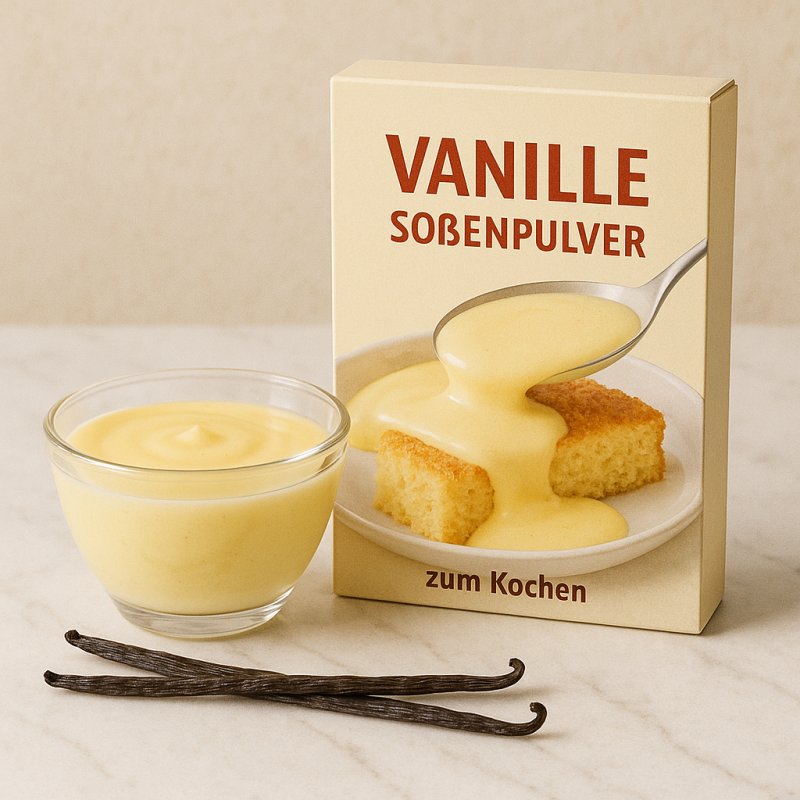
Vanilla sauce powder

Sweet powder for the quick preparation of vanilla sauce.

Wiki about vanilla sauce powder Nutri-Score D Vegan Yes Gluten-free Yes Lactose-free No Nut-free Yes
NUTRITION / 100 g
370 kcal 1.5 g Protein 90 g Kohlenhydrate 1.0 g Fett

Introduction

Vanilla sauce powder in a bowl
I still remember well the first rainy evening when I tried a sachet of vanilla sauce powder in my small kitchen and was surprised how quickly a warm, comforting dessert came from a few ingredients. For me vanilla sauce powder is one of those handy kitchen friends that require neither much space nor great skill, but reliably deliver flavor and coziness.

At its core vanilla sauce powder usually consists of a blend of starch, sugar, milk powder or emulsifiers and, of course, vanilla flavourings. Some varieties contain real vanilla or vanilla extract, others use natural or artificial flavourings. The powder is designed to thicken when heated and produce a velvety, smooth sauce that goes well with cakes, baked apples or simply for spooning.

I've learned to follow a few simple rules: first dissolve in cold liquid, then heat while stirring to avoid lumps. A colleague of mine swears by stirring in a little butter at the end — it makes the sauce shinier and rounds out the flavor. For a more intense vanilla note I sometimes add half a real vanilla bean, although the powder alone is often perfectly adequate for everyday use.

Practical about vanilla sauce powder is its versatility and long shelf life. In the pantry it belongs to the ingredients that can quickly turn into a dessert when unexpected guests arrive or the craving for something sweet takes over. For those avoiding sugar or lactose there are now varieties with sweeteners or plant-based versions.

  • Quick preparation: Stir powder into cold liquid, then heat slowly.
  • Enhance: Butter, a splash of rum or real vanilla for depth.
  • Storage: Store dry, in the dark and airtight.
In short, vanilla sauce powder for me is a small kitchen rescue: down-to-earth, flexible and always ready to bring warmth and a little luxury to the plate.

Availability & types

Availability and types

Vanilla sauce powder is available in many supermarkets, discounters and online shops. You usually find it in the baking or dessert aisle, because the powders are intended to quickly make a vanilla sauce — similar to an instant pudding that you stir with milk. There are small sachets for single portions, plastic tubs or cartons with multiple servings. Some brands also sell refill packs or larger containers for families.

Where does the vanilla come from?
The vanilla that gives the powder its name originally comes from tropical regions. The well-known growing areas are:

  • Madagascar – the best-known region, often referred to as "Bourbon vanilla". It smells very intense and sweet.
  • Tahiti – Tahitian vanilla often has a floral-fruity scent, so somewhat different from Madagascar's.
  • Mexico – this is where the vanilla story began; the flavor can be spicier.
  • Uganda and Indonesia – also important growing regions with different flavor profiles.
Important: For many vanilla sauce powders the whole vanilla pod is not used, but only extracts or flavorings.

Natural vanilla vs. artificial vanillin
There are two main kinds of vanilla flavor in the powder:

  • Natural vanilla – made from real vanilla pods or their extracts. It costs more, often tastes rounder and is labelled with terms like "real vanilla" or "vanilla extract".
  • Artificial vanillin – a single compound that mimics the typical vanilla taste. It is cheaper and found in many mass-market products. Often the packaging says "vanilla flavour", which can be artificial or natural. A comparison: natural vanilla is like a freshly picked apple, artificial vanillin like apple juice concentrate — both taste similar, but different.
Types of vanilla sauce powder
There are different variants that differ in ingredients and preparation:

  • Instant powder – simply mixed with cold or warm milk and thickens quickly. Good when you want speed.
  • Cooking powder – needs to be briefly boiled so the sauce binds. This often yields a slightly creamier texture.
  • With sugar – already contains sugar, so you don't need to add sweetener when preparing.
  • Sugar-free / reduced sugar – for people who want to eat less sugar or use their own sweetener.
  • Vegan / lactose-free – some powders contain no dairy ingredients, so they can be used with plant-based milk.
  • Organic / fair trade – often contain natural vanilla extract from controlled cultivation; usually a bit more expensive, but important for people who value sustainable production.
In summary: vanilla sauce powder is sold everywhere and comes in many variants — from cheap powders with artificial vanillin to more expensive versions with real vanilla extract or organic quality. The choice depends on whether you want a quick, inexpensive sweet sauce or prefer the fuller taste of real vanilla. It's best to try different packages, just like tasting different ice cream flavours, until you find your favourite.
Details & nutrition

Property Value
Unit g
Calories per 100 370
Protein per 100 1.5
Carbohydrates per 100 90
Sugar per 100 60
Fat per 100 1.0
Saturated fat per 100 0.3
Monounsaturated fat 0.2
Polyunsaturated fat 0.5
Fiber per 100 0.5
Vitamin C (mg) per 100 0
Vitamin D (IU) per 100 0
Calcium (mg) per 100 30
Iron (mg) per 100 0.2
Nutri-Score D
CO₂ footprint ca. 1.2 kg CO2e/kg
Origin Germany/EU (depending on manufacturer)
Gluten-free Yes
Lactose-free No
Nut-free Yes
Vegan Yes
Note Nutritional values refer to the dry powder; prepared sauce has significantly different values depending on the liquid used (e.g. milk/plant-based drink).

Technical & scientific information


Vanilla sauce powder is a ready-to-use dry product for the quick preparation of a warm or cold vanilla sauce. It consists of a mixture of technical ingredients that, when stirred into a liquid, form a spreadable sauce while delivering the characteristic vanilla aroma. Products of this type are used both in households and in the food industry.

Composition and typical ingredients

  • Starch base: Native or modified potato, corn or wheat starches are commonly used. Modified starch increases heat stability and reduces the tendency to retrogradation.
  • Sugars and sweeteners: Sucrose is common; in reduced-sugar variants sweeteners or sugar substitutes are used.
  • Milk components: Milk powder, whey powder or milk proteins are used to improve flavor and mouthfeel and to provide protein for binding.
  • Flavourings: Vanillin (chemically 4‑Hydroxy‑3‑methoxybenzaldehyd) is the most common single flavour. Products may contain synthetic vanillin, natural vanilla extract or a mixture; natural extracts provide more complex accompanying compounds.
  • Emulsifiers and stabilizers: Mono- and diglycerides, guar gum, xanthan or carrageenan ensure an even texture and stability.
  • Anticaking agents and release agents: Silicon dioxide or calcium phosphates prevent caking in the powder.
  • Salt, acidity regulators, colorants: Small amounts for flavor balance and visual adjustment (e.g. caramelized sugar compounds).
Manufacturing and processing methods

Production begins with mixing the dry components in defined proportions. Modified starches are often altered by chemical or physical treatment (e.g. etherification, oxidation, pregelatinization) so that they swell in a controlled way when heated. After homogeneous mixing, volatile flavorings are usually dripped in small quantities or incorporated by spray drying. The final products are sieved and packaged to avoid moisture and microbial contamination.

Physical and chemical processes during preparation

When stirred into cold or warm liquid the starch granules swell. Heating leads to gelatinization of the starch: the granules take up water, amylose leaches out and forms a network that thickens the sauce. Proteins from milk can complement the structure formation, while emulsifiers bind fat and water and stabilize a homogeneous emulsion. Vanillin is relatively heat-stable, but volatile accompanying compounds of natural vanilla can be partially lost at high temperatures.

Nutritional values and health aspects

Vanilla sauce powder is generally energy-rich due to its sugar and starch content; per 100 g energy values are usually in the range of 350–400 kcal. Protein content is low to moderate, fat usually low, although milk powder increases the fat content. Important notes are:

  • Allergens: Milk components are often present; when wheat starch is used, gluten may also be present.
  • Sugar content: Relevant for diabetics and calorie-conscious people; reduced-sugar variants are available.
  • Additives: Modified starches, emulsifiers and anticaking agents are technically common and considered safe in permitted amounts, but may be relevant for people with sensitivities.
  • Shelf life and microbiology: The powder is more stable at low moisture; the prepared sauce is perishable and should be stored refrigerated.
Final remark

Vanilla sauce powder is a technically optimized product that, by combining starch gelation, milk components, emulsifiers and vanilla flavourings, enables a stable, sensorially consistent vanilla sauce. Ingredient selection determines behaviour on heating, sensory properties, nutritional values and shelf life; consumers should check the ingredient list for allergens and sugar content.

Wiki entry for: vanilla sauce powder
Active now: 15 visitors of which 2 logged-in members in the last 5 minutes