Menu & categories

Tomato paste

Concentrated tomato base with intense aroma.

Wiki about tomato paste Nutri-Score B Vegan Yes Gluten-free Yes Lactose-free Yes Nut-free Yes
NUTRITION / 100 g
82 kcal 4.3 g Protein 18.9 g Kohlenhydrate 0.5 g Fett

Introduction

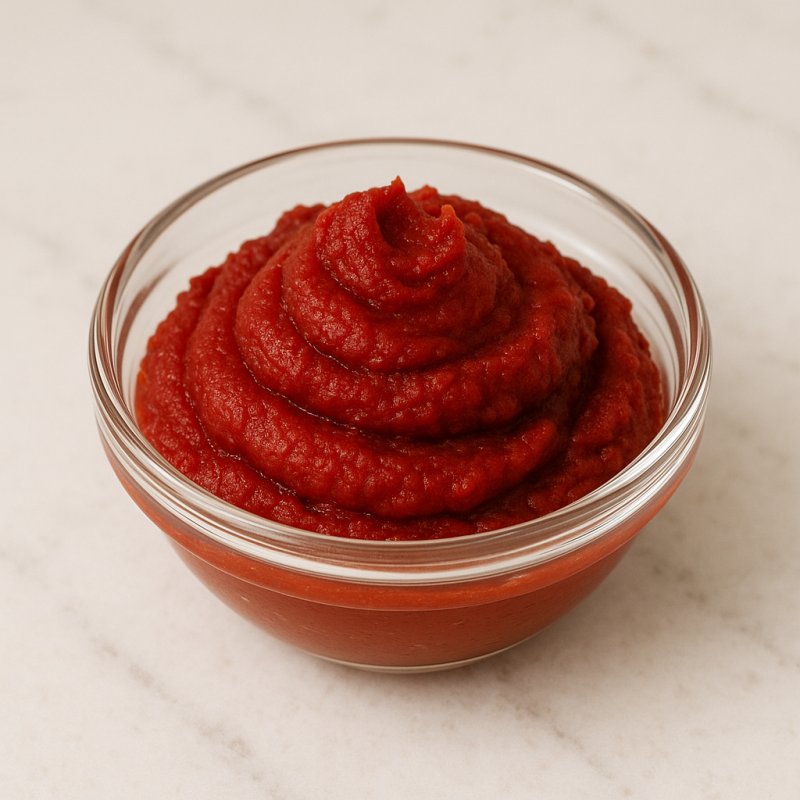
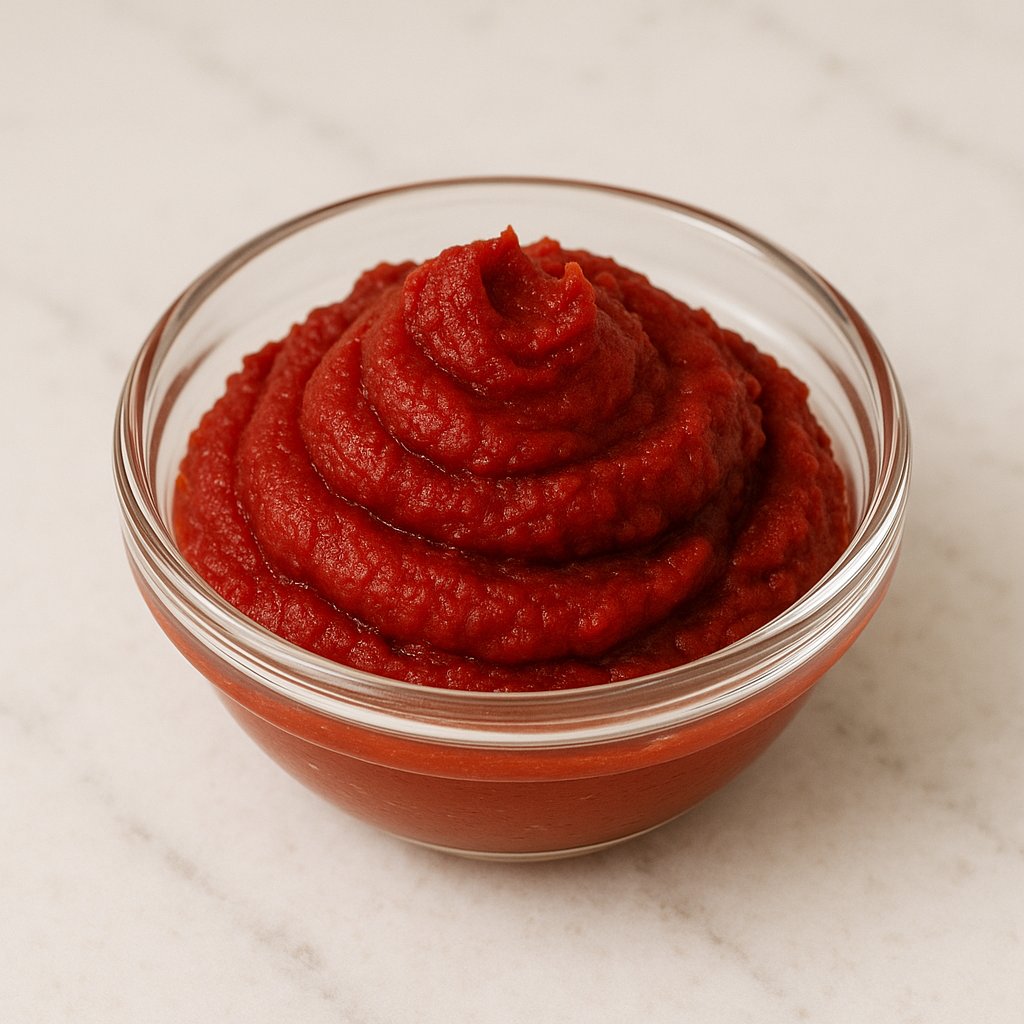
Tomato paste in a bowl

I have a secret love: tomato paste. It’s one of those ingredients you underestimate until you once saved a boring sauce with it. I still remember a rainy evening when a thin tomato soup turned within minutes into a silky, deep-red temptation – just because I stirred in a heaping teaspoon of tomato paste. Since then I always keep a tube ready, as if it were a small, concentrated stash of magic.

Tomato paste is made by cooking tomatoes for a long time until the liquid evaporates and the flavors concentrate. There are different concentration levels, and the darker the paste, the more intense the taste. What I love is the combination of sweetness, acidity and that savory umami note that gives many dishes depth. If I briefly fry the paste, it develops even more of that caramelized side that goes so well with stews and ragùs.

Practical uses come to mind easily in everyday life. Tomato paste is versatile and reliable:

  • As a base for pasta and pizza sauces.
  • To thicken soups, chilis or Bolognese.
  • In marinades and dressings for a more intense tomato flavor.
  • For seasoning and color enhancement in braised dishes.
A few tricks I’ve learned and like to pass on: briefly roast tomato paste in oil so the raw acidity disappears. A little sugar or balsamic can balance the acidity, and a pinch of salt enhances the flavor. I often freeze portions in ice cube trays, then I always have exactly the amount I need on hand.
A colleague once averted an entire kitchen crisis with a single cube of tomato paste – I won’t forget that.

In the end tomato paste for me is not a trivial ingredient but a little kitchen rescuer that gives character to simple dishes. It’s worth trying different brands and using the paste consciously, because it can turn a dish from “nice” to “irresistible”.

Availability & types

Tomato paste is a very practical ingredient in many dishes. It’s like the strong flavor of fresh tomatoes, but in a thick, red paste. Origin: Tomatoes originally come from South America, but were brought to Europe many hundreds of years ago. Today tomatoes grow almost everywhere in the world. Tomato paste is made from these tomatoes: the fruits are cooked, sieved (that is, pressed through a sieve to remove skins and seeds) and then reduced until only the concentrated paste remains. This makes the tomato flavor very intense.

Growing regions
Tomatoes need warmth and lots of sun, so they grow particularly well in southern regions. Important growing regions are:

  • Europe: Italy, Spain and Greece are large producers. Many tomatoes ripen there in the sun.
  • North America: In the USA there are large tomato fields, especially in warmer states.
  • Asia: China is one of the largest tomato producers in the world.
  • Tomatoes are also grown in Germany, often in greenhouses so they can grow longer and under controlled conditions.
Imagine tomato fields as red seas of fruit shining under the sun. The more sun and warmth, the sweeter and more aromatic the tomatoes can become — and you can taste that later in the paste.

Available types and variants
Tomato paste is not just one thing. Here are the main variants you find in stores:

  • Regular tomato paste: Lightly concentrated, tastes of tomato, usually in cans or jars.
  • Double or concentrated tomato paste: Very thick and intense in flavor; a spoonful often suffices. Often labeled on the package as “double concentrated”.
  • Passata / Tomato purée: Flowing more than paste, more like a thick juice; good for soups and sauces when you want a less intense tomato flavor.
  • Tomato paste in a tube: Convenient because you can squeeze out a small amount, similar to toothpaste. Good for seasoning.
  • Seasoned variants: Sometimes paste is available with herbs like basil or with garlic. It saves time when cooking.
  • Organic and regional products: From organic farming or local producers – often more expensive, but important to some for environmental or flavor reasons.
Availability and tips
You can get tomato paste almost everywhere: supermarkets, health food stores, farmers’ markets and online. In hot summer months there are often more fresh tomatoes, but tomato paste is available year-round because it has a long shelf life when the can is still sealed. A tip: after opening store in the refrigerator and transfer to a clean jar, then it will keep longer.

When you cook, choose double paste for a strong flavor in small amounts, and passata when you want a lighter, more fluid base. That way you’ll always find the right variant for your dish, whether pasta, soup or pizza.
Details & nutrition

Property Value
Unit g
Calories per 100 82
Protein per 100 4.3
Carbohydrates per 100 18.9
Sugar per 100 12.6
Fat per 100 0.5
Saturated fat per 100 0.1
Monounsaturated fat 0.1
Polyunsaturated fat 0.2
Fiber per 100 4.1
Vitamin C (mg) per 100 25
Vitamin D (IU) per 100 0
Calcium (mg) per 100 20
Iron (mg) per 100 2.0
Nutri-Score B
CO₂ footprint 1.3 kg CO2e/kg
Origin EU (depending on manufacturer)
Gluten-free Yes
Lactose-free Yes
Nut-free Yes
Vegan Yes
Note Values may vary depending on concentration and possible addition of salt/citric acid.

Technical & scientific information


Tomato paste is a concentrated product made from ripe tomatoes by thermal treatment and evaporation of water. It serves as a flavor-intense base ingredient in the kitchen and as a primary ingredient in processed foods. Technically, it is a pasty preparation with a high proportion of soluble solids that sustainably influence the aroma, color and texture of dishes.

Manufacturing process: Industrial production begins with washing and crushing the fruit, followed by mechanical separation of skins and seeds. The tomato mash is heated to inactivate enzymes and ensure microbiological safety, and then evaporated under vacuum or atmospheric pressure until the desired solids concentration is reached. Depending on the desired end product, different concentration grades are produced and labeled as “single”, “double” or “triple concentrate”. After evaporation, homogenization and, if necessary, pasteurization or sterilization take place for preservation. In artisanal production the process can be simpler, often without industrial filtration.

Chemical composition and constituents: Tomato paste contains mainly water and dissolved solids, which include sugars, organic acids, fiber, proteins and minerals. Typical components are:

  • Water: residual fraction remaining after concentration.
  • Carbohydrates: mainly glucose and fructose; total sugar content increases relative to fresh produce due to concentration.
  • Acids: mainly citric and malic acid, which bring the pH into the acidic range (typical pH 3.5–4.5).
  • Fiber: pectins and cell wall components that increase viscosity.
  • Carotenoids: particularly lycopene, responsible for the red color and which becomes more available with heat.
  • Vitamins and minerals: vitamin C is heat-sensitive and reduced by heating, while minerals like potassium remain relatively stable.
Nutritional values (typical ranges): Tomato paste provides concentrated energy and nutrients per 100 g. Values vary depending on concentration level; common approximate values are about 60–90 kcal, 3–5 g protein, less than 1 g fat, 15–25 g carbohydrates including fiber and sugars, as well as notable amounts of potassium and lycopene. Manufacturer information should be used for precise nutritional labeling.

Physical and chemical properties: The texture is viscous to pasty, the color an intense red to dark red. Heating leads to isomerization of lycopene (trans → cis), increasing its bioavailability. At the same time the content of heat-sensitive vitamins like vitamin C decreases. The reduced water activity and the acidic pH contribute to microbiological stability.

Health aspects: Tomato paste is a concentrated source of lycopene and other secondary plant compounds that have been associated in epidemiological studies with positive effects on cardiovascular health and as potentially protective against certain cancers. Such associations are complex and should not be taken as definitive therapeutic claims. Thermal processing reduces some heat-sensitive nutrients while making other compounds more available. Additives such as salt or sugar can alter the nutritional value.

Food safety and storage: Unopened, sterile-processed products have a long shelf life; opened tubes or jars should be stored in the refrigerator and consumed within a few days to weeks. The combination of low pH and preservative processing minimizes the risk of foodborne infections.

In practice, tomato paste is a technologically valuable food with specific sensory and functional properties, whose usefulness derives from concentration, stability and the high content of lipophilic antioxidants such as lycopene.

Wiki entry for: tomato paste
Active now: 20 visitors of which 2 logged-in members in the last 5 minutes