Menu & categories

Toffees

Soft caramel candies with a high sugar and fat content

Wiki about toffee Nutri-Score E Vegan No Gluten-free Yes Lactose-free No Nut-free No
NUTRITION / 100 g
430 kcal 2.0 g Protein 72.0 g Kohlenhydrate 14.0 g Fett

Introduction

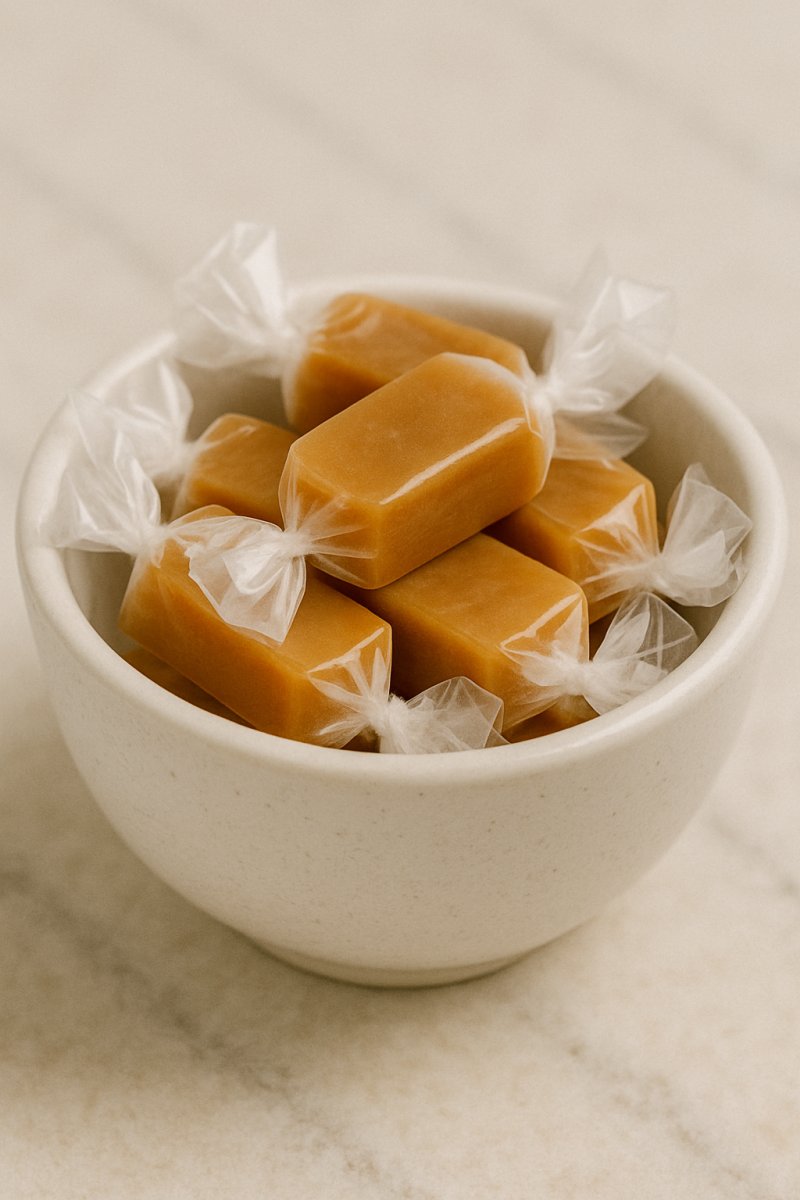
Several soft toffees in a golden caramel color
Toffees are for me one of those small, golden sins you only really learn to appreciate when you try them consciously. I still remember how, as a teenager, I secretly pocketed a tin of sticky toffees from the cupboard and watched for minutes as they stuck to my teeth. That sensual pulling, the delicate crackle when biting, and the warm, caramelized flavor — all of this makes toffees a confection that's more than just sugar and fat. For me they're keepsakes: birthday parties, cinema tickets and rainy Sundays when a single toffee could save the whole afternoon.

Culinarily, toffees are surprisingly versatile. Basically they are made from sugar, butter and sometimes cream, slowly heated until a dense, elastic mass forms. Depending on the cooking temperature different textures arise: soft and chewy or firm and slightly brittle. I once experimented with a friend and learned small milestones while experimenting:

  • Temperature control: One degree too much and the toffees become hard like chocolate; one degree too little and they remain sticky.
  • Flavor variants: Salt, vanilla, coffee or even a splash of whiskey turn the classic base into a little taste experience.
  • Preservation: Airtight containers and parchment paper prevent them from sticking together.
A colleague once brought handmade toffees to the office that he had refined with sea salt. The mix of sweet and salty caused a small euphoria among us all; suddenly the simple caramel seemed like a culinary statement. Such moments show how toffees build a bridge in the world of sweets: between the everyday and the festive, between childhood memory and adult pleasure.

For anyone who wants to have a go: patience pays off. Stirring calmly, reading the temperature precisely and the right timing when pouring make the difference between "tasty" and "legendary". And if something goes wrong on the first try, it's not a drama — often the little mishaps are the best stories you later tell while sharing the toffees. In the end toffee remains for me a little formula for happiness: sweet, a bit obstinate and always ready to stick memories.

Availability & types

Availability and types of Toffees

Toffees are soft, chewy sweets found in many countries around the world. Although they don't grow in a field like fruit or vegetables, they still have an origin: toffees are manufactured in factories, usually from sugar, butter, milk and flavorings. The basic ingredients come from different regions – sugar, for example, from sugar beet or sugar cane, milk often from dairy farms near creameries, and butter from cow's milk. These ingredients are heated and mixed in large kettles until the mass becomes thick and sticky. Afterwards it is cooled, cut into pieces and often wrapped individually.

Where to find toffees

  • Supermarkets: the most common place to buy. Many varieties are on shelves or in large bins to serve yourself from.
  • Confectionery shops: particularly many and special varieties, sometimes handmade or from old recipes.
  • Bakeries and cafés: some make toffees themselves or sell small packs.
  • Online shops: here you often find international brands and rare variants that are hard to find in stores.
Types and variants

Toffees come in a wide range of variants. You can think of them like different ice cream flavors: the basic idea is the same, but small changes create entirely new tastes and shapes.

  • Classic-Toffee: the simple, typical toffee is brown, chewy and tastes of butter and caramel. It is like the basic recipe many people know.
  • Butter-Toffee: particularly buttery in flavor. Often a step creamier and less hard than the Classic-Toffee.
  • Caramel-Toffee: very sweet and slightly melting. Caramel forms when sugar is heated strongly and takes on a nutty-brown color.
  • Fruit-filled toffees: on the outside it's normal toffee, inside is a soft fruit filling like strawberry or lemon – like a surprise inside.
  • Nut toffees: with whole nuts or nut pieces, for example almonds or hazelnuts. That adds extra crunch and flavor.
  • Salty toffees: a combination of sweet and salty (e.g. sea salt). This mix is popular with many because it tastes different to plain sugar.
  • Dentist-friendly or sugar-free toffees: for people who need to avoid sugar. They taste similar but use sugar substitutes.
  • Handmade/Artisan toffees: smaller batches, often with special ingredients like Madagascar vanilla or sea salt from the coast. They are often more expensive but particularly flavorful.
Why there are so many varieties

Manufacturers like to experiment with flavor and shape because people have different preferences. Some like them soft and creamy, others prefer chewy and long-lasting to suck on. Regional preferences also play a role: in some countries nutty varieties are popular, in others fruity or salty variants.

Simple tips for trying them

  • If you try toffees, start with a classic variety to know what toffee actually tastes like.
  • Then try variants like caramel or nut to find out what you like best.
  • If you need to watch your sugar intake, there are sugar-free alternatives that taste similar.
In summary: toffees are available worldwide and come in many variants – from simple butter toffees to fruit-filled or nutty types to special handmade varieties. You can buy them in supermarkets, specialty shops or online, and the wide selection ensures that almost everyone can find a variety they like.
Details & nutrition

Property Value
Unit g
Average weight per piece 6
Calories per 100 430
Protein per 100 2.0
Carbohydrates per 100 72.0
Sugar per 100 60.0
Fat per 100 14.0
Saturated fat per 100 9.0
Monounsaturated fat 3.0
Polyunsaturated fat 0.5
Fiber per 100 0.0
Vitamin C (mg) per 100 0.0
Vitamin D (IU) per 100 0.0
Calcium (mg) per 100 80.0
Iron (mg) per 100 0.2
Nutri-Score E
CO₂ footprint 3.0
Origin Varies by manufacturer, often Europe
Gluten-free Yes
Lactose-free No
Nut-free No
Vegan No
Note Nutritional values are average values for classic caramel toffees with sugar, glucose syrup, milk and butter; exact values vary by brand and recipe.

Technical & scientific information

Toffees are soft to chewy caramel candies that obtain their characteristic consistency through control of sugar, fat and protein content and through specific cooking and cooling processes. Classic toffee formulations are based on a blend of household sugar or sucrose, inverted sugar (e.g. glucose syrup), milk or cream, butter and sometimes other fat sources such as vegetable oils. When these components are heated a series of physico-chemical events occur (Maillard reactions, caramelization) that determine flavor, color and texture.

Chemical composition and reaction processes
The dominant component in toffees is sucrose; additionally glucose and fructose are present as a consequence of inversion, which reduces the tendency to crystallize. Milk components supply proteins (mainly casein and whey proteins) and lactose, which actively participate in Maillard reactions. Fat, primarily from butter, plays a structuring role by inhibiting sugar crystallization and influencing the perception of softness. Heating at temperatures typically between 115 °C and 140 °C leads to sugar caramelization, while Maillard reactions between reducing sugars and amino groups from proteins produce brown pigments and complex aroma compounds.

Physics of texture formation
The consistency of toffee is a function of water activity, the physical state of the sugars and the behavior of the fat phase. On cooling an amorphous or partially crystalline sugar residue forms; a high proportion of glucose syrup promotes a glass-like (amorphous) structure that remains soft, whereas a high sucrose content favors the formation of larger sugar crystals and thus more brittle textures. Water binding by milk proteins and the hygroscopic effect of sugars influence shelf life and sticky surface properties.

Nutritional values and ingredients
Toffee is energy-dense: caloric content typically ranges from 350–450 kcal per 100 g due to the high sugar and fat content. Macronutrient distribution shows a high proportion of carbohydrates (predominantly simple sugars), a moderate to high fat content (depending on butter or cream fraction) and low amounts of protein. Mineral and vitamin contents are low; traces of calcium or vitamin A may derive from dairy ingredients. Industrially produced toffees may contain additives such as emulsifiers (lecithins), stabilizers, flavorings and antioxidant preservatives to extend shelf life.

Processing methods
Industrial production is carried out in batch or continuous processes. Key steps include dissolving and homogenizing ingredients, heating to defined end-temperatures to set the sugar-water system, foaming and degassing for texture control, as well as controlled cooling and shaping (e.g. pulling, rolling, cutting). During cooking moisture content is precisely regulated; small differences in temperature or stirring speed lead to perceptibly different results. Surface treatments (e.g. coating with fat or icing sugar) prevent sticking.

Health aspects and storage
From a nutritional perspective toffees are to be classified as indulgent foods due to their high sugar and fat content; excessive consumption increases the risk of caries, overweight and metabolic disorders. Persons with lactose intolerance or milk protein allergy should avoid milk-based toffees. Microbial safety is supported by low water activity and high sugar content; nevertheless lipid oxidative processes and quality losses can occur with improper storage. Optimal storage conditions are dry, cool and protected from light to minimize texture and flavor losses.

Variants and technological adaptations
Toffees can be varied by using alternative sweeteners (e.g. isomalt, polyols), plant-based milk alternatives, or by deliberate control of caramelization degrees for different flavor profiles. Technological challenges include the balance between softness and shape stability, prevention of sticking and adaptation to nutritional requirements such as reduced calories or sugar-free formulations. Sensory requirements — e.g. chewiness, elasticity and mouthfeel — are also central criteria in product development and quality control.

In summary, toffee is a technologically well-controllable sugar-fat-protein system whose properties are decisively determined by composition, heat treatment and cooling regime. Chemical reactions such as caramelization and Maillard effects provide characteristic color and aroma while physical parameters shape texture and storage stability.
Wiki entry for: toffee
Active now: 14 visitors of which 2 logged-in members in the last 5 minutes