Menu & categories

Sweet popcorn

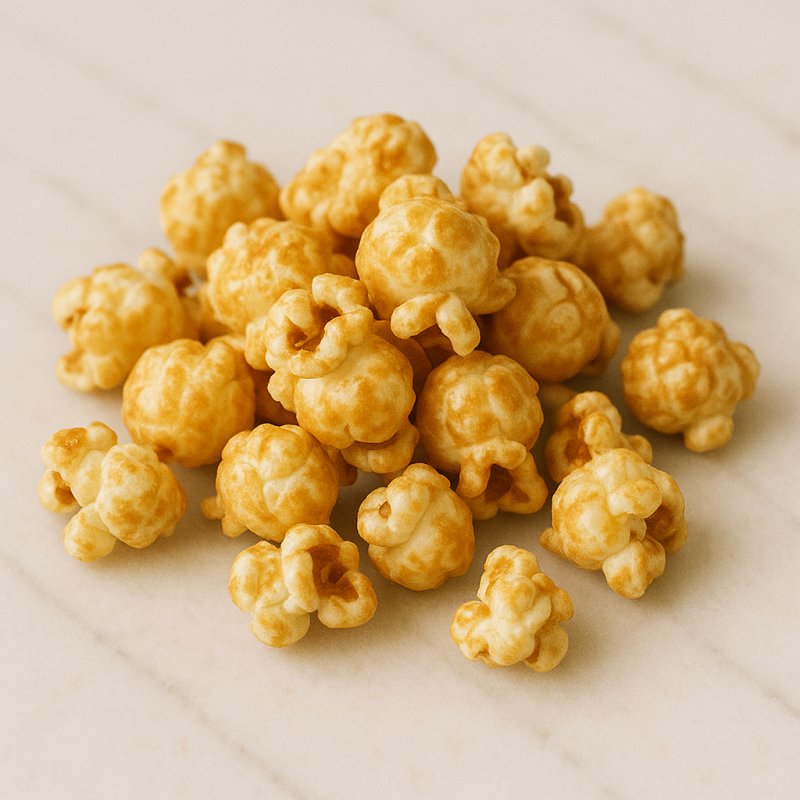
Lightly popped corn with a sugar coating

Wiki about sweet popcorn Nutri-Score D Vegan Yes Gluten-free Yes Lactose-free Yes Nut-free Yes
NUTRITION / 100 g
390 kcal 7 g Protein 76 g Kohlenhydrate 4 g Fett

Introduction

Bowl of sweet popcorn
I have a particular weakness: sweet popcorn. It's the small, crackling bit of happiness that accompanies me at movie nights as well as on spontaneous coffee dates on the balcony. I clearly remember a rainy Sunday afternoon when a friend brought a bag of sweet popcorn and we unwrapped it like a treasure among tissues. The aroma spread through the kitchen at once, and before the film had even started, the first kernels were already gone.

For me sweet popcorn is more than just a snack; it's a culinary chameleon. I love how easy it is to vary: a hint of caramel for the classic sweetness, a little sea salt that surprisingly pairs well, or a pinch of cinnamon for a quiet winter mood. A colleague once brought homemade popcorn tossed in maple syrup — it had such a velvety, warm note that I wanted the recipe immediately.

The preparation is almost meditative. The popping of the kernels alone is a little spectacle: first isolated pops, then a crescendo until silence when the last kernel has popped. I prefer to make my sweet popcorn myself because that way I can control the sweetness and avoid unnecessary additives in the bag. For sugar I swear by brown sugar or cane sugar because it gives a deeper, caramel-like note, and sometimes I stir in a little butter at the end to make the coating silkier.

When I have guests, I like to set up a small popcorn bar:

  • Basic popcorn from the pan or pot
  • Various sweet toppings like caramel sauce, chocolate shavings or honey
  • A few savory options like dried herbs or grated Parmesan for contrast
What I particularly like about sweet popcorn is its versatility: it works as a dessert, as a party snack and even as a gift if you package it nicely. It's surprisingly economical and creates great enthusiasm with little effort. I often think of the small moments of pleasure that arise — a spontaneous smile when you bite into a sweet, warm kernel, or the shared rustle of a paper bag in the dark of a cinema. Sweet popcorn remains for me an uncomplicated, comforting classic that continually surprises.

Availability & types

Availability and types

Sweet popcorn is a popular snack you can find almost anywhere in the world. But where does it actually come from and what types are there? Here we explain it in simple terms so that even a 12‑year‑old can easily understand.

Origin
Popcorn is made from a special type of corn called popcorn maize. This corn differs from the sweetcorn you eat as a vegetable or the corn used for meal. The kernels are harder and have a small amount of water inside. When heated, the water turns to steam and the kernel bursts — that's how the white, fluffy popcorn forms. People have eaten popcorn for hundreds of years; it was first used by indigenous peoples in North and South America.

Growing regions
Popcorn maize is mainly grown in regions with good farmland and a suitable climate. The main countries are:

  • United States: This is the largest growing area. Especially in the Midwestern states a lot of popcorn maize is grown.
  • Argentina and Brazil: In parts of South America there are large fields of popcorn maize.
  • China and India: Popcorn maize is also grown in Asia, mainly where there are flat fields and warm weather.
  • Germany and Europe: Less popcorn maize is grown in Europe, but there are specialized farms that produce this maize for local markets.
Popcorn is therefore practically available everywhere because it is either grown locally or imported. In supermarkets, cinemas and snack stands you'll find different varieties — from plain bagged kernels to ready-seasoned popcorn.

Available varieties and types
Popcorn comes in many shapes, colors and flavors. Here are the main types, explained simply:

  • Butter or salted popcorn: This is the classic cinema variety. After popping fat and a little salt are added. Sometimes it tastes like melted butter, sometimes a butter-flavor mix is used.
  • Sweet popcorn: Here sugar syrup, caramel or honey are used. In caramel popcorn the kernels are coated with a sweet, sticky layer that hardens as it cools — making it crunchy.
  • Colored popcorn: For children's parties there is often colorful popcorn (e.g. pink or blue), coated with food coloring and sugar.
  • Salt-free or lightly seasoned: For people who want less salt there are versions with herbs, cheese flavor or light olive oil.
  • Low‑fat or light: These varieties have less fat, often because they are "puffed" with hot air instead of fried in fat.
  • Gourmet varieties: These try out special combinations like chocolate and sea salt or chili and lime.
So popcorn is very versatile: there are simple raw kernels you can pop yourself in a pan or microwave, and packaged popcorn ready to eat. Whether you like it sweet or salty, you'll always find a suitable variant. That makes sweet popcorn easy to obtain and available in many tasty types — whether for movie night, a birthday party or just snacking between meals.

Details & nutrition

Property Value
Unit g
Calories per 100 390
Protein per 100 7
Carbohydrates per 100 76
Sugar per 100 35
Fat per 100 4
Saturated fat per 100 0.6
Monounsaturated fat 1.2
Polyunsaturated fat 2
Fiber per 100 9
Vitamin C (mg) per 100 0
Vitamin D (IU) per 100 0
Calcium (mg) per 100 10
Iron (mg) per 100 2
Nutri-Score D
CO₂ footprint 1.1
Origin Varies by manufacturer, typically EU or USA
Gluten-free Yes
Lactose-free Yes
Nut-free Yes
Vegan Yes
Note Nutritional values for ready-to-eat sweet popcorn made from popped corn with sugar and some vegetable oil; values may vary depending on the recipe and manufacturer.

Technical & scientific information

Sweet popcorn typically refers to popped corn that has been coated with sweetening ingredients or caramelized after popping. As an ingredient in the food industry and for home use, sweet popcorn represents a combination of thermally expanded corn kernel and various sugar or sweetener formulations. The basis is the endosperm of the popcorn kernel, which, when heated with an intact hull, rapidly expands by steam and transforms the starchy matrix into a porous, easily digestible structure.

Botanical and physical fundamentals
Popcorn is produced from special popping-corn varieties (Zea mays var. everta), whose kernels have a hard pericarp and a high starch content as well as a favourable moisture content. When heated, the water contained in the endosperm vaporizes, the internal pressure rises and leads to a hull rupture; the gelatinized starch expands and cools in the typical white, porous form. Physically, the structure is characterized by high porosity and low bulk density, which is relevant for texture and the ability to pick up a coating medium.

Composition and nutritional value
The main components of sweet popcorn are carbohydrates (mainly starch and added sugar), water, small amounts of protein and fat, and dietary fiber from the corn hull. Typical nutritional values per 100 g of sweet popcorn depend on the recipe and coating and are about 400–500 kcal, 60–80 g carbohydrates (with a high proportion of simple sugars in heavily sweetened variants), 6–10 g fat and 6–10 g protein. Fiber content is often 5–10 g/100 g. Micronutrients such as B vitamins, magnesium or iron are present in small amounts but usually play a minor role nutritionally.

Processing methods for sweet popcorn
Manufacture typically combines two process steps: popping the corn and applying the sweet components. Popping can be done in oil, hot air or in special steam/pressure chambers. Sweetening is achieved by the following procedures:

  • Dry dusting: addition of powdered sugar or flavored powders after popping.
  • Caramelization/glazing: heating a sugar solution (e.g. sucrose, glucose syrup) to the caramel stage and coating the popcorn, followed by cooling to form a crisp sugar layer.
  • Flavor and color addition: use of natural or synthetic flavors and colorants to target taste and appearance.
  • Binders and texture agents: use of fats, syrups or emulsifiers to improve adhesion of the coating and control texture.
Chemical reactions during caramelization
When sugar is heated Maillard reactions (in the presence of proteins) and direct caramelization reactions occur. These lead to the formation of aroma compounds (e.g. diacetyl, furans, sugar degradation products) and brown pigments (melanoidins). The exact composition of the aroma compounds is temperature- and time-dependent and critically influences the flavor.

Health aspects
Sweet popcorn should be considered an occasional treat rather than a staple food due to its high sugar and calorie content. Risks arise particularly from excessive sugar consumption (dental caries, obesity, metabolic disorders) and from high-fat preparations through increased intake of saturated fatty acids. For people with gluten intolerance plain corn popcorn is generally suitable; however additives or contamination in industrial products can be relevant. When preparing at home attention should be paid to hygienic processing and to avoiding burnt products during caramelization.

Storage and shelf life
Sweet popcorn is hygroscopic, meaning the crispy sugar crust absorbs moisture from the environment and loses crispness. Airtight packaging with moisture barriers extends shelf life and prevents texture loss and microbial spoilage in moister coatings. Industrial products are often stabilized by temperature control and the addition of antioxidant preservatives.

Overall, sweet popcorn combines simple botanical fundamentals with chemo‑technical processes in processing and sweetening. The sensory appeal is based on the combination of airy texture, caramelized aroma compounds and noticeable sweetness, while from a nutritional perspective caloric density and sugar content are decisive for moderate consumption.

Wiki entry for: sweet popcorn
Active now: 17 visitors of which 2 logged-in members in the last 5 minutes