Menu & categories

Sugar

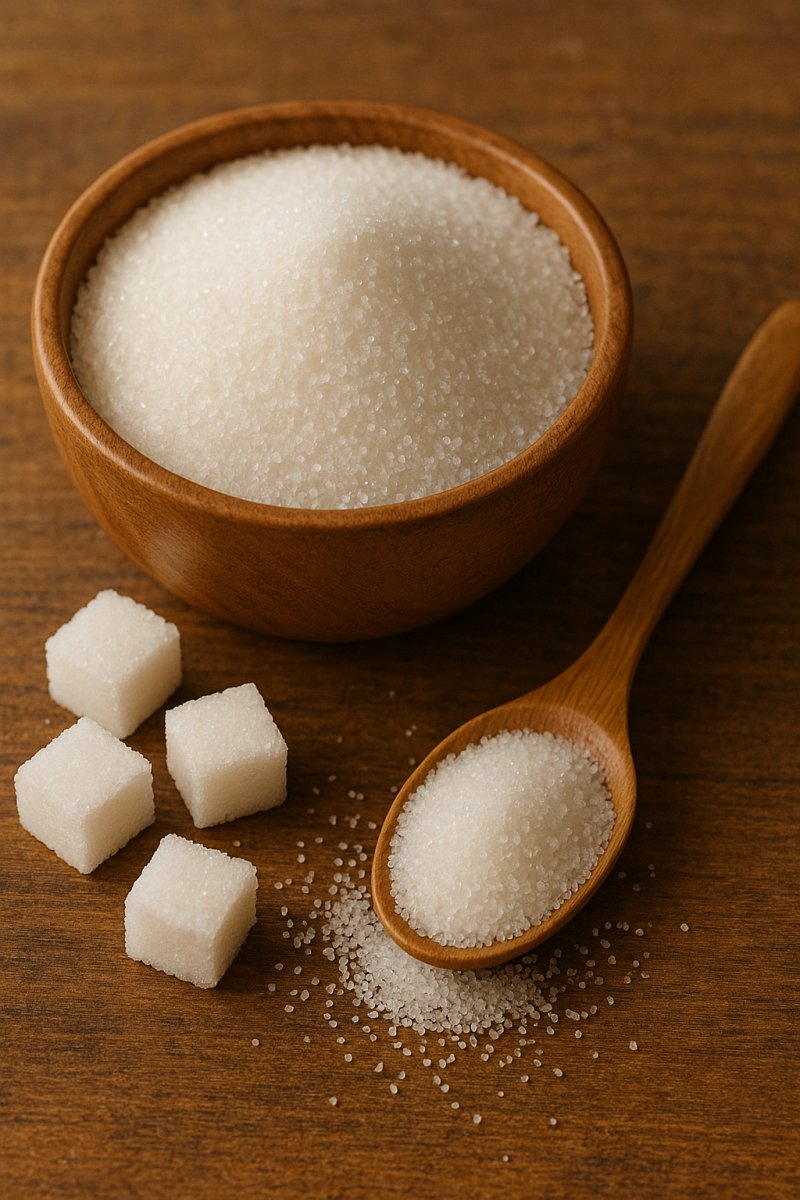
Sweetener with 100% carbohydrates - pure energy without micronutrients.

Wiki about sugar Nutri-Score E Vegan Yes Gluten-free Yes Lactose-free Yes Nut-free Yes
NUTRITION / 100 g
400 kcal 0 g Protein 100 g Kohlenhydrate 0 g Fett

Introduction

Sugar
I have a complicated but intimate relationship with sugar. It is the secret hero in many kitchen moments, from the first scent of cake on a Sunday morning to the clinking espresso spoon with which I sweeten life when it needs a small break. A colleague of mine swears by a pinch of sugar in the tomato sauce pot, and since then I try it occasionally when the acidity gets too cheeky.

Sugar is not only sweet; it is a versatile ingredient with surprising properties. It caramelizes, binds moisture, preserves fruit and gives yeast something to celebrate when dough rises. I still remember a workshop where I first saw simple crystals become a shiny carpet of caramel, and that moment changed my idea of sugar forever.

It's worth knowing a few basic types:

  • White granulated sugar – universally usable for baking and sweetening.
  • Cane sugar – often slightly more caramel-like in flavor.
  • Powdered sugar – ideal for icings and dusting.
  • Raw sugar / Muscovado – intense, with molasses notes; wonderful in dark baked goods.
In practice sugar has many culinary talents. It balances acidity, promotes browning and helps the texture of creams and pastries. When making jam, sugar together with pectin forms the magic bond that turns fruit into a spreadable delight. Some kitchen failures of mine – too much, too little, too early – have taught me more than any perfect cake.

Of course I also speak openly about moderation: sugar has its merits, but I try to use it consciously. Small tricks help reduce the sweet experience without losing enjoyment, for example by adding citrus or spices.

In the end sugar is for me an ingredient with personality: it can dominate or accompany subtly, it tells stories of traditions and experiments, and it connects simple household moments with the small luxury of indulgence.

Availability & types

Availability and types of sugar

Sugar is an ingredient that is available almost everywhere. It usually comes from two plants: the sugarcane plant and the sugar beet. You can imagine sugarcane as tall, green grass that grows in warm areas. Sugar beets look more like thick, white beets that grow in cooler regions. Both plants store sweetness that is extracted and processed in factories.


Where sugar is grown

  • Sugarcane: Mainly in tropical countries. Major growing areas include Brazil, India, Thailand and countries in Africa and South America. Sugarcane needs a lot of sun and warmth, which is why it grows very well there.
  • Sugar beet: Grows more in cooler climates. Many crops in Europe (for example France and Germany), in the USA and in parts of Russia are sugar beets. They are more cold-resistant than sugarcane.
Why there are different types of sugar

The reason for different types of sugar is how the sugar is processed and how much of the dark syrup called molasses remains. Molasses is like a sugar syrup with a strong flavor. The more molasses present, the darker and more strongly flavored the sugar. Sugar can also be ground finely or left coarse — this changes how it behaves in baking or when sprinkling.

Common sugar types and what they do

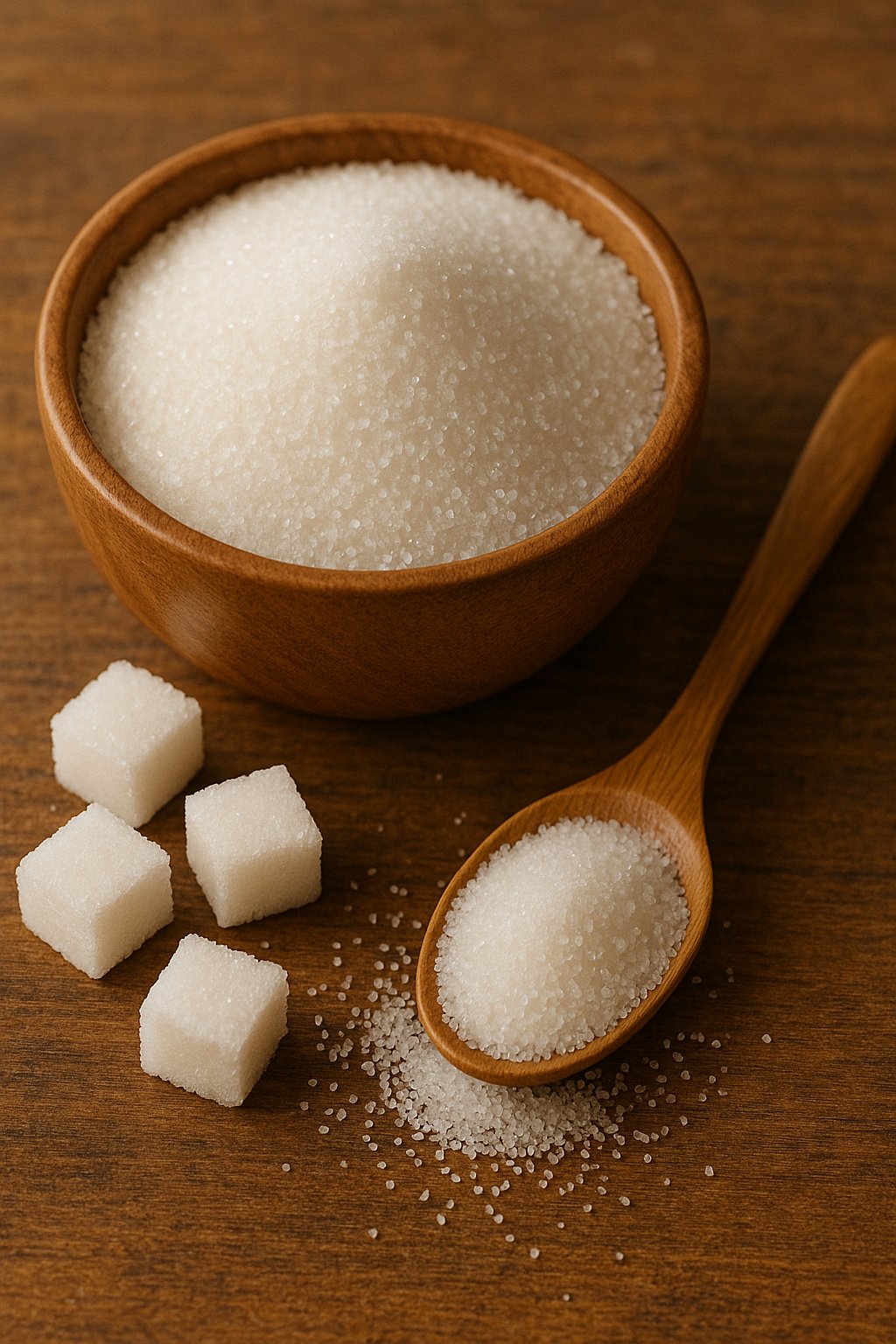
  • White granulated sugar: The most common sugar. It is pure, white and sweet. It dissolves well and is often used for cooking and baking.
  • Raw sugar / Cane sugar: Still contains some molasses, is slightly brown and tastes mildly caramel-like. Many people enjoy it in coffee or in cookies.
  • Brown sugar (e.g. Demerara, Muscovado): The darker it is, the stronger the flavor. Muscovado is very moist and has a strong caramel flavor; Demerara has larger crystals and is good for sprinkling.
  • Powdered sugar (confectioners' sugar): Very finely ground. It is often used for icings or to dust cakes.
  • Fine sugar (e.g. caster sugar): Finer than regular sugar, dissolves even better — good for desserts.
  • Alternatives: Coconut blossom sugar, maple syrup, agave syrup or sugar alcohols (e.g. xylitol). These have different flavors and are sometimes used instead of regular sugar.
How and where to get sugar

Sugar is found in almost every supermarket, health food store or even at farmers' markets. It comes in small packages for households or in large sacks for bakeries. You can also look for special variants: organic sugar comes from more controlled farming, fair-trade sugar often supports farmers socially and financially. Sugar keeps for a long time as long as it is stored dry and airtight — so it is easy to stock up.

In summary: sugar usually comes from sugarcane or sugar beets, grows in warm or cool regions and is available in many varieties — from white granulated sugar to dark muscovado or alternative sweeteners. That way everyone can find the right type for their taste and recipe.
Details & nutrition

Property Value
Unit g
Calories per 100 400
Protein per 100 0
Carbohydrates per 100 100
Sugar per 100 100
Fat per 100 0
Saturated fat per 100 0
Monounsaturated fat 0
Polyunsaturated fat 0
Fiber per 100 0
Vitamin C (mg) per 100 0
Vitamin D (IU) per 100 0
Calcium (mg) per 100 0
Iron (mg) per 100 0
Nutri-Score E
CO₂ footprint 0.07 kg CO2e/100g
Origin Depending on origin: sugar beet (often EU) or sugarcane (partly overseas).
Gluten-free Yes
Lactose-free Yes
Nut-free Yes
Vegan Yes
Note Nutritional values refer to table sugar (sucrose). May be contaminated with traces, but typically does not contain allergens that must be declared.

Technical & scientific information


Sugar in food and nutritional science refers to a group of water-soluble carbohydrates whose simplest members are the monosaccharides. The best-known chemical representatives in the kitchen are glucose (grape sugar) and fructose (fruit sugar). Common household sugar is predominantly sucrose, a disaccharide composed of one molecule of glucose and one of fructose with the molecular formula C12H22O11. Sucrose is a non-reducing sugar that is split into glucose and fructose by hydrolysis (e.g. with acids or the enzyme invertase); the product is called invert sugar.

Main properties and nutritional values: sugar provides energy-dense carbohydrates at about 4 kcal (≈17 kJ) per gram. Different sugars have varying sweetness potency and metabolic effects: fructose tastes sweeter than sucrose but has a lower glycaemic index (GI ≈ 15–25), while glucose is the reference with GI=100 and sucrose typically has a GI around ≈ 60–70. Sugar is hygroscopic, crystalline (or amorphous as a syrup) and highly soluble in water.

Origin and processing: Industrially, sugar is mainly obtained from sugarcane and sugar beets. Basic processing steps include:

  • Extraction of the juice (pressing sugarcane / diffusion for beets)
  • Purification by liming, carbon dioxide or activated carbon and filtration
  • Evaporation to concentrate and subsequent crystallization
  • Centrifugation to separate crystals and molasses
  • Optional refining, bleaching and drying to produce white granulated sugar
Commercial forms include cane sugar, beet sugar, brown sugar (with residual molasses), powdered sugar, granulated sugar and liquid syrups. Molasses and by-products are used in animal feed, fermentation (e.g. ethanol production) or as food ingredients.

Function in foods: Sugar is not only a sweetener but influences texture, color and shelf life. Important technical roles include:

  • Promotion of the Maillard reaction and caramelization, which produce color and aroma during heating
  • Reduction of water activity, thereby inhibiting microbial growth (preservation)
  • Bulking agent, providing volume and structure in baked goods
  • Substrate for yeasts in fermentation
  • Influence on freezing point (in sorbets/ice cream) and crystallization behaviour
Health aspects: Excessive sugar consumption is epidemiologically associated with dental caries, overweight and an increased risk of type 2 diabetes and metabolic disorders. Fructose is primarily metabolized in the liver; at very high intakes it can promote lipogenesis. The World Health Organization recommends substantially limiting intake of free added sugars (guidance: <10 % of daily energy intake, ideally <5 % to further reduce caries risk).

Storage and quality: Sugar should be stored dry, cool and protected from foreign odours, as it is hygroscopic and tends to clump. In syrup form microbiological stability is critical; proper preservation and pasteurization are relevant.

Alternatives to sucrose include low-calorie sweeteners, polyols (sugar alcohols) and high-intensity sweeteners, which have different physiological and technological properties. When choosing sugar in foods, nutritional aspects, technical requirements and sustainability issues of raw material sourcing should be considered.

Wiki entry for: sugar
Active now: 26 visitors of which 2 logged-in members in the last 5 minutes