Availability and types
What are sugar pearls and where do they come from?
Sugar pearls are tiny, round confections often used to decorate cakes, cookies or ice cream. They are usually made of sugar and a few other ingredients such as water and starch. The original raw material is sugar, which is obtained either from sugar beet or sugar cane. Sugar beets are grown in cooler regions such as parts of Europe and North America, while sugar cane grows in warmer, tropical areas like Brazil, India or Thailand. So when you see sugar pearls, the sugar in them usually comes from one of these plants.
Where are sugar pearls manufactured?
Sugar pearls are produced in factories specialized in baking accessories and confectionery. Such factories exist in many countries with a large food industry, for example Germany, the Netherlands, the USA, Turkey and China. Often the pearls are colored, glazed and sorted there before being packed into bags or jars and sent to shops. You can buy them in supermarkets, specialist baking shops and online.
What kinds and variants are there?
There are many different types of sugar pearls. The main groups are:
- Sizes: Very small spheres are often called “nonpareils” and look like tiny grains of salt. Larger, smooth pearls are also called “dragées” – they are like little marbles.
- Shapes: Mostly round, but there are also hearts, stars or other shapes for special occasions.
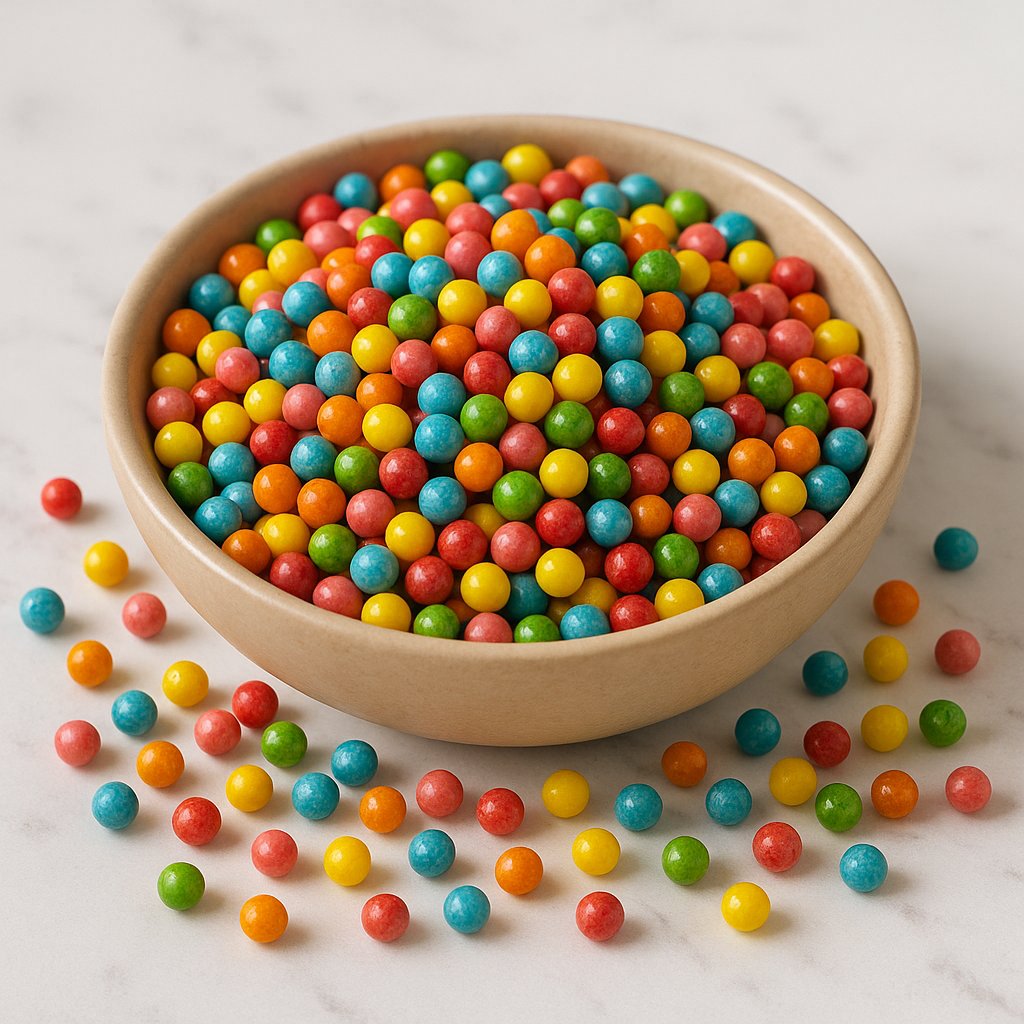
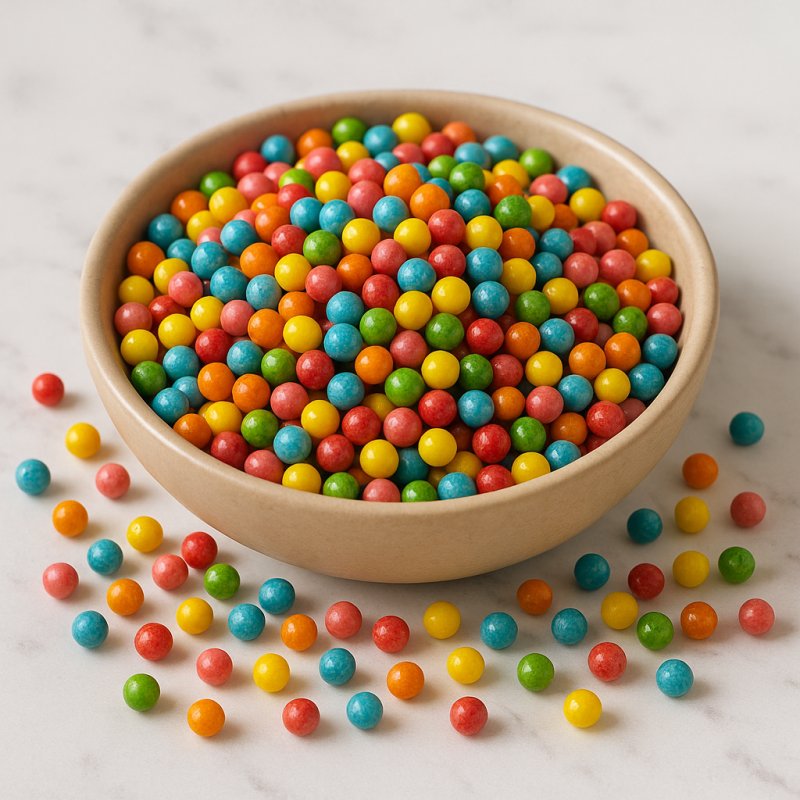
- Colors: From snow-white to delicate pastels to bright rainbow colors. Some are single-colored, others mixed like a bowl full of colorful sweets.
- Sheen and effects: Some pearls are matte, others are highly glossy or have a metallic effect (gold or silver). A thin layer is applied for the shine, sometimes made from natural substances and sometimes using specific coatings.
- Taste: Most sugar pearls taste simply sweet. There are also variants with a slight vanilla or chocolate flavor. Sometimes they are completely neutral and serve only as decoration.
- Materials: In addition to pure sugar pearls there are similar decorations made of chocolate, marzipan or sugar paste (fondant). These are softer or creamier than hard sugar pearls.
What should you watch out for?
Some shiny pearls are coated with a finish that is not suitable for everyone – for example a coating called “shellac” is a natural lacquer derived from small insects. This is not necessarily a problem, but people who follow vegetarian or vegan diets may prefer to avoid it. Therefore it is good to read the ingredient list on the package. Allergens such as soy or milk can also occur in some variants.
Some shiny pearls are coated with a finish that is not suitable for everyone – for example a coating called “shellac” is a natural lacquer derived from small insects. This is not necessarily a problem, but people who follow vegetarian or vegan diets may prefer to avoid it. Therefore it is good to read the ingredient list on the package. Allergens such as soy or milk can also occur in some variants.
Simple comparison image:
Think of sugar pearls like the little colorful pebbles in a toy shop: some are tiny, some are larger, some shine like pearls in a jewelry box, others are colorful like chalk. Depending on what you want to decorate, you'll find the right type.
Think of sugar pearls like the little colorful pebbles in a toy shop: some are tiny, some are larger, some shine like pearls in a jewelry box, others are colorful like chalk. Depending on what you want to decorate, you'll find the right type.
In summary, sugar pearls are easy to find and come in many shapes, colors and sizes. They are made from sugar, whose raw material is either sugar beet or sugar cane, and they are produced where many confectionery factories are located. When buying it is worth checking the ingredients, especially if you follow a specific diet.