Menu & categories

Smoked ham

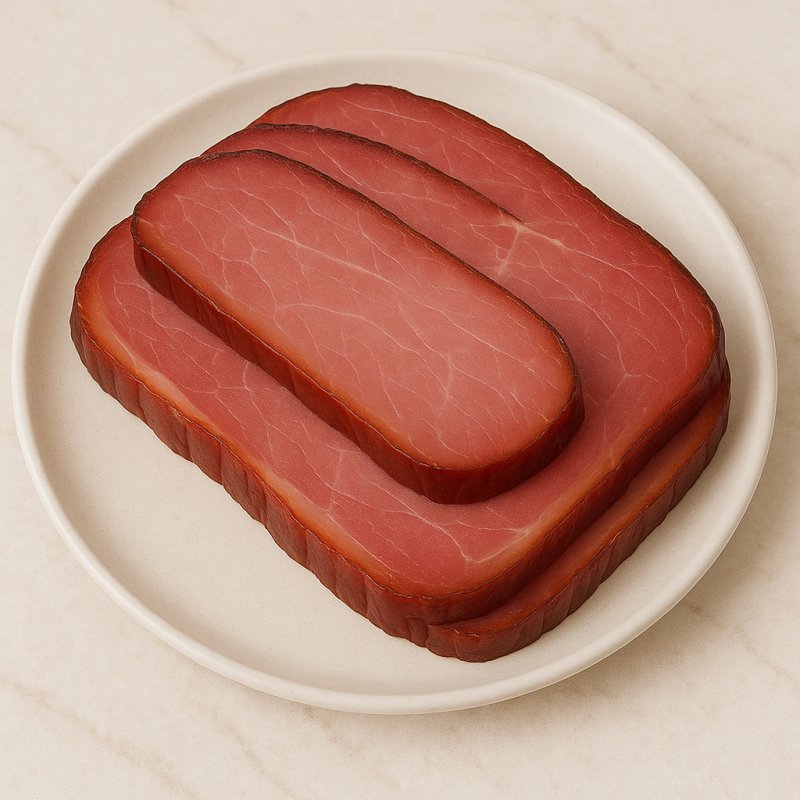
Hearty smoked ham made from pork

Wiki about smoked ham Nutri-Score D Vegan No Gluten-free Yes Lactose-free Yes Nut-free Yes
NUTRITION / 100 g
240 kcal 30 g Protein 1 g Kohlenhydrate 14 g Fett

Introduction

Slices of smoked ham on a wooden board
I have a secret weakness for smoked ham, one fed by small everyday rituals. When I stroll through the market at the weekend, the scent of smoke and spices pulls me like a magnet to the stalls. Once, years ago, a colleague brought back a piece of home-smoked ham from a bike tour, wrapped in brown paper; we cut it open without fuss, and it was a kind of culinary revelation: salty, smoky, with a texture that swung between tender and hearty.

Smoked ham is more than just meat. It is preservation and flavor in one, the result of time, fire and patience. Traditionally it is dry-salted or cured and then smoked over wood, sometimes cold, sometimes warm. The wood determines a lot: beech brings a mild, slightly sweet note, oak gives depth, and Frau Holle would probably have experimented with juniper too, if she could have waved. For me that is the most exciting part – how simple ingredients develop their own language through smoke.

I use smoked ham in surprisingly many ways. It enriches a simple slice of bread as much as an elaborate risotto. Sometimes I dice it small and fry it briefly to elevate vegetables and legumes; other times thin slices that melt over warm potatoes while the smoke fills the air. A friend swears by the combination with pears and goat cheese, and she is right: the play of sweet, salty and smoky works almost always.

  • Taste: salty, smoky, often with woody or slightly sweet nuances
  • Texture: can be tender to firm, depending on maturity and cut
  • Use: starters, main dishes, soups, salads and snacks/platters
Smoking is an art, but also a keepsake. I think of evenings when the crackle in the fireplace and the aroma of fresh ham made conversations livelier. I remember one winter when I sat in front of the oven and slowly enjoyed a slice while snow fell outside; the simple pleasure was non-negotiable. For me smoked ham is a small luxury that shows great effect with little effort, and that is exactly why I always keep a piece in the fridge.

Availability & types

Availability and types of smoked ham

Smoked ham is a popular ingredient in many kitchens. When we talk about its availability, we mean where you can buy it and how often it is offered. Smoked ham can be found almost everywhere: in supermarkets, at butchers, at weekly markets and sometimes directly from farms. Large supermarkets often have several brands and pack sizes, butchers can sell fresh pieces in various cuts. Farms occasionally offer homemade ham, which is often particularly fresh and has a regional character.

Origin
Ham is made from the hind part of the pig. Origin here means which country or region the pig comes from and where the ham was processed. Popular origin countries in Europe are Germany, Spain, Italy and France. Each region has its own tradition of curing (that is salting for preservation) and smoking, therefore hams taste different. You can imagine it like apples: an apple from another country sometimes tastes sweeter or tarter — so it is with ham.

Growing areas? – rather livestock and regions
For ham you don't speak of "growing areas", because ham does not grow. But there are regions particularly known for their pig farming and ham production. In Germany these include, for example, regions in Bavaria, Westphalia or the Rhineland. In Spain the region of Andalusia is famous for Ibérico ham (from special pigs), and in Italy well-known types come from Parma or San Daniele. These regions often have long traditions, specific animal feeding and particular climatic conditions that shape the taste.

Available types and variants
There are many kinds of smoked ham. Here are some simple categories to make understanding easier:

  • Raw ham (sometimes air-dried): This ham has been salted and dried, but not heavily smoked. It is often milder in taste. Example: Italian prosciutto.
  • Cooked ham: This ham has been cooked or heated and can then be lightly smoked. It is juicy and suitable for sandwiches.
  • Smoked raw ham: Some hams are first cured and then lightly smoked. This gives them a smoky aroma, but they are not cooked.
  • Heavily smoked ham: Here the smoky flavor is clearly noticeable. Such hams are often drier and are good for thin slicing or heating in dishes.
  • Special varieties: These include hams like Serrano (Spain), Parma (Italy) or regional German types such as Schwarzwälder Schinken. Each specialty has its own production method and typical taste.
Packaging and shelf life
Smoked ham comes vacuum-packed, sliced or as a whole piece. Vacuum packaging makes it last longer because little air comes into contact with the meat. Fresh ham from the butcher should be eaten sooner, but is often more aromatic.

Simple shopping tip
When you're in the shop you can ask: "Is the ham home-smoked?" or "Which region does the pig come from?" That way you'll know if it is particularly smoky or mild. Try different varieties — just like when tasting chocolates or yogurts you'll quickly find which you like best.

In summary: smoked ham is widespread and available in many variants that differ in origin, smoke intensity and processing. Whether in the supermarket, at the butcher or from the farm — there is always a variety that fits your taste and intended use.
Details & nutrition

Property Value
Unit g
Calories per 100 240
Protein per 100 30
Carbohydrates per 100 1
Sugar per 100 1
Fat per 100 14
Saturated fat per 100 5
Monounsaturated fat 6
Polyunsaturated fat 1
Fiber per 100 0
Vitamin C (mg) per 100 0
Vitamin D (IU) per 100 0
Calcium (mg) per 100 10
Iron (mg) per 100 1.2
Nutri-Score D
CO₂ footprint 5.5
Origin Pork, mostly from Europe
Gluten-free Yes
Lactose-free Yes
Nut-free Yes
Vegan No
Note Product high in sodium and salt; nutritional values may vary slightly depending on fat content and processing.

Technical & scientific information

Smoked ham refers to a product made from pork that has been preserved and flavored by curing and subsequent smoking. This traditional procedure combines physical and chemical processes that increase shelf life, change flavor and color, and improve microbiological safety. Smoked ham can be sold whole, in slices or as pieces; its properties depend on origin, cut, curing method and smoking process.

Composition and nutritional values
The nutritional value of smoked ham varies with fat content and processing degree. Typical constituents are water (approx. 50–70 %), protein (approx. 15–25 %), fat (approx. 5–30 %) and minerals such as sodium and potassium. Because of curing, smoked ham contains relatively high amounts of sodium; salt content often ranges between 2 and 4 g per 100 g of product. Micronutrients include B vitamins (especially niacin and vitamin B12), iron and zinc. Energy content varies with fat content and typically lies between 100 and 300 kcal per 100 g.

Chemical changes through curing and smoking
In curing nitrite- or nitrate-based curing salts are used, which react chemically with meat components. Nitrite reduces the growth of Clostridium botulinum and promotes the formation of characteristic pink pigments by reacting with myoglobin to form nitrosylmyoglobin. During smoking volatile aromatic compounds such as phenols, carbonyl compounds and organic acids are absorbed, which contribute to flavor, color and antioxidant effects. Thermal processes and smoke components also lead to partial denaturation of proteins and lipids, affecting texture and juiciness.

Processing methods
Production includes several steps:

  • Selection of raw material: muscle meat from leg or shoulder with a defined fat content.
  • Curing: dry curing or brine curing (pickle) with table salt, nitrite/nitrate and spices; duration from hours to days.
  • Maturation: time for salt equilibrium and enzymatic changes.
  • Smoking: hot smoking (thermal cooking, 60–80 °C) or cold smoking (below 30 °C), stationary or in continuous plants; use of different woods influences the aroma.
  • Cooking/Cooling: hot smoking processes include cooking, while cold smoking processes may require additional cooking.
These steps are varied across industry to achieve different quality criteria such as juiciness, sliceability and smoke intensity.
Microbiology and food safety
Curing and smoking lower water activity and lead to a high salt concentration, which inhibits the growth of many spoilage organisms and pathogens. Nitrite acts specifically against clostridia. Nevertheless hygiene measures are necessary, since certain microorganisms, such as Listeria monocytogenes, can survive in chilled, smoked products. Spoilage occurs mainly through lipid oxidation (rancidity) and microbial degradation processes.
Health aspects
Smoked ham provides high-quality protein and essential nutrients, but contains relatively high levels of sodium and can form nitrosamines when nitrite and certain organic compounds are exposed to high temperatures. Nitrosamines are potentially carcinogenic, which is why production conditions and permissible nitrite amounts are regulated. Consumption should be part of a balanced diet, especially for people with high blood pressure or increased salt sensitivity.
Sensory properties and applications
Sensorily smoked ham is characterized by smoky, spicy aromas, a variable texture and a characteristic color. It is used in a versatile way: as a sandwich topping, in salads, hot dishes and as an ingredient in processed meat products. The choice of smoking wood, the duration of smoking and the curing recipe determine its culinary applicability and flavor nuances.
In summary, smoked ham is a technically and chemically complex product in which curing and smoking are the central steps. These processes influence nutritional value, microbiological stability, sensory properties and potential health aspects. Proper processing and controlled use of curing agents are essential to ensure quality and food safety.
Wiki entry for: smoked ham
Active now: 18 visitors of which 2 logged-in members in the last 5 minutes