Menu & categories

Savoy cabbage

Tender cabbage with a mild, slightly spicy aroma – ideal for stews, stir-fries and roulades.

Wiki about savoy cabbage Nutri-Score A Vegan Yes Gluten-free Yes Lactose-free Yes Nut-free Yes
NUTRITION / 100 g
27 kcal 2.0 g Protein 5.4 g Kohlenhydrate 0.1 g Fett

Introduction

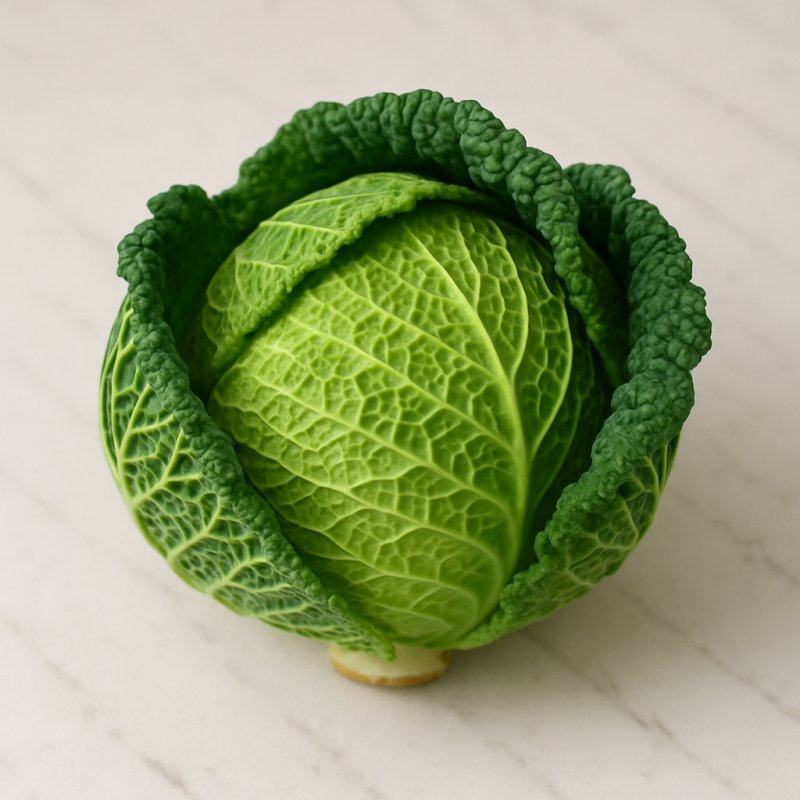
Fresh savoy cabbage head
Wirsing (savoy cabbage) is for me one of those ingredients you underestimate until you really get to know it. I still vividly remember my first savoy cabbage soup on a rainy afternoon, when the scent of roasted bacon and the tender cabbage filling filled the whole room and I thought: why didn't I discover this earlier?

On the outside savoy cabbage looks rustic with its crinkled, dark green leaves, but when cut open it reveals a tender, almost buttery texture. Its flavor is milder than that of firm white cabbage and has a fine, slightly nutty sweetness that intensifies when braised. I find that it shines in soups, stews and curries as well as simply steamed as a side dish.

A colleague once brought a whole head of savoy cabbage after finding an especially nice specimen at the market, and we spontaneously made a hearty lasagna using savoy cabbage instead of pasta. The leaves gave the lasagna a velvety layer that surprisingly harmonized well with tomatoes and ricotta.

For storage I recommend keeping the savoy cabbage uncut and loosely wrapped in a cloth in the vegetable drawer. It will keep several days up to a week that way. When preparing it I remove the large ribs only if they are very tough, because they contain a lot of flavor.

  • Quick sauté: Cut savoy cabbage into thin strips and fry with garlic and chili.
  • Braised: Slowly cook with stock and a splash of wine for intense flavor.
  • Raw: Thinly shaved with a lemon dressing as a crunchy salad.
Savoy cabbage pairs excellently with strong flavors like bacon, caraway, mustard or spicy seasonings and goes well with potatoes, legumes and full‑fat dairy. I especially like it in the transitional period between late autumn and winter, when the cabbage is fresh from the field and simple, warming dishes are particularly welcome.

Availability & types


Availability and types of savoy cabbage

Origin:
Savoy cabbage is a vegetable variety in the cabbage family. It is believed to have originated long ago in Europe from wild cabbage plants. Those wild plants grew on coasts and in gardens. Over time people bred the plants so that the leaves became thicker, softer and crinkled. That's why savoy cabbage looks a bit like a large green lettuce head, but with sturdier, curled leaves.

Growing regions:
Savoy cabbage grows best where it is not too hot – in regions with a temperate climate. Typical growing areas include:

  • Europe, especially countries such as Germany, the Netherlands, France and the United Kingdom.
  • Temperate zones in other parts of the world, for example in North America or parts of Asia.
  • Small gardens and hobby plots: many people also grow savoy cabbage at home because the plant is quite robust.
Important: savoy cabbage is winter‑hardy. That means it tolerates cold better than many other vegetables and can often be harvested into autumn and winter. "Winter‑hardy" is a simple term meaning the plant can withstand frost.

Available varieties and types:
There is not just one kind of savoy cabbage – it comes in different varieties that differ in shape, color and maturity time. Here are the main groups, explained simply:

  • Early varieties: These mature quickly and are harvest‑ready already in summer. They are practical when you want fresh vegetables early in the year.
  • Mid‑early varieties: These need a bit more time than early types and are harvested from late summer to autumn.
  • Late or winter‑hardy varieties: These grow slowly but are very robust and can often remain until winter. They are therefore good for storage.
  • Small heads vs. large heads: Some varieties form compact, small heads (good for families), others grow very large and are suitable when feeding many people.
  • Different leaf colors and structures: There are savoy cabbages with dark, intense green and others with light green or slightly yellowish tones. Leaves can be more or less strongly crinkled – this makes it attractive and gives different textures when cooking.
How to get fresh savoy cabbage year‑round?
Fresh savoy cabbage is available in gardens, farmers' markets and supermarkets. Because some varieties store well, savoy cabbage can be found outside the harvest season: it can be cold‑stored or frozen. It is also sometimes sold pre‑cut in bags (for example as soup vegetables) or offered in organic vegetable boxes. When buying fresh, look for firm heads and crisp, intact leaves – this is a sign of good quality.

In summary: savoy cabbage originates from Europe, grows best in cooler regions and comes in many varieties for different needs. Whether early yields for quick cooking, late varieties for winter or large heads for family cooking – there is a suitable variant for every taste.

Details & nutrition

Property Value
Unit g
Average weight per piece 1000
Calories per 100 27
Protein per 100 2.0
Carbohydrates per 100 5.4
Sugar per 100 2.3
Fat per 100 0.1
Saturated fat per 100 0.02
Monounsaturated fat 0.01
Polyunsaturated fat 0.05
Fiber per 100 3.1
Vitamin C (mg) per 100 31
Vitamin D (IU) per 100 0
Calcium (mg) per 100 35
Iron (mg) per 100 0.4
Nutri-Score A
CO₂ footprint 0.02
Origin Germany (seasonal), otherwise EU
Gluten-free Yes
Lactose-free Yes
Nut-free Yes
Vegan Yes
Note Nutritional values refer to raw savoy cabbage; when cooked vitamin C and weight may vary.

Technical & scientific information

Savoy cabbage (Botanical: Brassica oleracea var. sabauda) is a leaf‑type cabbage of the Brassicaceae distinguished by strongly crinkled, usually dark green to yellowish leaves and a loose head. Morphologically savoy cabbage differs from white cabbage by its thinner, more elastic leaves and a higher leaf area per plant, which affects textural and culinary properties. As a cool‑season crop, savoy cabbage prefers moderate temperatures, even soil moisture and mineral‑rich, deep soils; it is susceptible to diseases such as clubroot (Plasmodiophora brassicae) and pests like the cabbage butterfly.

Nutrient composition (approximate values per 100 g fresh leaves): savoy cabbage is about 90–93% water. Energy and macronutrients are moderate: 20–30 kcal, 3–6 g carbohydrates (of which fiber about 2–4 g), 1–3 g protein and negligible fat. Secondary and micro components are particularly relevant nutritionally:

  • Vitamins: Relatively high levels of vitamin C (typically 20–50 mg), notable vitamin K (several tens up to over 100 µg) and B‑vitamins such as folate and B6 in moderate amounts.
  • Minerals: Potassium (approx. 200–300 mg), calcium (approx. 30–50 mg), magnesium and traces of iron and manganese are present.
  • Phytochemicals: Glucosinolates (mustard oil precursors), flavonoids (e.g. kaempferol derivatives), phenolic acids and other antioxidant compounds characterize the bioactive profile.
Biochemical features: Glucosinolates are sulfur‑containing glucose esters that, when cells are damaged, are hydrolyzed by the enzyme myrosinase to isothiocyanates and other breakdown products. These compounds contribute to the characteristic odor and are the subject of research for potential biological effects, as isothiocyanates show activity in vitro and in animal studies. Formation of these breakdown products is temperature‑dependent: myrosinase is denatured already at moderate heating, so the method of preparation strongly influences the chemical composition of the consumed food.

Processing and storage: Boiling, steaming or blanching change texture and cause losses of water‑soluble and heat‑sensitive nutrients, particularly vitamin C. Steaming or quick sautéing minimizes these losses compared with long boiling. Mechanical disruption before consumption promotes isothiocyanate formation, while intense heating inactivates enzymes and produces different degradation profiles. Lactic acid fermentation (kraut‑like processes) leads to microbial transformation: sugar breakdown, increase in organic acids, stabilization and sometimes increased bioavailability of certain micronutrients and formation of probiotic microorganisms in non‑pasteurized products.

Health aspects: Regular consumption of savoy cabbage contributes to bowel function through fiber and provides micronutrients that can support antioxidant and hemostatic processes. Glucosinolates and their degradation products are being intensively researched; evidence suggests they can trigger biochemical interactions in cells. However, claims about specific disease‑preventive effects in humans are not yet conclusive and depend on dose, preparation method and overall diet. Raw savoy cabbage can cause flatulence in sensitive individuals due to fermentable oligosaccharides (e.g. raffinose) and sulfur‑containing compounds. People with severely restricted iodine intake should moderate high consumption of raw cruciferous vegetables because of potential goitrogenic effects.

Overall, savoy cabbage is a cultivated cabbage with favorable nutrient density, versatile culinary uses and an interesting phytochemical composition, whose specific health effects are the subject of ongoing research.

Wiki entry for: savoy cabbage
Active now: 11 visitors of which 2 logged-in members in the last 5 minutes