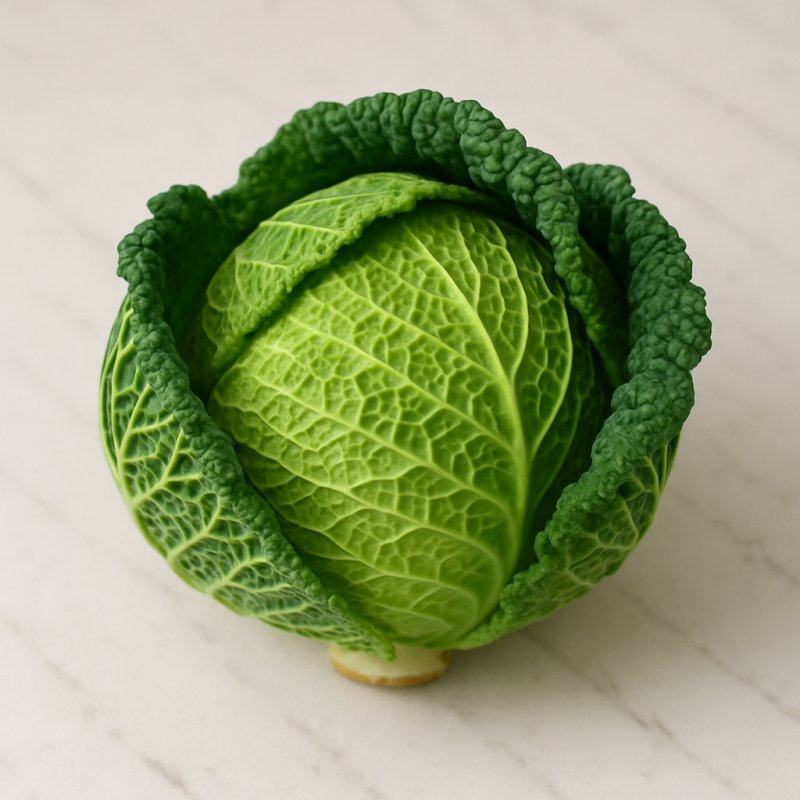
Availability and types of savoy cabbage
Origin:
Savoy cabbage is a vegetable variety in the cabbage family. It is believed to have originated long ago in Europe from wild cabbage plants. Those wild plants grew on coasts and in gardens. Over time people bred the plants so that the leaves became thicker, softer and crinkled. That's why savoy cabbage looks a bit like a large green lettuce head, but with sturdier, curled leaves.
Growing regions:
Savoy cabbage grows best where it is not too hot – in regions with a temperate climate. Typical growing areas include:
- Europe, especially countries such as Germany, the Netherlands, France and the United Kingdom.
- Temperate zones in other parts of the world, for example in North America or parts of Asia.
- Small gardens and hobby plots: many people also grow savoy cabbage at home because the plant is quite robust.
Important: savoy cabbage is winter‑hardy. That means it tolerates cold better than many other vegetables and can often be harvested into autumn and winter. "Winter‑hardy" is a simple term meaning the plant can withstand frost.
Available varieties and types:
There is not just one kind of savoy cabbage – it comes in different varieties that differ in shape, color and maturity time. Here are the main groups, explained simply:
There is not just one kind of savoy cabbage – it comes in different varieties that differ in shape, color and maturity time. Here are the main groups, explained simply:
- Early varieties: These mature quickly and are harvest‑ready already in summer. They are practical when you want fresh vegetables early in the year.
- Mid‑early varieties: These need a bit more time than early types and are harvested from late summer to autumn.
- Late or winter‑hardy varieties: These grow slowly but are very robust and can often remain until winter. They are therefore good for storage.
- Small heads vs. large heads: Some varieties form compact, small heads (good for families), others grow very large and are suitable when feeding many people.
- Different leaf colors and structures: There are savoy cabbages with dark, intense green and others with light green or slightly yellowish tones. Leaves can be more or less strongly crinkled – this makes it attractive and gives different textures when cooking.
How to get fresh savoy cabbage year‑round?
Fresh savoy cabbage is available in gardens, farmers' markets and supermarkets. Because some varieties store well, savoy cabbage can be found outside the harvest season: it can be cold‑stored or frozen. It is also sometimes sold pre‑cut in bags (for example as soup vegetables) or offered in organic vegetable boxes. When buying fresh, look for firm heads and crisp, intact leaves – this is a sign of good quality.
Fresh savoy cabbage is available in gardens, farmers' markets and supermarkets. Because some varieties store well, savoy cabbage can be found outside the harvest season: it can be cold‑stored or frozen. It is also sometimes sold pre‑cut in bags (for example as soup vegetables) or offered in organic vegetable boxes. When buying fresh, look for firm heads and crisp, intact leaves – this is a sign of good quality.
In summary: savoy cabbage originates from Europe, grows best in cooler regions and comes in many varieties for different needs. Whether early yields for quick cooking, late varieties for winter or large heads for family cooking – there is a suitable variant for every taste.
