Menu & categories

Salt

Classic seasoning and preservative for the kitchen.

Wiki about salt Nutri-Score E Vegan Yes Gluten-free Yes Lactose-free Yes Nut-free Yes
NUTRITION / 100 g
0 kcal 0 g Protein 0 g Kohlenhydrate 0 g Fett

Introduction

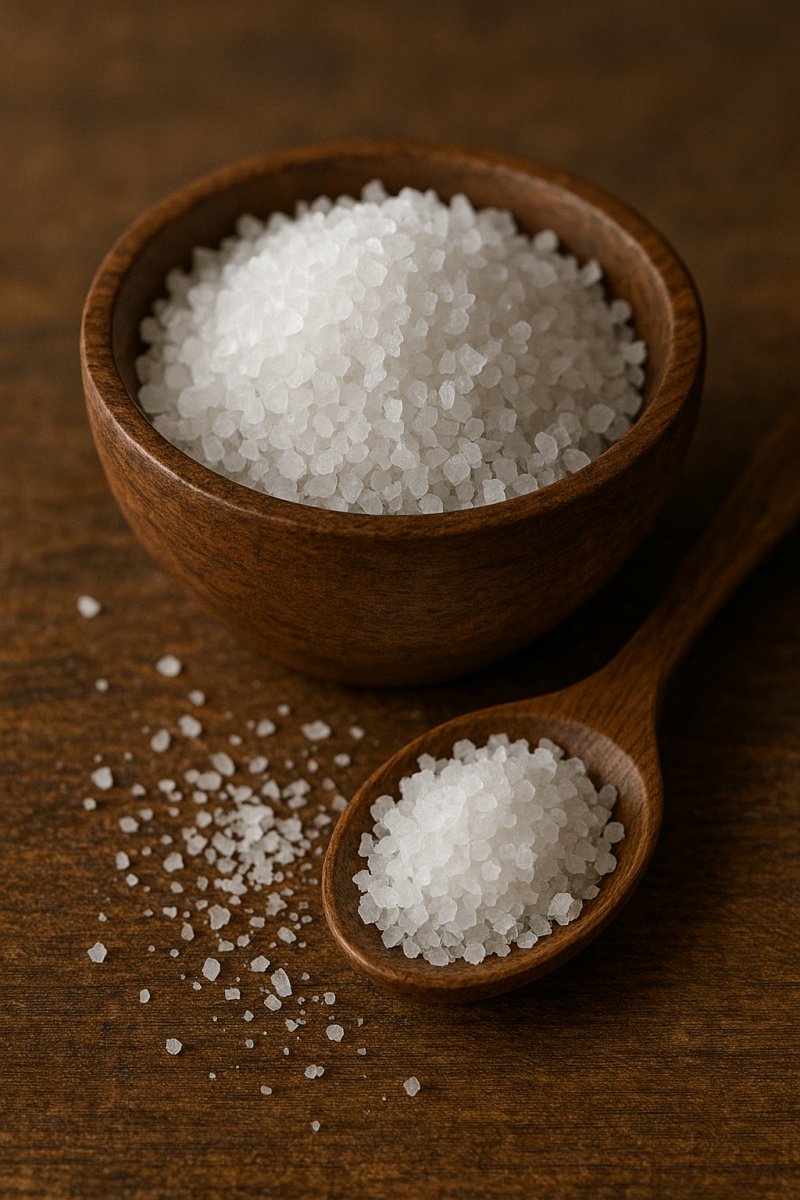
Salt in a bowl
When I think of salt, I don't just picture a white grain, but a whole world full of memories, smells and small kitchen wonders. Salt to me is the quiet but indispensable element that shapes flavors, lifts textures and brings dishes to life. I still remember a long evening in a noisy kitchen when a tiny grain too much or too little decided the outcome; since then I measure with my eyes and taste with my heart.

Salt has an amazing range. There is coarse sea salt with crunchy crystals, fine table salt that dissolves instantly, and luxurious Fleur de Sel that looks like a little treasure when sprinkled over a poached egg. Once I gave a friend a homemade chocolate with sea salt, and his surprised face was priceless.

Worthwhile details are often small. Salt can dampen bitterness and enhance sweetness. It helps proteins in meat to bind, encourages the release of aromas from vegetables, and is an ancient preservative that once determined whole trade routes. A colleague of mine swears by a pinch of Maldon for mashed potatoes because the large flakes offer a little play of texture and flavor.

My practical everyday tips:

  • Fleur de Sel: For finishing, over salads or desserts, just before serving.
  • Sea salt: Versatile, good for cooking and baking.
  • Table salt: Dissolves evenly, practical for most recipes.
  • Kosher salt: Easy to dose, ideal for rubbing onto meat.
Of course salt should be respected: too much can destroy balance and affect health. For me it remains a companion that, used with a delicate touch, works wonders. For the next dish I'll try something new again: perhaps a pinch of exotic salt on fried pineapple. Often it is the small grains that bring the greatest pleasure.

Availability & types

Availability and types

Salt is one of the easiest ingredients to find and is available almost everywhere. It can be found in nearly every grocery store, supermarket, health food shop and online. You can often buy salt in small shakers for the table or in large sacks for industry. But salt is not all the same: there are many types that differ in appearance, taste and origin. Here I explain simply where salt comes from, which growing or extraction regions are important and which varieties you can find in stores.

Where does salt come from?
Salt is produced in two main ways:

  • Sea salt: is produced when seawater evaporates in shallow basins (salt pans) and only the salt remains. This often happens on coasts with plenty of sun and wind, for example in the Mediterranean, on Europe's Atlantic coast, in India or Australia. Places like France's Guérande or the salt pans in Portugal and Mallorca are known for good sea salt.
  • Rock salt (mined salt): is ancient seawater that was trapped underground long ago and is now mined as rock salt. Such salt mines exist in countries like Germany, Poland, the USA (e.g. Utah) and Pakistan (the famous Khewra deposit).
What kinds and variants exist?
Here are some of the most common and popular salt types, explained so it's easy to understand:

  • Table salt: This is the ordinary fine salt many families use. It is often purified and sometimes iodized. Iodine is a trace mineral important for our health — which is why it is sometimes added to salt.
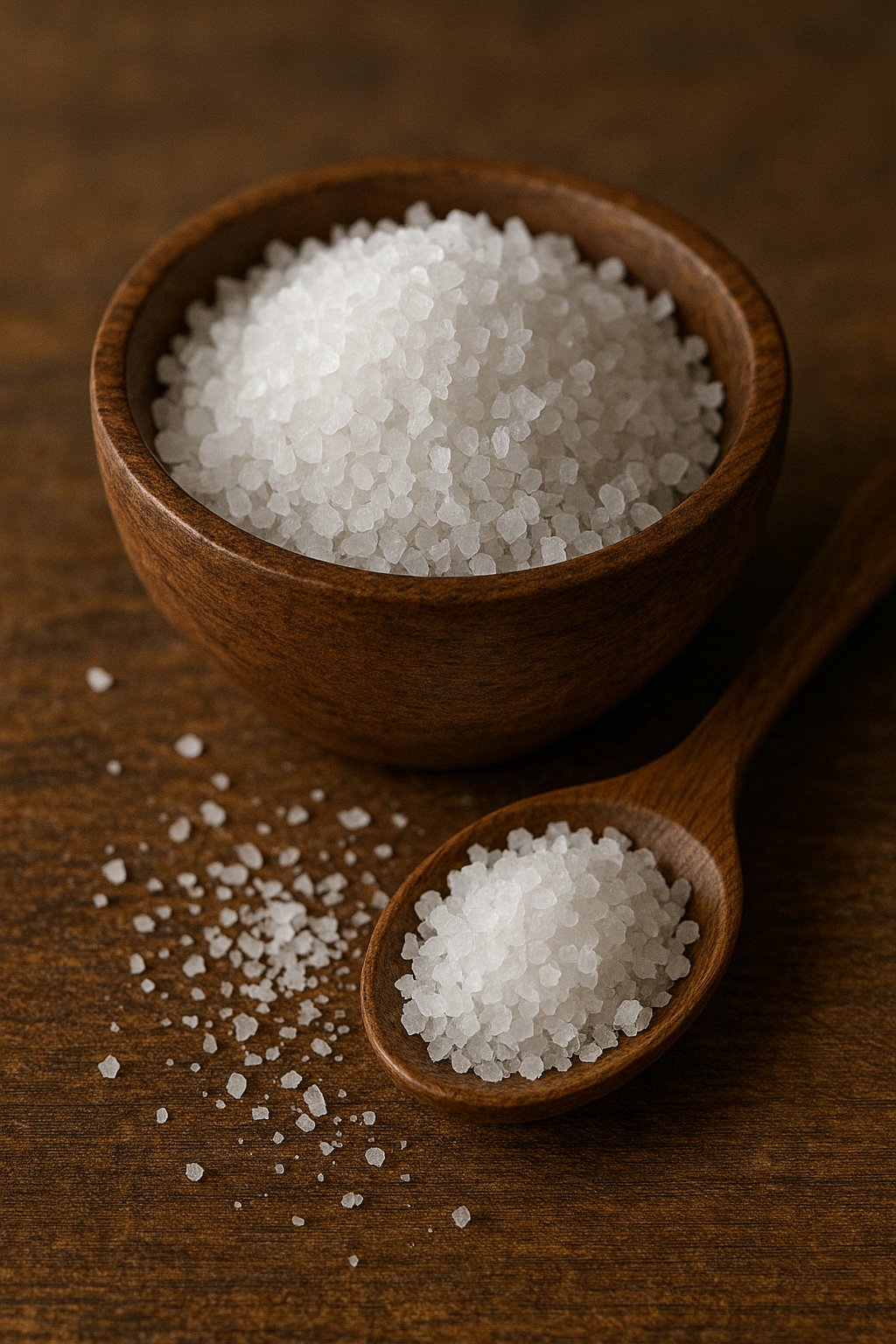
  • Sea salt: usually has larger, coarser crystals and can have slight taste differences due to minerals. Some people like it for its more “sea-like” flavor.
  • Fleur de Sel: a fine, crunchy sea salt that crystallizes on the surface of salt ponds. It is often used as a special finishing salt.
  • Coarse and flake salts (e.g. Maldon): the crystals are flat or flaky and crunch in the mouth — ideal for sprinkling on salads or roasts.
  • Himalayan salt: pink in color and from a mine in Pakistan. Many like the color and often use it decoratively or as a table salt.

Smoke salt: salt that has been smoked over wood. It gives foods a smoky taste, as if grilled.
Iodized salt and reduced-sodium salt: special variants for health purposes — iodized salt contains iodine, and reduced-sodium salt has part of the sodium chloride replaced by other salts.
More specialized salts: there are also flavored salts (e.g. with herbs), grey salt (Sel Gris) or coarse cooking salts for brining foods.

How to choose?
For everyday use ordinary table salt is usually sufficient. If you want something special, try sea salt or Fleur de Sel as a finish on a dish. For recipes where salt must dissolve quickly, fine table salt is better. For a crunchy texture, flake or coarse salts are great.

In short: salt is easy to obtain and there are many types — from simple table salt to special sea salts and rock salt. Each has its own properties, and which you choose depends on how and for what you will use it.
Details & nutrition

Property Value
Unit g
Calories per 100 0
Protein per 100 0
Carbohydrates per 100 0
Sugar per 100 0
Fat per 100 0
Saturated fat per 100 0
Monounsaturated fat 0
Polyunsaturated fat 0
Fiber per 100 0
Vitamin C (mg) per 100 0
Vitamin D (IU) per 100 0
Calcium (mg) per 100 0
Iron (mg) per 100 0
Nutri-Score E
CO₂ footprint 0.01 kg CO2e pro 100 g
Origin Germany/EU (depending on the extraction or evaporation area)
Gluten-free Yes
Lactose-free Yes
Nut-free Yes
Vegan Yes
Note Nutritional values are practically zero; what is relevant is mainly the salt/sodium content. Iodized table salt may additionally contain iodine.

Technical & scientific information

Salt generally refers in common usage primarily to the chemical sodium chloride (NaCl), an ionic compound made of sodium and chloride ions. In nature it occurs as the mineral halite and forms cubic crystals with characteristic 90‑degree angles. Pure sodium chloride is odorless, tastes salty and is solid at room temperature; it dissolves readily in water, conducts electricity in solution and has a melting point of about 801 °C.

Chemical and physical properties: Sodium chloride consists of equal numbers of positively charged sodium ions and negatively charged chloride ions that form a regular ionic lattice. Solubility in water is about 35.7 g NaCl per 100 g water at 20 °C. In aqueous solution NaCl stabilizes electrolyte concentrations, influences osmotic pressure relations and contributes significantly to the conductivity of solutions.

Components and nutritional value: Table salt is composed predominantly of sodium chloride; 1 gram of household salt contains roughly 400 mg of sodium. Pure salt provides no calories, proteins, fats or carbohydrates, but reduced-sodium variants may be supplemented with other minerals. Natural sea salt contains trace amounts of elements such as magnesium, potassium and calcium, which can slightly affect flavor.

Production and processing methods: Salt is produced by three main methods:

  • mining of rock salt (halite) by conventional mining or by solution mining of deposits and subsequent recrystallization;
  • evaporation of seawater or saline lakes by solar evaporation, preferred in warm, dry regions;
  • technical evaporation (vacuum or multiple-effect evaporation) to obtain highly pure salt.
After extraction, cleaning, fine grinding and addition of additives such as iodine (in the form of potassium iodide or potassium iodate) to prevent iodine deficiency and free‑flow agents (e.g. calcium or magnesium silicate) as anti‑caking aids are commonly performed.
Types and fineness: Commercially available salt is differentiated by grain size and processing: table salt (fine), crystal salt (coarse), sea salt (often minimally processed) and Fleur de Sel (surface crust from evaporation). Specialty salts can be smoked, blended with herbs or offered with reduced sodium content by partial replacement with potassium chloride.
Applications: Salt has a wide range of uses:
  • Culinary: flavor enhancer, seasoning, component in baked goods and cheese production;
  • Preservation: reduction of water activity in foods through osmotic effects and inhibition of microorganisms;
  • Industrial: raw material for the chlor‑alkali electrolysis, de‑icing roads, water treatment and chemical syntheses.
Health aspects: Sodium is an essential electrolyte necessary for fluid and blood pressure regulation, nerve conduction and muscle contraction. Excessive sodium intake, however, is epidemiologically associated with increased blood pressure and a higher risk of cardiovascular disease. Guidelines cite a maximum daily sodium intake of about 2 g (equivalent to roughly 5 g of table salt) for adults; many health organizations recommend keeping intake as low as reasonably possible and tailored to individual needs. Too low sodium intake can in rare cases lead to hyponatremia, while acute or chronic overdose can cause hypernatremia and volume problems.

In sum, salt is a simple but chemically and biologically significant mineral whose safe and appropriate use underlies both many traditional techniques and modern industrial processes.

Wiki entry for: salt
Active now: 15 visitors of which 2 logged-in members in the last 5 minutes