Menu & categories

Saffron

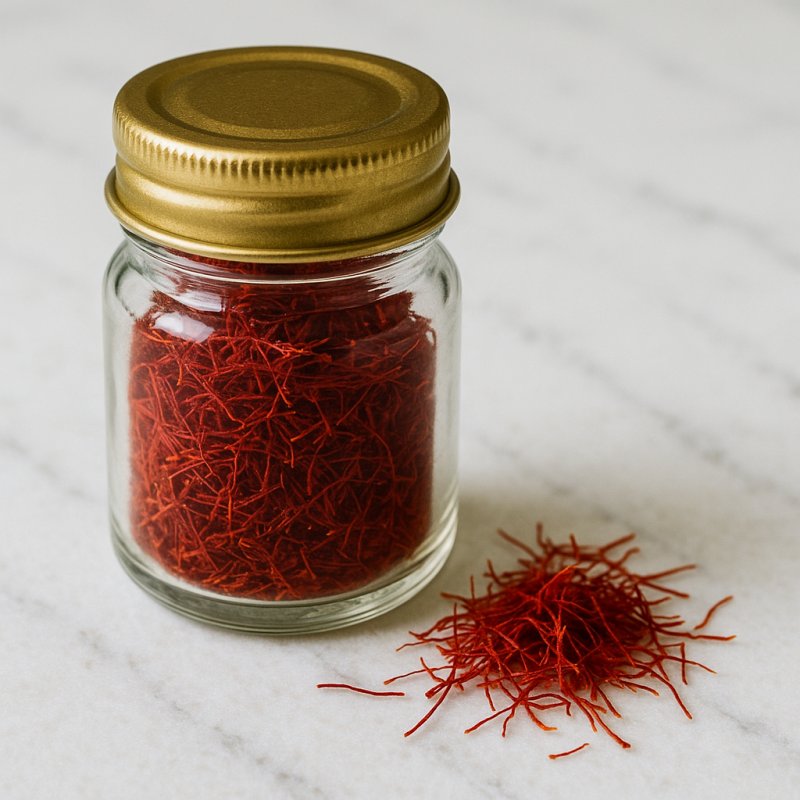
Noble spice with an intense aroma and strong yellow coloring power.

Wiki about saffron Nutri-Score C Vegan Yes Gluten-free Yes Lactose-free Yes Nut-free Yes
NUTRITION / 100 g
310 kcal 11.4 g Protein 65.4 g Kohlenhydrate 5.9 g Fett

Introduction

A pinch of saffron threads
Saffron feels magical to me, as if it were a tiny secret in every spoonful of rice or in every cream sauce. I still remember a winter market visit when an old vendor handed me a sample and said, "Only three threads are enough." I was skeptical and excited at the same time when the aroma filled the whole stall minutes later.

The red plant, which looks so delicate, hides behind its stigmas a whole story of handcraft, patience and long journeys. I learned that saffron is obtained from the threads of Crocus sativus and that hundreds of flowers are often needed for a gram. This knowledge explains the price, but also my appreciation when I open a small jar.

In terms of flavor, saffron is subtle and multi-layered. It brings a slightly floral, almost honey-like note together with a warm spiciness that makes dishes profound without dominating. I prefer to use it in small amounts and let it steep first in lukewarm liquid so that its aroma fully develops. A colleague of mine swears by grinding the threads with sugar first to achieve an even distribution.

Practical tips I've picked up over the years:

  • Storage: Dry, protected from light and well sealed.
  • Dosage: Less is more; one to three threads can be enough.
  • Usage: In rice dishes, broths, desserts and baked goods saffron shows its versatility.
When shopping I look for deep, rich color and avoid powders without origin information, because real threads are usually more aromatic. I've also learned that a touch of saffron enhances a dish not only in taste but also visually, because it gives a warm, golden color.
When I have guests, I sometimes sprinkle a few threads over a risotto and watch the small amazement at the table.

Saffron remains for me a precious spice that demands humility and generosity at once, and time and again it manages to turn everyday dishes into special moments.

Availability & types

Availability and types of saffron

Saffron is a special spice obtained from the tiny red threads of the flower Crocus sativus. Imagine: each flower has only three of these thin red threads. That means a great many flowers are needed to get a small amount of saffron. That's why saffron is often expensive and not always available in every shop. It is usually sold dried, because that preserves the aroma longer and makes it easier to store.

Where does saffron come from? The main growing areas are:

  • Iran – the largest producer. Many people consider Iranian saffron very aromatic.
  • Spain (especially La Mancha) – known for mild, good saffron, often used in cooking for paella.
  • India (Kashmir) – this saffron often has a deep red color and a strong aroma.
  • Greece and Morocco – also traditional growing regions with their own flavor notes.
  • Italy – in some regions there is artisanal saffron cultivation.
Because saffron grows in many countries, it is generally available year-round – but the harvest season is short, usually in autumn. Freshly harvested saffron is dried; after that it can be used for longer. If you want to buy saffron, you will find it as saffron threads (the whole form) or as ground powder.

Types and varieties – briefly explained:

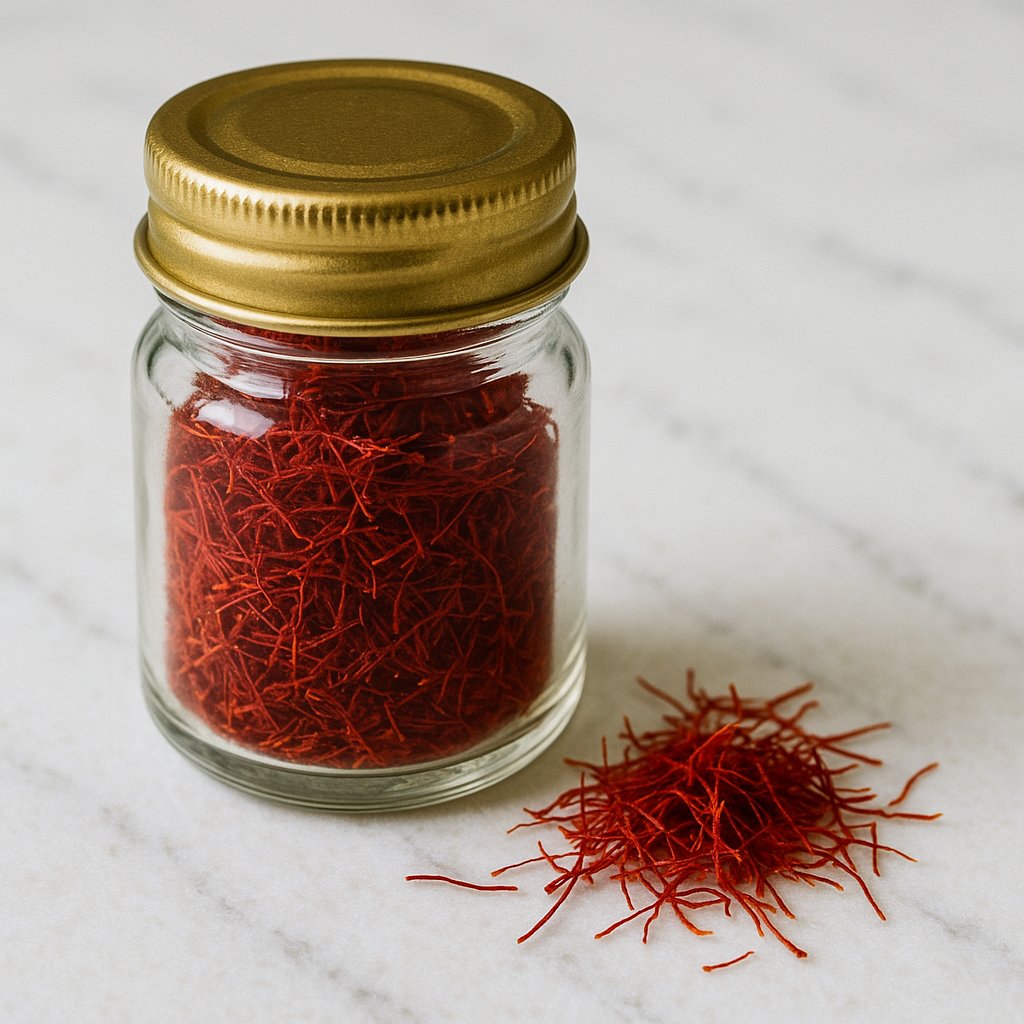
  • Saffron threads (whole threads): These are the red, wiry parts. Many chefs like whole threads because they are easier to inspect (you can see if they are genuine) and because they retain their aroma better.
  • Ground saffron powder: Convenient, but it can be more easily mixed with other, cheaper substances. Make sure to buy powder from a trusted source.
  • Saffron extracts or tinctures: Liquid forms, often for industrial food or cosmetic use. These are concentrated and are used differently from threads.
  • Quality grades (simply explained): Producers sometimes give names like Negin, Sargol or Pushal. In short:
    • Negin = long, strong threads, often very pure and intense.
    • Sargol = only the red tips, good in color and flavor.
    • Pushal = contains small yellow parts from the flower base, somewhat cheaper.
When buying it is helpful to pay attention to color and smell: real saffron threads are deep red and smell slightly floral or honey-like. Ground saffron should not look very pale orange or too cheap. Store saffron in a dark, dry container – this way it stays good for a long time.

In summary: saffron is present in many countries, mainly Iran, Spain, India and some Mediterranean countries. It exists as whole threads, powder and extracts as well as in different quality grades. Because of the laborious handwork involved in collecting the threads, saffron is often precious, but a small amount is enough to give dishes a lot of flavor and color.
Details & nutrition

Property Value
Unit g
Calories per 100 310
Protein per 100 11.4
Carbohydrates per 100 65.4
Sugar per 100 0.0
Fat per 100 5.9
Saturated fat per 100 1.6
Monounsaturated fat 0.4
Polyunsaturated fat 2.7
Fiber per 100 3.9
Vitamin C (mg) per 100 80.8
Vitamin D (IU) per 100 0
Calcium (mg) per 100 111
Iron (mg) per 100 11.1
Nutri-Score C
CO₂ footprint sehr hoch (ca. 50–70 kg CO2e/kg, abhängig von Anbau & Verarbeitung)
Origin Often Iran, Spain, Afghanistan or Greece (depending on variety/batch)
Gluten-free Yes
Lactose-free Yes
Nut-free Yes
Vegan Yes
Note Very economical: typically used in very small amounts (mg range). For best aroma, briefly steep in warm water/milk and store protected from light in a dry place.

Technical & scientific information


Saffron (botanical: Crocus sativus) is the dried stigma material of the Crocus flower and is among the most expensive spices in the world. Its economic importance is based on a very labor-intensive harvest, since the delicate red stigmas must be picked by hand from each flower. Main growing regions are Iran, Spain, Greece, Kashmir (India) and Morocco. The plant is a sterile, triploid variety and is propagated vegetatively by bulb division, which keeps the cultivar stable over centuries.

Chemical composition and characteristic constituents include in particular:

  • Crocins: water-soluble carotenoids (glycosides of crocetin), responsible for the intense yellow-orange coloration in solution; they show absorption maxima at about 440 nm in the visible spectrum.
  • Crocetin: the aglycone form, lipophilic, contributes to color and potential biological effects.
  • Picrocrocin: a glycosidically bound monoterpene considered the precursor of bitterness and which can become aroma during drying.
  • Safranal: a volatile monoterpenoid aldehyde, formed thermally and enzymatically from picrocrocin and defining the typical aroma; it is relatively volatile and light-sensitive.
  • Other components: flavonoids, amino acids, minerals (trace amounts), phenolic compounds and small amounts of carbohydrates.
Analytically, saffron quality and authenticity are often examined using chromatographic and spectrometric methods. Common procedures are HPLC for the separation and quantification of crocin, picrocrocin and safranal, and UV-Vis spectrophotometry according to ISO 3632, which uses extinction values at defined wavelengths (approx. 257, 330 and 440 nm) for classification. Mass spectrometry and NMR are also used, particularly for origin determination and detection of adulterations.

Processing and technology: After harvest the stigmas are carefully separated, followed by a gentle drying or roasting process (curing) that affects aroma formation and shelf life. The formation of safranal is closely linked to these drying conditions; temperatures that are too high reduce color and aroma stability. Modern extraction methods include water or alcohol extraction for culinary applications and supercritical CO2 extraction for concentrated, solvent-free aroma and pigment extracts.

Nutritional and health aspects: In normal culinary amounts saffron provides hardly any calories or macronutrient contributions. Chemically active constituents such as crocins and safranal have shown antioxidant and anti-inflammatory modulating properties in vitro and in animal models. Clinical trials have provided indications of possible positive effects in mild to moderate depression and premenstrual complaints, although the effect is dose-dependent and not definitively established. Due to limited data, therapeutic claims should be made cautiously. Higher dosages can cause side effects; pregnant women are advised to avoid very high amounts. Possible interactions with medications have not yet been comprehensively studied.

Quality assurance and risks: Because of its high price saffron is susceptible to adulteration (addition of colorants, other plant parts). Certified testing procedures, spectral analyses and content declarations according to ISO 3632 help with assessment. For optimal storage an airtight, light-protected container in a cool, dry place is recommended to minimize loss of volatile aroma compounds and degradation of carotenoids.

In summary, saffron is a complex botanical ingredient with characteristic carotenoids and volatile aroma compounds, whose sensory and pharmacological properties strongly depend on cultivation, harvest and drying. Scientific analysis and quality standards now enable a reliable classification of quality and authenticity, while research into health effects continues to expand.

Wiki entry for: saffron
Active now: 14 visitors of which 2 logged-in members in the last 5 minutes