Menu & categories

Polenta

Fine cornmeal for creamy side dishes, casseroles and slices for frying.

Wiki about polenta Nutri-Score B Vegan Yes Gluten-free Yes Lactose-free Yes Nut-free Yes
NUTRITION / 100 g
360 kcal 8.0 g Protein 77.0 g Kohlenhydrate 1.5 g Fett

Introduction

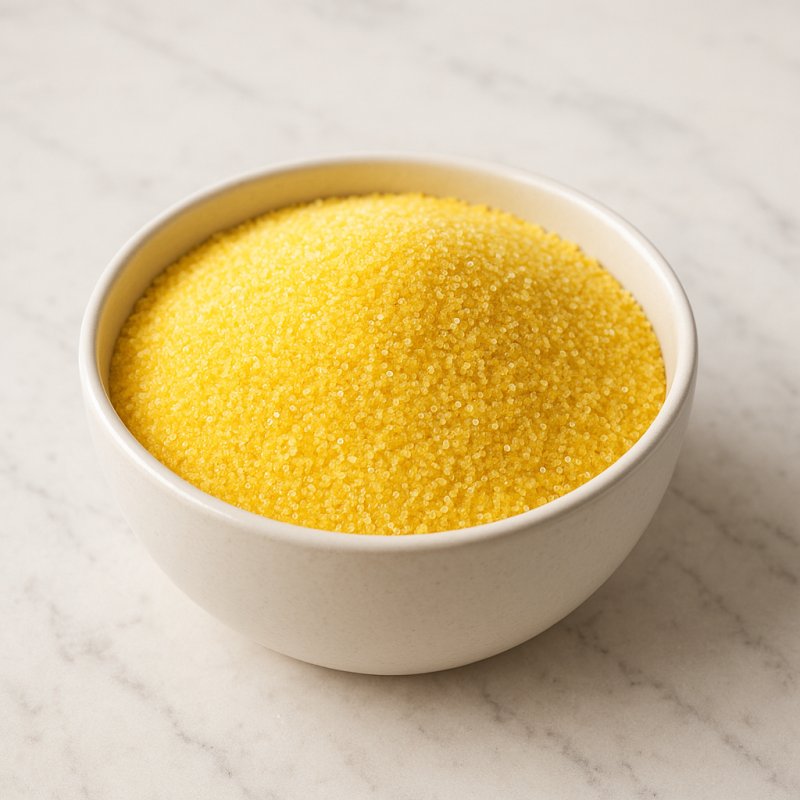
Yellow cornmeal (polenta) in a bowl

I still remember the first evening when I truly understood why polenta is so much more than just cornmeal. A friend brought a steaming pot, the air smelled of butter and rosemary, and within minutes a seemingly simple dish became a small celebration. Since then polenta has been for me a synonym of coziness, versatility and the pleasure of simple cooking.

Polenta is essentially made from cornmeal, yet the variations are astonishing: from coarse to fine, from instant to traditionally cooked polenta that develops its character with long stirring. I learned that slow stirring not only creates texture but also stories: at a Sunday dinner I stood for hours next to the pot chatting with a neighbor while the polenta gently bubbled. Those small rituals make the difference.

I love polenta because it is so adaptable. It can be creamy like a purée, cut and fried to get a crispy crust, or baked in the oven as a base for hearty toppings. My favorite combinations include braised vegetables, strong Parmesan and a drizzle of olive oil. A colleague once brought fried polenta slices to the office; that was the best snack we ever had at tea break.

A few practical points I always recommend:

  • Ratio: For creamy polenta usually 1 part polenta to 4 parts liquid.
  • Stirring: Patience pays off; slow stirring yields a silky texture.
  • Enriching: Butter, cheese or a splash of milk work wonders.
  • Leftover use: Once cooled, slice and pan-fry or grill.
To me polenta is a culinary invitation: plain, hearty and yet surprisingly elegant on the plate. It combines simple ingredients with big impact and has rescued many an improvised dinner. When I cook polenta today I think of those warm evenings, the clink of cutlery and the small conversations held around a pot full of cornmeal.

Availability & types


Polenta is a simple, flavorful dish made from corn and an ingredient you can find in many kitchens. Think of polenta like a warm corn porridge, similar to oatmeal but made with corn instead of oats. It originates from Europe, especially northern Italy, but the corn used to make polenta originally comes from the Americas. After people in Europe brought corn from the Americas, it became so popular in Italy that polenta developed.

Origin and cultivation
Corn grows well in warm climates and needs enough sun and water. That is why corn for polenta is grown in many places:

  • Northern Italy (regions such as Veneto, Lombardy and Piedmont): polenta has a long tradition there and many different varieties are produced.
  • Europe in general: corn is also grown in France, Germany and Eastern Europe and processed into polenta or similar corn dishes.
  • The Americas: in the USA and South America there are vast cornfields. Corn is grown there for many purposes, including food products like polenta.
  • Other growing areas: in warmer countries such as Spain or Portugal you can also find cornfields that can supply corn for polenta.
Available types and variants
Polenta comes in several forms. Sometimes it looks very fine, sometimes coarse like small grains. Here are the main variants, explained simply:

  • Coarse grind: this polenta has larger grains and takes longer to cook. It is firm and has more bite, almost like small potato pieces in the porridge.
  • Medium: a mix of coarse and fine grains. It is versatile and often used for classic polenta dishes.
  • Fine grind: this polenta cooks faster and becomes very creamy, almost like pudding.
  • Pre-cooked / instant: this variant is precooked and then dried. You only need to rehydrate it with hot water or milk — very practical when you need something quick.
  • Stone-ground: here the corn is slowly ground between stones. This preserves more flavor and makes the polenta particularly aromatic. It is often described as more artisanal.
  • Degerminated or whole-grain kernels: some polenta is made from corn that has parts removed to increase shelf life. Other variants contain the whole kernel and have a slightly nuttier taste.
  • Color differences: there is yellow and white corn. Yellow polenta is the most common, white has a milder taste.
  • Regional variants: in Italy there is, for example, Polenta taragna (mixed with buckwheat) or polenta stirred with cheese — this changes flavor and texture.
  • Ready polenta slabs: precooked slabs or slices that you can cut, fry or grill. Handy for takeaway or quick dishes.
Where to find polenta
Polenta is available in supermarkets, health food stores, Italian delis and online. Check the label: "instant" means quick to prepare, "coarse polenta" takes more time. If you want more flavor look for "stone-ground" or "organic". Polenta is also gluten-free, so it is suitable for people who cannot eat gluten.

Polenta is therefore versatile: from coarse to fine, from quick to traditional, from different countries and in different colors. There is a suitable variant for every preference.

Details & nutrition

Property Value
Unit g
Calories per 100 360
Protein per 100 8.0
Carbohydrates per 100 77.0
Sugar per 100 1.0
Fat per 100 1.5
Saturated fat per 100 0.2
Monounsaturated fat 0.4
Polyunsaturated fat 0.7
Fiber per 100 3.0
Vitamin C (mg) per 100 0
Vitamin D (IU) per 100 0
Calcium (mg) per 100 7
Iron (mg) per 100 2.0
Nutri-Score B
CO₂ footprint 0.7 kg CO2e/kg
Origin EU/Italy (depending on the manufacturer)
Gluten-free Yes
Lactose-free Yes
Nut-free Yes
Vegan Yes
Note Nutritional values refer to dry polenta (cornmeal) per 100 g; when prepared with water the values are significantly lower per 100 g.

Technical & scientific information


Polenta in Italian cuisine refers both to a dish and to the base ingredient made from coarsely ground cornmeal. Traditionally yellow corn (Zea mays) is used, and the term applies to both the product (cornmeal or grits) and the cooked, formable corn mass. Chemically and nutritionally, polenta is a form of processed starch with accompanying protein, fat, fiber, vitamin and mineral components.

Chemical composition and constituents. The main component is starch, which consists of two macromolecules: amylose and amylopectin. The amylose content influences gel formation: a higher amylose proportion promotes a firmer structure after cooling. Corn proteins are mostly prolamins (zein-like proteins), with a limited amino acid profile, particularly low in lysine and tryptophan. Lipids are present in small amounts, mainly as triglycerides and phospholipids in the germ. Fiber includes both soluble and insoluble fractions; its amount depends on the grind size and whether the germ and bran have been removed (degerminated vs whole grain).

Typical nutritional values (dry product, rounded per 100 g): energy about 350–370 kcal, carbohydrates 75–80 g (starch being the main fraction), fiber 2–8 g, protein 6–9 g, fat 1–5 g. Micronutrients include B-complex vitamins (e.g. niacin), phosphorus, magnesium, iron and in yellow corn significant amounts of carotenoids such as lutein and zeaxanthin, which are considered antioxidant.

Processing methods and physical properties. Corn for polenta can be milled differently: coarse, medium or fine; there are also degerminated and whole grain variants. Industrial processing includes debranning, milling and occasionally precooking and drying for instant polenta. During cooking starch gelatinization occurs: starch granules absorb water, swell and lose crystalline structure, producing a viscous paste. Temperature, water ratio and particle size control viscosity and setting behavior. On cooling retrogradation takes place, where amylose chains realign and the mass becomes firmer; this effect influences slicing firmness and shelf life.

Functional aspects in cooking and further processing. Polenta acts as a flavor carrier, it does not emulsify fats but can be made creamier by adding milk, butter or cheese. During frying or baking Maillard browning and moisture loss occur, producing crispy surfaces. Repeated heating and cooling promote formation of resistant starches, which act as prebiotic fiber and can attenuate glycemic response.

Health aspects and safety. Corn is naturally gluten-free, so polenta can be suitable for people with celiac disease provided there has been no contamination with gluten-containing cereals during storage or processing. Corn protein is nevertheless incomplete in essential amino acids; combining it with legumes improves protein quality. Glycemic effect varies with grind size, cooking time and added fat/protein. Risks include possible contamination by mycotoxins (e.g. aflatoxins) with improper storage and oxidation of germ lipids leading to rancidity. Nixtamalization, an alkaline treatment of corn, alters nutrient availability (e.g. increases bioavailable calcium) and reduces certain toxins, but this is rarely used in traditional polenta preparation.

Overall polenta is a technically simple but chemically interesting ingredient, whose properties depend strongly on corn variety, grind size and processing steps. It provides a starch- and energy-rich base for diverse preparations and can be nutritionally balanced by combining it with protein-rich foods.
Wiki entry for: polenta
Active now: 20 visitors of which 2 logged-in members in the last 5 minutes