Menu & categories

Persimmon

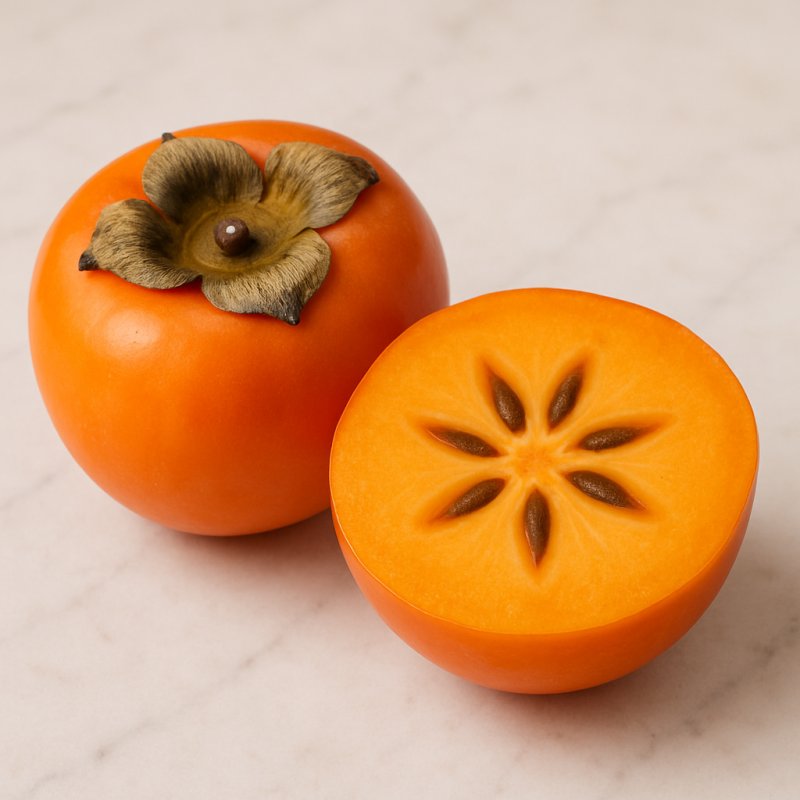
Sweet, aromatic fruit with soft flesh.

Wiki about persimmon Nutri-Score A Vegan Yes Gluten-free Yes Lactose-free Yes Nut-free Yes
NUTRITION / 100 g
70 kcal 0.6 g Protein 18.6 g Kohlenhydrate 0.2 g Fett

Introduction

Ripe persimmons
I still remember my first bite into a juicy persimmon: an almost indescribable feeling of sweetness, a velvety texture and the surprise that this orange fruit can be so versatile. Since then I have used it in salads, desserts and even savory dishes. A colleague of mine swears by thinly sliced persimmon on goat cheese, while a friend blends it into a simple smoothie — both variations have left a lasting mark on my kitchen.

The two best-known varieties are Hachiya and Fuyu. Hachiya is often elongated and astringent, meaning it must become very soft for the tannins to disappear and a nearly jelly-like texture to develop. Fuyu is round and can be eaten firm, almost like a soft apple. I learned that the correct ripeness makes the difference between a charming experience and a dry, fuzzy mouthfeel — and yes, once I misjudged it and loudly learned why it's better to leave inedible fruit alone.

Practical tips that have often helped me:

  • To ripen, place persimmons at room temperature next to apples or bananas; this speeds up ethylene-driven softening.
  • Eat Hachiya only when fully soft; otherwise the tannins are unpleasant.
  • Store ripe fruit in the refrigerator; they keep for a few days, or freeze them for sorbets and purées.
Persimmons pair wonderfully with nuts, cinnamon, citrus, aged cheese, poultry and even robust ham. In my favorite recipes I turn them into a quick chutney, bake them in cakes or slice them raw into winter salads. Nutritionally they provide beta‑carotene, vitamin C and fiber — a sweet, healthy luxury still underestimated in many kitchens.

Next time you see a persimmon, take one home, try a slice plain and then let curiosity guide your experiments. Sometimes a small try is enough to discover a new favorite ingredient.

Availability & types


Persimmon is a fruit originally from East Asia. It is believed to have originated thousands of years ago in China and then spread to Japan and Korea. From there trade routes and travelers carried persimmon to many other parts of the world. Today it grows not only in Asia but also around the Mediterranean, in parts of North and South America, in South Africa and in Australia — essentially wherever the climate is mild enough.

Persimmons like warm days and not too severe frosts. That means: they grow well in areas with warm summers and mild winters. Well-known growing regions include:

  • China and Japan – the oldest and traditionally most important regions.
  • Spain – the variety Rojo Brillante is particularly popular there.
  • Italy and parts of Greece – also many orchards.
  • California in the USA – where many varieties are grown for export.
  • Israel, Chile and Brazil – countries producing persimmons for various markets.
There are two major groups of persimmon varieties that children can easily distinguish:

  • Astringent varieties: These contain particular substances that cause a dry, puckering sensation in the mouth — similar to drinking overly strong tea. A well-known example is Hachiya. These fruits must become very soft before they taste sweet and juicy.
  • Non-astringent varieties: These can be eaten while still firm because they do not cause the dry sensation. The best-known variety is Fuyu, which looks a bit like a tomato: flattened and round.
A special name you often hear is Sharon fruit. This is actually a persimmon bred or treated in Israel so that it is always sweet and non-astringent — even when still firm. You can think of it as a persimmon that has been “helped” to be immediately tasty.

Besides varieties, persimmons are offered in different forms in stores:

  • Fresh as whole fruit – the most common form in supermarkets.
  • Dried – in Japan this is called Hoshigaki, thin sweet slices or whole dried fruits.
  • Puree, jam or juice – persimmon can also be processed, similar to apples or pears.
  • Candied or used as an ingredient in sweets and baked goods.
The season for fresh persimmons is usually autumn and early winter. When you see a persimmon in the store, you can judge ripeness by color and firmness: non-astringent types like Fuyu are firm and orange; astringent types like Hachiya must be soft and almost pillow-like before they are tasty. At home, hard fruits ripen at room temperature, soft ones are better kept in the refrigerator so they don't spoil.

In summary: persimmon originates from Asia, now grows worldwide in mild regions and comes in several varieties — mainly astringent (must be very soft) and non-astringent (edible when firm). You can find it fresh, dried or processed, especially in autumn and winter. That way you can always try which variety you like best.

Details & nutrition

Property Value
Unit g
Average weight per piece 200
Calories per 100 70
Protein per 100 0.6
Carbohydrates per 100 18.6
Sugar per 100 12.5
Fat per 100 0.2
Saturated fat per 100 0.0
Monounsaturated fat 0.0
Polyunsaturated fat 0.0
Fiber per 100 3.6
Vitamin C (mg) per 100 7.5
Vitamin D (IU) per 100 0
Calcium (mg) per 100 8
Iron (mg) per 100 0.2
Nutri-Score A
CO₂ footprint 0.45 kg CO2e/kg
Origin Spain (seasonal), otherwise import (e.g. Israel/Italy)
Gluten-free Yes
Lactose-free Yes
Nut-free Yes
Vegan Yes
Note Depending on the variety (e.g. Sharon) the fruit can be eaten firm or very soft; very ripe persimmons are especially sweet.

Technical & scientific information

Persimmon (botanical: Diospyros kaki) is a sweet fruit of the Ebenaceae family, cultivated mainly in East Asia. It exists in numerous cultivars differing in shape, skin, texture and tannin content. Typical types are astringent varieties (e.g. Hachiya), edible only after full ripening, and non-astringent varieties (e.g. Fuyu), which can be eaten while firm.

Chemical composition and constituents
Persimmon consists mostly of water and carbohydrates; the content of simple sugars (glucose, fructose, sucrose) increases with ripeness. Typical nutritional ranges per 100 g are approximately 70–80 kcal energy, 14–20 g carbohydrates, 10–13 g sugars, 3–6 g fiber, 0.5–1 g protein and less than 0.5 g fat. Mineral-wise the fruit contains notable amounts of potassium and traces of manganese, magnesium and phosphorus. Micronutrients include vitamin C and provitamin A carotenoids (especially β‑carotene and β‑cryptoxanthin), responsible for the yellow‑to‑orange coloration.

Polyphenols, tannins and pectins
Key secondary plant compounds are polyphenols such as gallotannins, proanthocyanidins and flavonoids (e.g. catechins). In unripe astringent fruits these tannins are present at high concentrations and cause the characteristic rough mouthfeel. During ripening, tannins are converted into less astringent forms by polymerization or by ripening treatments (e.g. ethanol or CO2). Persimmon also contains soluble pectins important for gelling during processing.

Physicochemical properties and processing
Persimmon is consumed fresh, dried, made into purée, jam, juice or vinegar and used in fermented products. Common processing methods include:

  • drying (air or freeze drying) to concentrate sugars and flavors;
  • thermal treatment and pasteurization in juice and jam production;
  • enzymatic treatment to improve juice clarification;
  • CO2 or ethanol treatment to remove astringency by converting soluble tannins.
Storage, ripening and storage technologies
Persimmons are ethylene-sensitive and continue to ripen after harvest. Cold storage slows ripening but temperatures that are too low can cause storage injuries. Ripeness is often assessed by firmness, color and gel‑forming ability; a high soluble solids content (°Brix) correlates with sweet taste.

Health aspects
Persimmon provides fiber, antioxidant polyphenols and carotenoids, which may have anti-inflammatory and cell-protective effects. Fiber supports bowel function and may positively influence blood glucose profiles. Considerations include the relatively high sugar content and the presence of tannins in unripe fruits, which can reduce protein digestion and, in rare cases, promote formation of phytobezoars in the stomach. Allergic reactions to persimmon are rare, but sensitive individuals should exercise caution and seek medical advice if needed.

In summary, persimmon is a versatile fruit with characteristic polyphenolic components and carotenoids, providing nutritionally valuable micronutrients and fiber. Choice of variety, ripeness and processing method decisively determine the sensory properties, chemical composition and health effects of the specific ingredient.

Wiki entry for: persimmon
Active now: 14 visitors of which 2 logged-in members in the last 5 minutes