Menu & categories

Powder for pepper sauce

Spice mix for quickly preparing a creamy pepper sauce.

Wiki about pepper sauce powder Nutri-Score D Vegan No Gluten-free No Lactose-free No Nut-free Yes
NUTRITION / 100 g
330 kcal 8.0 g Protein 55.0 g Kohlenhydrate 10.0 g Fett

Introduction

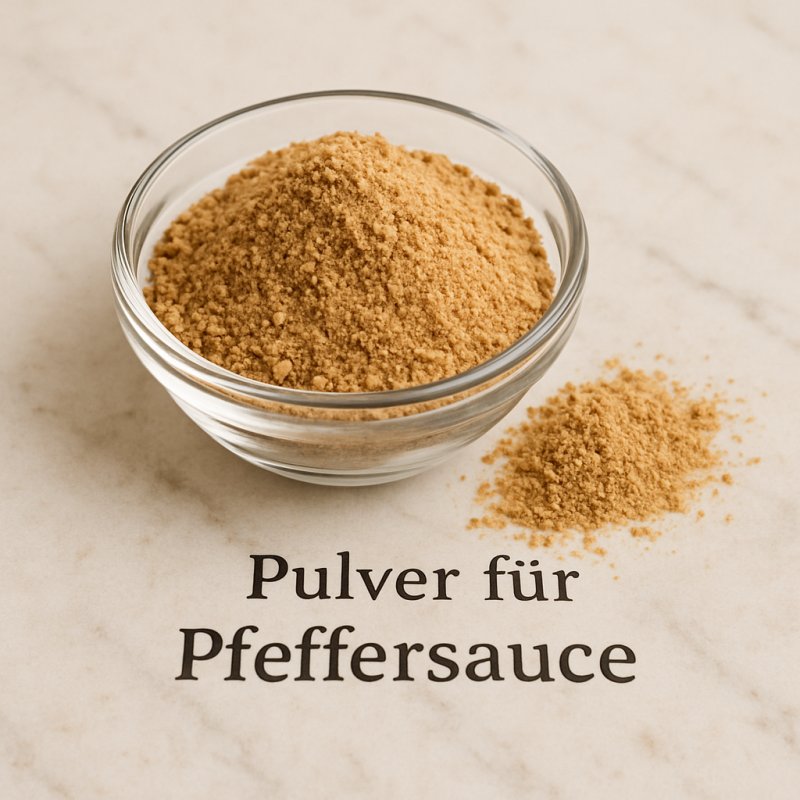
Powder for pepper sauce in a bowl

I remember clearly the day I first tried pepper sauce powder: a friend had spontaneously invited us for a Sunday roast and the kitchen was a bit chaotic. While I was stirring the gravy, he handed me an unassuming little packet with a broad grin. The result was surprising — a creamy, flavorful sauce with just the right peppery kick, without me having to reduce for hours or grind in a mortar.

Pepper sauce powder is basically a convenient blend of dried pepper (often black, green, or white), flour- or starch-based binders, salt, sometimes dried onion and garlic bits, and milk powder or cream substitutes for a creamy texture. That makes it a true convenience hero when the plate needs a little something quickly.

I use it in three typical situations: when time is short, when I want to offer guests a reliable sauce, and when I want to refine a dish without using the precise technique of reduction. Once, at a small dinner, I tried three variants — classic with peppercorns, with a splash of cognac, and with caramelized onions — and everyone asked for the recipe.

  • Simplicity: Stirring into hot liquid (stock, cream, or milk) quickly yields a silky sauce.
  • Versatility: With fresh peppercorns, herbs, or a squeeze of lemon you can customize the powder.
  • Storage: Kept dry and dark it lasts a long time; flavor loss is avoided by airtight containers.

Of course there are moments when I prefer the laborious version — freshly crushed peppercorns, real cream, stepwise reduction — but for everyday use and spontaneous invites the powder is a true kitchen friend. Try it, experiment with ingredients, and remember that good cooking often comes from small shortcuts combined with love and creativity.

Availability & types

Availability and types of pepper sauce powder are quite varied. You can buy such powders in many stores: supermarkets, spice shops, health food stores, or simply online. Often there are small portion sachets for home use, larger tins for professional kitchens, and handy single portions for on-the-go. Because the powder is long-lasting, it sits on shelves year-round – unlike fresh ingredients that can be seasonal.

The powder mostly consists of ground pepper and other dried ingredients like onion, garlic, milk powder or starch. These ingredients are dried so that later you can quickly whisk a sauce with water, milk, or stock. Think of it like instant cocoa: you mix powder with liquid and you already have something ready – only a savory sauce instead of a sweet drink.

Origin and growing regions: The main ingredient – peppercorns – comes from the pepper plant. This grows mainly in warm, rainy countries, for example in:

  • India (especially the southern regions),
  • Vietnam, which today exports a large share of peppercorns,
  • Indonesia (e.g. the island of Java),
  • Brazil and some countries in Africa.

Each country can give pepper a slightly different taste – like different apple varieties taste different. That is why you sometimes find labels such as “black pepper from Vietnam” or “white pepper from India.”

Available kinds and variants: There are several types of pepper and therefore different powders for pepper sauce. The main ones are:

  • Black pepper powder: It is pungent and slightly hot. It is made from whole green berries that are dried and then ground.
  • White pepper powder: It is milder and has a somewhat earthy taste. The skin of the berries is removed before drying.
  • Green pepper powder: Brighter and fresher in flavor, sometimes less hot. It is made from younger berries.
  • Pink peppercorns: Technically not true peppercorns but from other plants. They look pretty and taste mild and fruity. Sometimes they are part of blends.

There are also differences among ready-made pepper sauce powders:

  • Pure pepper powders – only ground pepper.
  • Ready mixes – contain, besides pepper, dried onion, herbs, milk or cream powder and stabilizers so the sauce thickens.
  • Spicier variants – with added chili, paprika or herbs.
  • Healthier variants – for example reduced-salt or without additives, organic-certified.

When shopping you can choose: do you want a simple pepper powder that you season yourself, or a convenience mix that quickly yields a creamy sauce? Both are easy to find and suitable for home use or stockpiling, because properly stored (cool, dry, airtight) they remain good for a long time.
Details & nutrition

Property Value
Unit g
Calories per 100 330
Protein per 100 8.0
Carbohydrates per 100 55.0
Sugar per 100 10.0
Fat per 100 10.0
Saturated fat per 100 6.0
Monounsaturated fat 3.0
Polyunsaturated fat 1.0
Fiber per 100 4.0
Vitamin C (mg) per 100 0
Vitamin D (IU) per 100 0
Calcium (mg) per 100 150
Iron (mg) per 100 1.5
Nutri-Score D
CO₂ footprint 4.0 kg CO2e/kg
Origin EU/Non-EU (depending on manufacturer)
Gluten-free No
Lactose-free No
Nut-free Yes
Vegan No
Note Nutritional values are typical reference values for pepper sauce powder; exact values and allergens vary by brand (check the label).

Technical & scientific information

Pepper sauce powder is a ready-to-use dry ingredient intended for the rapid preparation of savory pepper sauces in households and catering. It typically consists of a blend of dried pepper components and functional carriers, thickeners, emulsifiers, flavor enhancers and stabilizers. The composition varies by manufacturer but follows general principles that ensure sensory quality, storage stability and easy preparation.

Typical ingredients

  • Pepper components: ground black, white or green pepper and possibly chili flakes or paprika for heat and aroma. The active chemical components are piperine (heat/pungency) and volatile aroma compounds, which can be partly lost during drying.
  • Stabilizers and thickeners: modified starch, xanthan, guar gum or hydroxypropyl starch, which form the desired sauce consistency when mixed with liquid.
  • Milk and cream powders: milk powder, whey powder or milk proteins (e.g. sodium caseinate) are often used to provide creaminess and Maillard-type aromas; as a result many powders are not vegan.
  • Carrier and filler materials: maltodextrin or rice/corn starch are often used to improve powder flow and mixability.
  • Emulsifiers and anti-caking agents: lecithin, mono- and diglycerides and silicon dioxide as an anti-caking aid.
  • Salt, sugar and flavor enhancers: sodium chloride, possibly sucrose or dextrose and flavor enhancers such as monosodium glutamate or hydrolyzed proteins.
  • Preservation and antioxidants: ascorbate salts, tocopherols or other permitted antioxidants to extend shelf life.

Physical and chemical properties

The functional performance of this powder depends on particle size, water activity and solubility. Fine particles speed up aroma extraction but may promote agglomeration. Instantized (agglomerated) powders dissolve better and reduce dust formation. Chemically, piperine and other alkaloids are responsible for pungency, while volatile terpenes and piperoles shape the aroma. Milk components provide proteins and lipids that stabilize emulsions upon rehydration.

Manufacturing process

  • Raw materials are dosed and mixed into a homogeneous dry blend.
  • Fat and milk components can be integrated via spray drying or by adding preformed dry products.
  • Agglomeration and sieving optimize flow and dissolution properties.
  • Final packaging is carried out in moisture-barrier films or cans to prevent aroma loss and ingress of moisture.

Analytical and microbiological aspects

Quality control measures include moisture (loss on drying), ash, fat content, protein and microbiological parameters. For pepper components HPLC methods are used to determine piperine and GC-MS for volatile aroma compounds. Low moisture content and water activity below about 0.6 reduce microbial growth and extend shelf life.

Nutritional and health aspects

Pepper sauce powder is low in calories when based solely on pepper, but it can provide significant amounts of energy, saturated fats and sodium due to milk powder, fat and salt. Allergens such as milk or soy must be declared. Piperine can affect intestinal transport processes at higher doses and may interact with medications. Added flavor enhancers and high sodium contents should be considered in sensitive diets.

Storage and shelf life

Optimal storage conditions are cool, dry and protected from light, keeping relative humidity low to avoid caking and aroma loss. Vacuum sealing or protective atmospheres can extend shelf life to 12–24 months, depending on formulation and packaging.

Overall, pepper sauce powder is a technically optimized blend that combines the sensory properties of pepper with functional ingredients to enable simple, stable and safe preparation of pepper sauces. Consumers should read the label to check allergens, additives and salt content.

Wiki entry for: pepper sauce powder
Active now: 17 visitors of which 2 logged-in members in the last 5 minutes