Menu & categories

Pecans

Aromatic tree nut with a high content of unsaturated fatty acids.

Wiki about pecan Nutri-Score C Vegan Yes Gluten-free Yes Lactose-free Yes Nut-free No
NUTRITION / 100 g
691 kcal 9.2 g Protein 13.9 g Kohlenhydrate 72.0 g Fett

Introduction

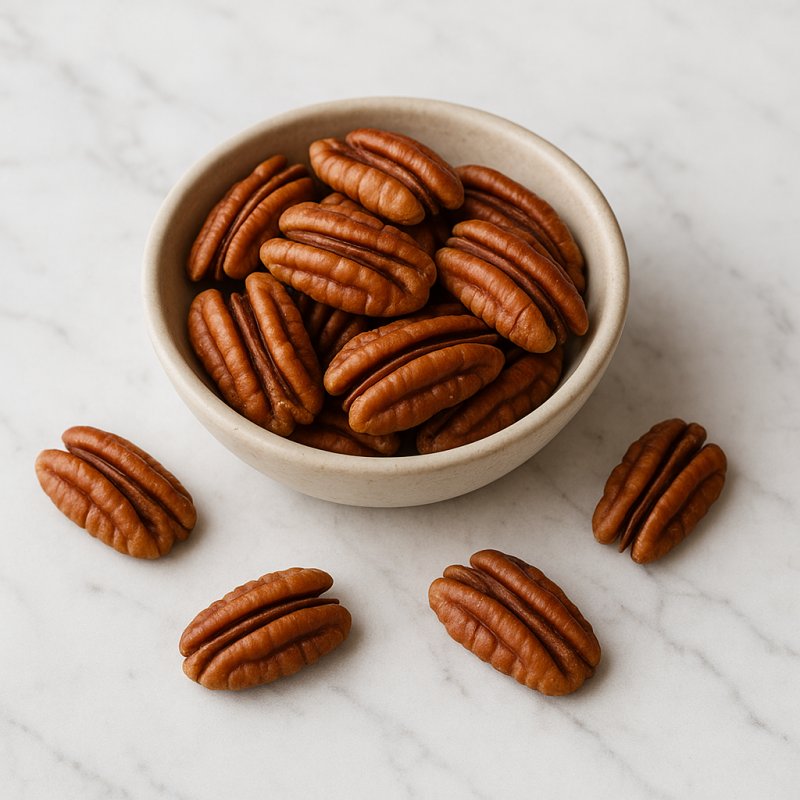
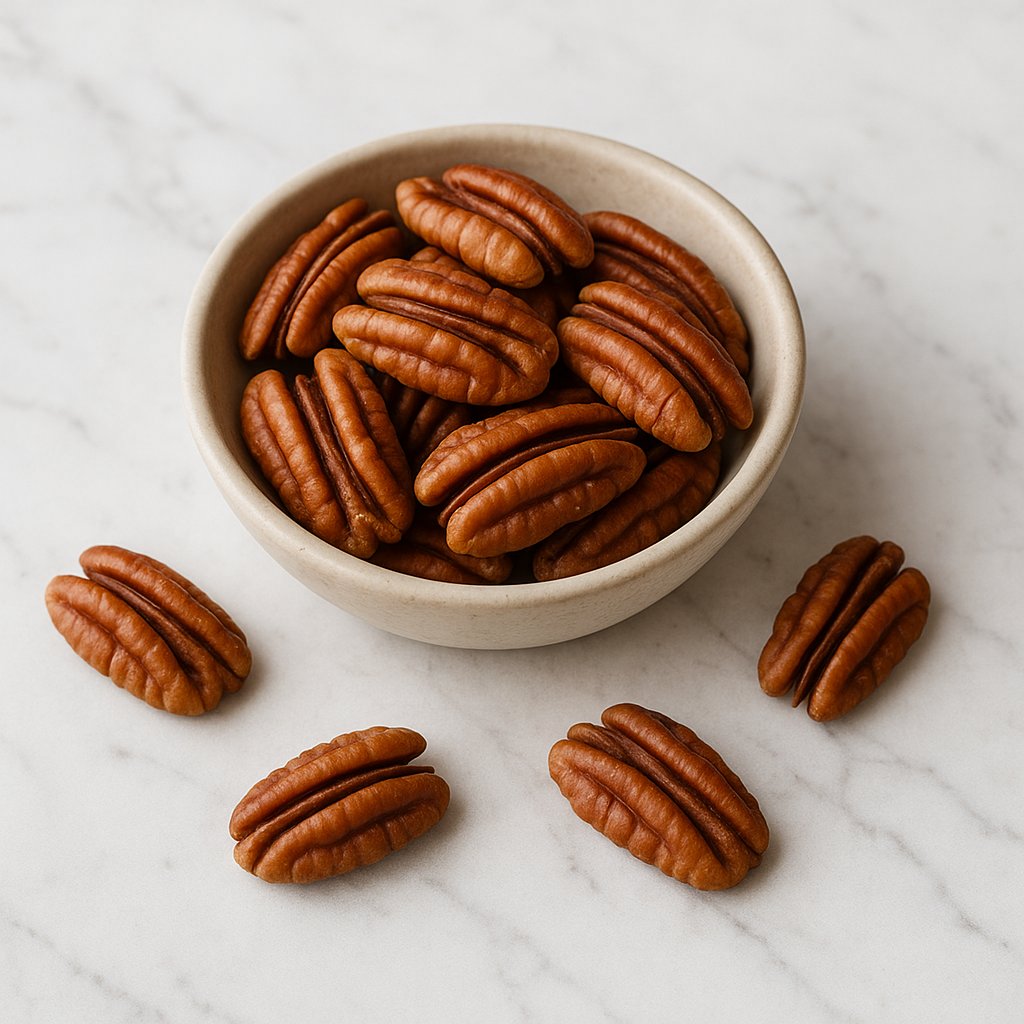
Pecans in a bowl
When I think of pecans, I don't just picture those warm, almond-shaped kernels, but also the first autumn market where I tried them as a newcomer in a foreign city. Cracking the shell, inhaling the scent of roasted oil and then enjoying that buttery, slightly sweet bite — it's homely. Pecans are for me one of those ingredients that wonderfully link kitchen and memory.

I still remember a colleague telling me that his grandmother scattered pecans in every cake decoration because she believed they brought luck. Whether that's true or not remains open, but since then I see a small ceremony in every praline and every salad. Pecans have a fine-porous texture and an aroma that sits between walnut and hazelnut, with a subtler bitterness than some other tree nuts.

Pecans are practical in many ways. They are excellent for baking, caramelizing, as a crunchy topping or simply as a snack. I love tossing them briefly in butter and maple syrup until they glaze, then sprinkling them over a winter ice cream. Such simple rituals brighten everyday life.

  • Taste: Buttery, slightly sweet, mildly nutty.
  • Texture: Tender yet crunchy, ideal for roasting.
  • Uses: Baking, salads, snacks, dessert garnish, sauces.
A small tip I learned from a baker: toast pecans briefly over medium heat in a pan until they begin to smell more intense. That enhances their aroma and makes them more flavorful in dishes.
I like to store them airtight, otherwise they quickly lose their flavor.

In the end, pecan remains for me a small celebration in the kitchen: versatile, warm in flavor and always ready to turn everyday moments into special ones. Once you've tried the crunchy, buttery kernel, you carry a piece of it thereafter in recipe ideas and memories.

Availability & types


Availability and types of pecans

Pecans are the nutty fruits of a large tree that grows mainly in warm regions. They can be bought in many varieties — fresh, dried, raw, roasted or as an ingredient in sweets and baked goods. Below I explain in simple and clear terms where pecans come from, where they are grown and what varieties and forms exist.

Origin
Pecans originally come from North America. Indigenous peoples and early settlers knew and used them long ago. The word “pecan” comes from an Indigenous language and means something like “hard-shelled nut that must be cracked with stones”. The tree grows along riverbanks and in warm valleys — where winters are mild and summers sunny.

Growing regions
Pecans are grown today in several parts of the world. Major growing areas include:

  • USA – especially in the South, in states such as Georgia, Texas, New Mexico and Louisiana. The USA is one of the largest producers.
  • Mexico – an important country of origin that supplies many nuts for export.
  • Australia and South Africa – where there are plantations suitable for warm climates.
  • China – is also increasingly becoming a producer, especially for the domestic market.
Because different regions have slightly different temperatures and soils, the nuts sometimes taste and look a little different — similar to apples that are a bit sweeter in one country and slightly tarter in another.

Available varieties
There are many varieties of pecans, much like apple varieties have different names. Some well-known varieties are:

  • Schley – a common variety with long halves, good for baking and decorating.
  • Stuart – hardy and often found on commercial plantations.
  • Desirable – popular for its good flavor and shape.
  • Pawnee and Apache – newer varieties that are often more disease-resistant.
Each variety has a slightly different shape, size or flavor — some are oilier, others slightly milder. In everyday use you often notice the difference only when you taste carefully.

Forms and variants sold
Pecans are available in many different forms:

  • In shell – fresh and unhulled; you have to crack them before eating the kernel.
  • Shelled kernel – the shell is removed; often sold as halves or pieces.
  • Raw or roasted – roasted nuts are often more aromatic, raw ones have a milder taste.
  • Salted or sugared – popular as snacks; sugared ones are sometimes candied.
  • Processed – as pecan oil, nut flour or an ingredient in baking mixes and confections.
  • Organic – grown without synthetic pesticides.
Year‑round availability
Fresh pecans are often seasonal, just after the autumn harvest. However, through storage, imports and processing they are available year‑round in supermarkets and online. Those seeking particularly fresh nuts usually find them at weekly markets or directly from producers.

Overall, pecans are easy to obtain and there are many varieties and forms — from the raw in‑shell nut to the ready‑to‑use piece for cakes. That way everyone can find the right variant for snacking, baking or trying out.
Details & nutrition

Property Value
Unit g
Average weight per piece 5
Calories per 100 691
Protein per 100 9.2
Carbohydrates per 100 13.9
Sugar per 100 4.0
Fat per 100 72.0
Saturated fat per 100 6.2
Monounsaturated fat 40.8
Polyunsaturated fat 21.6
Fiber per 100 9.6
Vitamin C (mg) per 100 1.1
Vitamin D (IU) per 100 0
Calcium (mg) per 100 70
Iron (mg) per 100 2.5
Nutri-Score C
CO₂ footprint 0.30
Origin USA, Mexico (depending on the batch)
Gluten-free Yes
Lactose-free Yes
Nut-free No
Vegan Yes
Note May contain traces of other tree nuts; store in a cool, dry place protected from light.

Technical & scientific information

Pecans (Carya illinoinensis) are the edible kernels of the pecan tree and belong to the family of walnuts. Botanically they are not "true" nuts in the strict sense, but drupes with a hard shell surrounding the oil-rich kernel. Pecans are grown mainly in North America; the main varieties differ in shape, flavor and oil content.

Chemical composition and nutritional values
Pecans consist predominantly of fat (typically 65–72 g per 100 g), followed by carbohydrates (approx. 4–14 g, of which fiber 8–10 g) and proteins (approx. 7–10 g). The energy content is about 690–720 kcal per 100 g. The fat profile is characteristic:

  • Monounsaturated fatty acids (mainly oleic acid): the major component, typically 40–60 % of fatty acids.
  • Polyunsaturated fatty acids (notably the linoleic/linolenic family): about 20–35 %.
  • Saturated fatty acids: relatively low, usually 5–10 %.
The mineral and vitamin profile includes appreciable amounts of magnesium, phosphorus, zinc, manganese and B vitamins (particularly thiamine). Pecans are also a good source of plant secondary compounds such as tocopherols (forms of vitamin E) and various polyphenols, including flavonoids and proanthocyanidins, which have antioxidant properties.

Processing methods
Processing typically includes the following steps:

  • Harvest: mechanical shaking and collecting the fruits from the ground.
  • Drying: reducing moisture content to safe storage levels (usually < 6–8 %) to avoid mold formation and enzymatic changes.
  • Shelling/cracking: mechanical cracking processes separate the hard shell from the kernel; sorting removes damaged or contaminated pieces.
  • Roasting/pasteurization: heat treatments improve flavor and shelf life but partially reduce heat-sensitive nutrients.
  • Oil extraction: cold pressing yields pecan oil, which has a high oleic acid content and is used in the food industry.
Food safety and storage
Due to their high fat content, pecans are prone to oxidation and rancidity. Storage conditions with low temperature, reduced air exposure and light-protected packaging slow oxidative processes. Improper storage can lead to spoilage through lipid oxidation and microbiological contamination (including mold growth and possible mycotoxin formation). Industrial safety measures include humidity control, mold sampling and occasional pasteurization to reduce pathogen contamination risk.

Health aspects
Because of their high proportion of monounsaturated fatty acids and antioxidants, pecans are often associated with beneficial effects on cardiovascular risk factors, including improved lipid profiles. However, their high energy density makes them calorie-rich, so portion sizes should be considered. Individuals with tree nut allergy must avoid pecans. Furthermore, improper storage carries a low risk of contamination with fungal toxins, making quality assurance important.

Overall, pecans are a nutrient-rich, oil-bearing food with a characteristic fatty acid pattern, meaningful amounts of vitamins, minerals and antioxidant plant compounds. Their processing and storage largely determine the safety, shelf life and nutritional properties of the final products.

Wiki entry for: pecan
Active now: 12 visitors of which 2 logged-in members in the last 5 minutes