Menu & categories

Passion fruit juice

Fruity, tart passion fruit juice – intense aroma.

Wiki about passion fruit juice Nutri-Score C Vegan Yes Gluten-free Yes Lactose-free Yes Nut-free Yes
NUTRITION / 100 ml
55 kcal 0.5 g Protein 13.0 g Kohlenhydrate 0.2 g Fett

Introduction

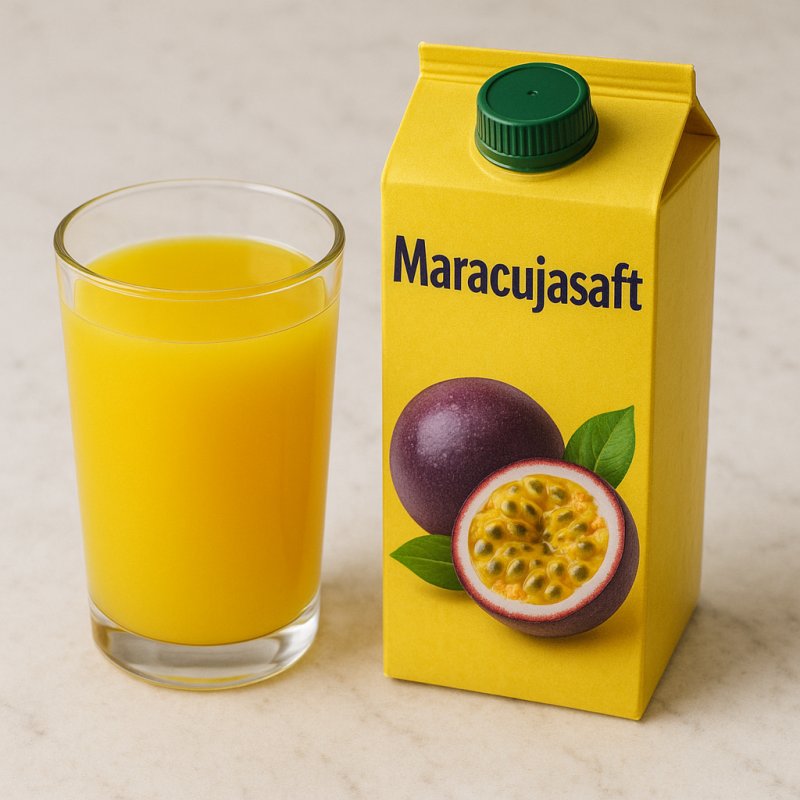
Glass of passion fruit juice
I have a small passion for ingredients that surprise on the first sip, and passion fruit juice sits at the top of that list. I still remember a hot summer afternoon when I first tasted freshly pressed juice: so intense that for a moment I thought someone had mixed up lemon and honey. Since then passion fruit juice has been, for me, the secret of every refreshing drink and many desserts.

What fascinates me about passion fruit juice is the balance of sweet and sour and the exotic aroma that evokes tropical flowers and ripe fruit. A colleague once swore that a splash of it in his vinaigrette turned his salads into a little summer cinema, and I can only agree. In cocktails the juice provides depth, in sorbets freshness, and in sauces surprising elegance.

It's also practical that passion fruit juice is versatile. I have used it in combination with dark chocolate, cream cheese, and even as a glaze for seared scallops. The acidity helps cut through fatty components, while the aroma highlights the sweetness of other ingredients.

  • Taste: The juice is fruity, aromatic and has a pronounced acidity.
  • Use: It is suitable for drinks, desserts, dressings and marinades.
  • Nutrients: Passion fruit juice provides vitamin C and secondary plant compounds in a pleasant amount.
  • Tips: Freshly pressed is best, but a good direct juice in a bottle can be practical.
Anyone rediscovering passion fruit juice should start with small amounts, because its intensity can easily overwhelm. I love drinking a glass of cold water with a splash of passion fruit juice as a little luxury, and each time I enjoy the fine acidity that briefly ruffles everyday life and makes it feel alive again.

Availability & types

Availability and types

Passion fruit juice comes from the passion fruit, which many people also call maracuja. Maracuja grows mainly in warm regions. Important countries of origin are Brazil, Colombia and Peru in South America. But it is also cultivated in Central America (for example Ecuador), Africa (for example Kenya) and in parts of Asia and Australia. It's similar to bananas or oranges: it does not grow everywhere, but where the climate is warm and often humid.

If you look for passion fruit juice, you will find it in different places:

  • in the supermarket among the juices,
  • in the chilled section as fresh juice,
  • in the freezer as fruit puree,
  • in the beverage range as a mixed drink or lemonade,
  • in health food stores or organic shops as an organic variant,
  • online from specialist retailers or directly from producers.
Different kinds of passion fruit juice

  • 100% pure passion fruit juice: This is juice made exclusively from passion fruit. It can taste intensely tart and very aromatic.
  • Juice from concentrate: Here water is removed from the juice so that only a thicker, sweeter "syrup" remains. Water is added again before sale. It's like making lemonade concentrate at home and adding water.
  • Nectar: Nectar is diluted juice, often with sugar or sweetener. It tastes milder and is cheaper. For children it is sometimes more pleasant because it is not so sour.
  • Passion fruit puree or fruit pulp: Often still contains small seeds. This is very practical when you want to use the juice in cakes or desserts.
  • Strained variants: In these products the seeds have been removed. They are smoother and suitable for drinks and fine sauces.
  • Frozen puree: Convenient when fresh juice is not available – thaw and use.
Different fruit types

There are different passion fruit species that make the juice taste and look different. The best known are the yellow passion fruit (externally yellow, juice often very aromatic and somewhat more tart) and the purple/dark passion fruit (externally dark, flavor often more intense and somewhat sweeter). Sometimes juice from both varieties is blended so that it tastes good – similar to mixing concentrates to achieve the perfect flavor.

Quality and storage

Passion fruit juice can be pasteurized – that means it has been briefly heated so that no microbes remain. This makes it more shelf‑stable. Other variants are processed cold (e.g. cold‑pressed) to preserve more of the fresh taste. Check labels when buying: they indicate whether it is 100% juice, from concentrate or nectar. Fresh variants are kept in the chilled section, frozen purees in the freezer, and shelf‑stable packages stored dry and dark.

In summary: passion fruit juice comes in many variants – pure or mixed, with or without seeds, fresh or from concentrate. It mainly originates from warm countries such as Brazil or Kenya and is available year‑round in supermarkets, organic shops and online in various forms, so you can choose the right type depending on taste and use (drinking, cooking, baking).
Details & nutrition

Property Value
Unit ml
Calories per 100 55
Protein per 100 0.5
Carbohydrates per 100 13.0
Sugar per 100 12.0
Fat per 100 0.2
Saturated fat per 100 0.05
Monounsaturated fat 0.03
Polyunsaturated fat 0.07
Fiber per 100 0.2
Vitamin C (mg) per 100 15
Vitamin D (IU) per 100 0
Calcium (mg) per 100 5
Iron (mg) per 100 0.2
Nutri-Score C
CO₂ footprint 0.06 kg CO2e/100 ml
Origin South America (depending on bottling/import also Africa or Asia)
Gluten-free Yes
Lactose-free Yes
Nut-free Yes
Vegan Yes
Note Nutritional values may vary depending on the proportion of direct juice/fruit juice concentrate and possible added sugar.

Technical & scientific information

Passion fruit juice is the liquid product from the pulp of passion fruit (Passiflora edulis and related species) and is used both as a refreshing beverage and as an ingredient in the food industry. Chemically and sensorially, passion fruit juice is characterized by pronounced acidity, an intense floral to fruity aroma, and a combination of water‑soluble nutrients and lipophilic aroma compounds. Composition varies depending on variety (yellow or purple), ripeness and processing method.

Main constituents

  • Water: Major component, typically over 85% in the juice.
  • Carbohydrates: Mainly sugars such as sucrose, glucose and fructose; content varies with ripeness and is often 6–12 g per 100 mL.
  • Acids: Mainly citric and malic acid; pH usually ranges between 2.7 and 3.5, while titratable acidity determines the perception of sourness.
  • Vitamins and minerals: Notable amounts of vitamin C (ascorbic acid) and small amounts of provitamin A (carotenoids). Minerals such as potassium, magnesium and phosphorus are present, with potassium quantitatively highest.
  • Polyphenols and flavonoids: Phenolic compounds contribute to antioxidant capacity; purple varieties additionally contain anthocyanins.
  • Aroma compounds: Complex mixture of esters (e.g. hexyl acetate), terpenes (e.g. linalool, limonene) and other volatile compounds that generate the characteristic aroma.
  • Fatty acids and seed components: Seeds contain oil high in linoleic acid (omega‑6) and provide fiber; in clear juice they are however removed or ground.
Nutritional value and figures

The energy content of passion fruit juice depends on sugar content and is roughly between 30 and 70 kcal per 100 mL. Fiber content is low in pressed juice; in juice with pulp or smoothies the fiber proportion increases markedly. Quality controls use figures such as Brix (total dissolved solids), titratable acidity, pH and sensory profiles.

Processing methods

  • Extraction: Mechanical extraction of the pulp, separation of seeds by sieving or centrifugation.
  • Clarification: Use of pectinases to reduce viscosity and turbidity; alternatively filtration processes such as micro‑ or ultrafiltration.
  • Concentration: Vacuum evaporation to produce direct juice concentrate; the reconstituted product differs sensorily from cold‑pressed.
  • Preservation: Thermal pasteurization (HTST), aseptic filling and modern techniques like high pressure processing (HPP) or pulsed electric fields to preserve aroma and nutrients.
  • Additives: Occasionally stabilizers, sweeteners or preservatives (e.g. sorbates) to extend shelf life.
Health aspects

Passion fruit juice supplies antioxidants, vitamin C and potassium, which can be beneficial for the immune system and electrolyte balance. Because of its natural sugar content, moderate consumption is recommended, especially for diabetics. Raw or insufficiently pasteurized juices carry an increased microbiological risk. Drug interactions with the juice itself are rare, but patients with specific conditions should consult their physician, as secondary plant compounds in other parts of Passiflora can have sedative effects.

Analytical methods and quality parameters

Characterization employs HPLC for determination of sugars and phenols, GC‑MS for volatile aroma analysis and standard methods for Brix, acidity and microbiological testing. Sensory evaluation complements analytical data, since aroma and mouthfeel are decisive for consumer acceptance.

Overall, passion fruit juice combines nutritionally relevant micronutrients with a differentiated aroma profile; its quality depends largely on variety, ripeness and processing technology used, while nutrition‑related risks mainly concern sugar intake and inadequate microbial treatment.

Wiki entry for: passion fruit juice
Active now: 15 visitors of which 2 logged-in members in the last 5 minutes