Menu & categories

Papaya

Tropical fruit high in vitamin C with a mildly sweet aroma.

Wiki about papaya Nutri-Score A Vegan Yes Gluten-free Yes Lactose-free Yes Nut-free Yes
NUTRITION / 100 g
43 kcal 0.5 g Protein 10.8 g Kohlenhydrate 0.3 g Fett

Introduction

Fresh papaya
I have a small weakness for papaya that developed one day from a random market encounter. There was a crate of sun-warmed, honey-yellow flesh, and the scent was so inviting that I just had to take it home. Since then papaya has been my uncomplicated superstar ingredient that surprisingly complements both breakfast bowls and hearty curries.

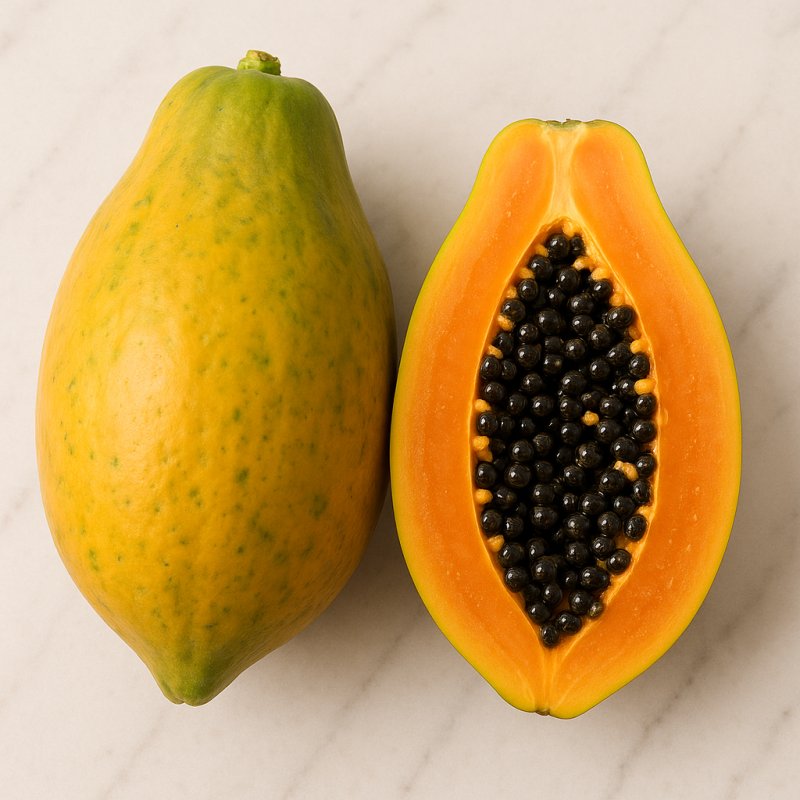
Visually it’s unassuming, sometimes ochre, sometimes deep orange, and the brown seeds inside look unusual at first glance. Tasting it immediately reveals its versatility: tender, sweet flesh that evokes melon and apricot but with its own slightly exotic note. I still remember an evening when a friend ground the seeds and served them as a spicy substitute for pepper. That was an aha moment.

Papaya is also practical in the kitchen. Untreated it works wonderfully in smoothies or as a compote. Harvested green it becomes the base for salads like Thai som tam, and when ripe and mashed it is a natural meat tenderizer because the enzyme Papain breaks down proteins. A colleague of mine swears by putting beef in pureed papaya overnight and then grilling it briefly.

Some quick facts I like to pass on:

  • Vitamins: Rich in vitamin C and beta‑carotene.
  • Digestion: Papain supports digestion and can be beneficial after heavy meals.
  • Uses: Fresh, as a marinade, in salads, smoothies and desserts.
  • Precautions: Unripe fruits contain more latex; caution is advised during pregnancy or if prone to allergies.
Finally a tip: I recognize a ripe papaya by a gentle pressure test and by the smell. The seeds are edible and peppery, but if you don’t like them you can simply remove them and enjoy the flesh on its own. For me papaya remains one of those ingredients that enable small everyday culinary adventures and continually surprise me.

Availability & types


Availability and types

The Papaya is a tropical fruit that grows in many parts of the world. It originally comes from Central America, from countries like Mexico and the northern part of South America. Today, however, it is grown almost everywhere in warm regions: in the Caribbean, in parts of Africa, in India, Thailand, the Philippines and also in Hawaii. You can think of papaya like a traveler: it has come a long way and is now at home in many places.

Growing regions
Papayas like warmth and lots of sun. They do not grow well in cold regions. Therefore you will mainly find them:

  • In tropical countries close to the equator (e.g. Mexico, Brazil, India).
  • In subtropical areas with mild winters (e.g. parts of Africa or southern regions of Australia).
  • On plantations or in small gardens: some farmers grow papayas on a large scale, others in home gardens for personal use.
Varieties and forms
There are many different papaya varieties. They differ in size, shape, color and taste. Here are some simple groups to distinguish them:

  • Large papayas – often called “Maradol”: These fruits are large and easily fill a basket. They usually have orange-red flesh and are very juicy.
  • Small / Solo papayas – e.g. “Solo” from Hawaii: These are smaller, rounder and ripen faster. They are good when you want to eat only a small amount.
  • Red vs yellow varieties – some papayas have deep red flesh, others more yellow-orange. Red varieties often taste a bit sweeter.
  • Green papaya – this is an unripe papaya. It is firm and not eaten for its sweetness, but often used as a vegetable, for example in salads like the Thai “Som Tam”.
  • Mountain papaya / Babaco – a related fruit that grows at higher altitudes. It is usually more elongated and has a somewhat different aroma.
How and where to buy papaya
In tropical countries you will find fresh papayas at markets or supermarkets almost year-round. In cooler countries they are often imported and therefore seasonal or more expensive. You can get papaya in these forms:

  • Fresh and whole – the classic whole fruit.
  • In pieces or pre-packaged in the refrigerated section – sometimes already peeled and cut.
  • Frozen or canned – practical when fresh is not available. Taste and texture differ, but they have a long shelf life.
  • Dried or powdered – for example as a snack or to mix into drinks.
A simple picture: imagine fresh papayas are like fresh strawberries in summer – tasty and juicy, but not always available everywhere fresh. Canned or frozen papaya is like jam or frozen berries: practical when the fresh season is over. Whatever the variety, papayas are versatile: sweet as a dessert, preserved or green as a crunchy salad. One last small tip: if the papaya gives slightly when pressed, it is ripe and at its juiciest.

Details & nutrition

Property Value
Unit g
Average weight per piece 600
Calories per 100 43
Protein per 100 0.5
Carbohydrates per 100 10.8
Sugar per 100 7.8
Fat per 100 0.3
Saturated fat per 100 0.1
Monounsaturated fat 0.1
Polyunsaturated fat 0.1
Fiber per 100 1.7
Vitamin C (mg) per 100 61
Vitamin D (IU) per 100 0
Calcium (mg) per 100 20
Iron (mg) per 100 0.25
Nutri-Score A
CO₂ footprint 1.3 kg CO2e/kg
Origin Tropics (often imported, e.g. Brazil)
Gluten-free Yes
Lactose-free Yes
Nut-free Yes
Vegan Yes
Note Nutritional values refer to the edible flesh (raw). Ripeness affects sugar content.

Technical & scientific information

Papaya (scientific name Carica papaya) is a tropical fruit of the family Caricaceae, cultivated worldwide for its mild-sweet flavor, soft texture and nutrient profile. Botanically it is a berry with soft flesh and numerous black seeds in a central cavity. Fruit varieties differ in size, shape and flesh color, ranging from pale yellow to intense orange-red.

Chemical composition and nutritional values: Fresh papaya flesh consists mainly of water (about 85–90 %) and has a moderate carbohydrate content, mainly in the form of free sugars such as glucose, fructose and sucrose. Typical nutritional values per 100 g of raw product range from 30–45 kcal, about 7–11 g carbohydrates, 0.3–0.6 g fat, 0.5–1.0 g protein and 1–3 g fiber. Papaya is a notable source of vitamin C (often 40–70 mg/100 g) and contains provitamin A carotenoids, particularly beta-carotene and lycopene, which give the orange-red coloration. Minerals such as potassium and small amounts of magnesium and calcium are also present.

Enzymes and secondary plant compounds: A characteristic enzyme of papaya is papain, a proteolytic enzyme concentrated in the latex and unripe flesh. Papain cleaves proteins and is used industrially as a meat tenderizer, in pharmaceutical preparations and in cosmetic applications. Other bioactive compounds include flavonoids, phenolic compounds and seed-contained isothiocyanate-like compounds that may exhibit antimicrobial properties.

Physical properties and processing: Fruit puree pH typically lies in the mildly acidic range (about 5–6), which facilitates thermal processing and pasteurization. Common processing methods include fresh consumption, cold-chain distribution, heating and pasteurization for juices, freeze-drying for powders, canning and enzymatic extraction of papain. During processing, enzyme activity, water content and oxidation of carotenoids are central quality parameters. Microencapsulation can be employed to stabilize heat-sensitive nutrients.

Health aspects: Regular consumption of papaya contributes, due to its high vitamin C, carotenoids and fiber content, to antioxidant intake and support of digestion. Papain can promote proteolytic digestion but may cause local irritation in sensitive individuals. Unripe fruits and milky sap contain latex components that, if consumed excessively, may have uterotonic effects; pregnant women should therefore exercise caution. Allergic reactions to papaya proteins are rare but possible, and cross-reactions with latex allergies have been reported.

Safety, storage and quality control: Ripe papayas are relatively short-lived at room temperature; refrigeration slows ripening and reduces microbial spoilage. For trade, tests for pesticide residues, microbiological safety and sensory characteristics are common. Technical analyses include determination of papain activity, carotenoid content by HPLC, vitamin C content and moisture determination.

Applications: Besides direct consumption, papaya is used in juices, smoothies, baby food, meat preparations (as a tenderizer), cosmetic peels and pharmaceutical products. Due to its enzymatic and nutritional properties, papaya remains a versatile ingredient in the food industry, traditional remedies and modern biotechnological applications.

Wiki entry for: papaya
Active now: 11 visitors of which 2 logged-in members in the last 5 minutes