Menu & categories

Orange syrup

Fruity-sweet orange syrup for flavoring and sweetening.

Wiki about orange syrup Nutri-Score D Vegan Yes Gluten-free Yes Lactose-free Yes Nut-free Yes
NUTRITION / 100 ml
280 kcal 0.2 g Protein 70 g Kohlenhydrate 0 g Fett

Introduction

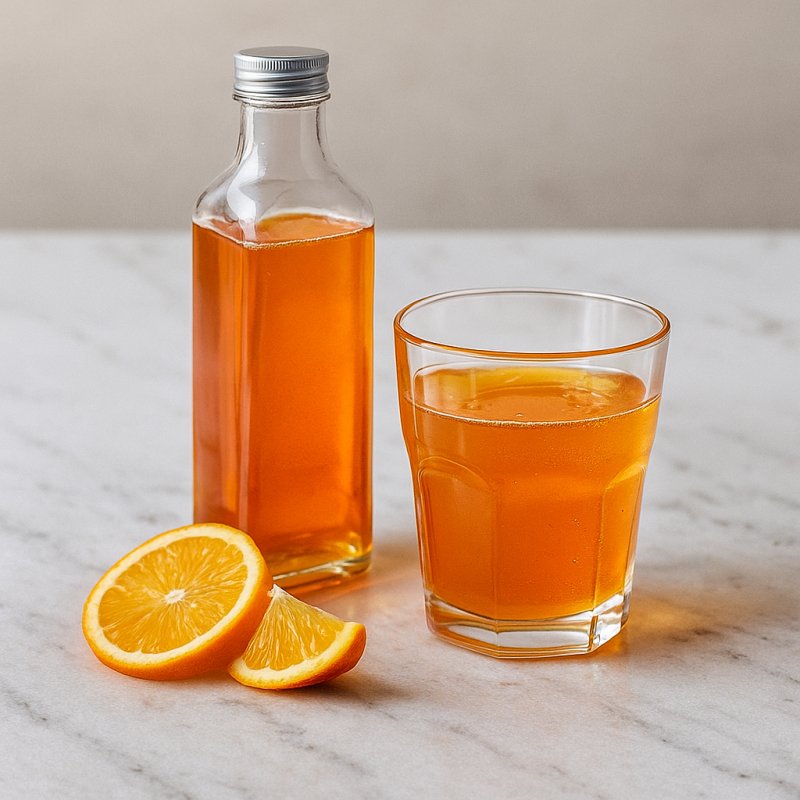
Orange syrup in a glass bottle
Orange syrup is for me a small, liquid pleasure that can play a prominent role in any kitchen. I still remember a rainy Saturday afternoon when I first tried a homemade syrup and immediately thought: why didn't I discover this much earlier? The scent of cooked peel and caramelized sugar is comforting and at the same time surprising, combining sweet and bitter notes in an elegant way.

What I especially appreciate about orange syrup is its versatility. It elevates drinks, from a simple mineral water to complex cocktails, and gives desserts a fresh, fruity depth. A colleague once brought a bottle to a shared brunch because he thought we needed some "orange magic" for our pancakes. The pancakes became the talk of the day, and since then I have never reached for industrial syrups again.

A few practical things I've learned:

  • Orange syrup can be made from freshly squeezed juice or from concentrated ingredients, and each method brings its own nuances.
  • The peel provides the bitter component and should be dosed carefully so the syrup doesn't become too harsh.
  • Properly sealed and stored cool, homemade syrup keeps for several weeks.
When I make syrup, I like to control sweetness and intensity. Sometimes I let a hint of vanilla simmer with it, and sometimes I prefer a splash of lemon to balance the sweetness. At the last summer party a neighbor suggested adding a bit of fleur de sel, and the small salty element gave the syrup a whole new dimension.

Orange syrup is more than just an ingredient; it is a little secret that enhances dishes and drinks and creates memories. I continue to enjoy experimenting with different orange varieties and blends, and each result tells its own, delicious story.

Availability & types

Availability and types of orange syrup

Orange syrup is a sweet syrup with a clear, fruity orange flavor. The basic ingredient is oranges, which originally come from South Asia. A long time ago, hundreds of years ago, people planted orange trees from Asia in warm regions around the Mediterranean and later also in America and Australia. That is why the oranges used to make syrup today often come from countries like Spain, Italy, Greece, the USA (Florida, California), Brazil, South Africa and Australia. These places have a warm climate that helps orange trees form sweet fruit – you can imagine it like a plant that grows better in a warm jacket than under a thick blanket of snow.

There are different kinds of orange syrup, and they differ a little in taste and in how they are made. Here are the main types, simply explained:

  • Mild orange syrup: It is usually made from sweet oranges and tastes gentle and fruity, almost like freshly squeezed orange juice with sugar. It goes well with lemonades or over ice cream.
  • Blood orange syrup: Made from blood oranges, which have red-colored flesh. The syrup is somewhat more intense and can have a slightly tart note – similar to mixing juice with a small splash of lemon.
  • Seville or bitter orange syrup: This variety comes from bitter oranges (also called Seville oranges). It does not taste as sweet, but rather slightly bitter and aromatic. This is good for adults who like a stronger flavor.
  • Orange blossom syrup: Here the blossom, not the fruit, is used. The flavor is very delicate and floral – imagine a perfume of orange blossoms floating in a lemonade.
  • Reduced-sugar / organic variants: Some syrups have less sugar or are made from organically grown oranges (organic). These are often a good choice for people who pay attention to sugar or cultivation methods.
  • Concentrated syrups & mix syrups: Some are very thick and concentrated, others are ready to be mixed with water. It's like homemade syrup: some you must dilute with water first, others you can put directly over pancakes.
You can find orange syrup in many places. Supermarkets often carry well-known brands. In delicatessens or from organic farmers you can find special or handmade varieties. Cafés, bars and cocktail shops often use specific brands, and online you can order almost any type. Making it yourself is also simple: with a few oranges, sugar and water you can cook a fresh syrup at home – sugar helps to preserve the syrup longer, almost like a protective coat for the flavor.

When you buy orange syrup, pay attention to the ingredient list: some syrups contain only orange juice and sugar, others have added flavors or preservatives. Fresh, simple ingredients are often the most aromatic. After opening, syrup should usually be stored in the refrigerator to keep it good longer.

In summary: orange syrup comes from oranges that grow in warm countries, and there are many varieties – from sweet and mild to floral and bitter. You can find it in stores, online, at the market or even make it yourself. That way you'll surely find the variant that suits your taste best.
Details & nutrition

Property Value
Unit ml
Calories per 100 280
Protein per 100 0.2
Carbohydrates per 100 70
Sugar per 100 68
Fat per 100 0
Saturated fat per 100 0
Monounsaturated fat 0
Polyunsaturated fat 0
Fiber per 100 0
Vitamin C (mg) per 100 2
Vitamin D (IU) per 100 0
Calcium (mg) per 100 10
Iron (mg) per 100 0.2
Nutri-Score D
CO₂ footprint ca. 1,0 kg CO2e/kg
Origin EU/Non-EU (depending on the manufacturer and the origin of the oranges)
Gluten-free Yes
Lactose-free Yes
Nut-free Yes
Vegan Yes
Note Nutritional values can vary greatly depending on the recipe (sugar content/fruit juice proportion).

Technical & scientific information

Orange syrup is a concentrated, sweet liquid extract based on oranges, used in cooking and the food industry as a flavoring agent, sweetener and humectant. Chemically, it is essentially a saturated sugar-water solution to which fruit acids, aroma compounds and in many cases secondary plant substances from the pulp and the peel are added. The physical and chemical properties of orange syrup are mainly determined by the sugar content, the pH value and the presence of volatile terpenes.

Composition and ingredients. The main components are sucrose, glucose and fructose, with sucrose being partially hydrolyzed by acid at elevated temperatures to invert sugar (glucose + fructose). Typical additives from the orange include citric acid and ascorbic acid (vitamin C), although vitamin C content can be greatly reduced by thermal processing. Volatile aroma compounds from the peel include d-limonene, linalool and myrcene, as well as flavonoids such as hesperidin and naringin, which have antioxidant properties.

Nutritional values (typical values per 100 g). Orange syrup is energy- and carbohydrate-rich. A commercial syrup contains about 250–320 kcal per 100 g and around 70–80 g of available sugars. Protein and fat contents are negligible. Minerals occur only in trace amounts. Actual values vary depending on formulation and concentration.

Processing methods. There are several production techniques that produce different sensory and preservative properties:

  • Cold infusion: Sugar is combined with freshly squeezed orange juice or zest at low temperature by maceration to preserve heat-sensitive aromas.
  • Heating/concentration: By heating and evaporation the desired Brix value is achieved; this can lead to inversion of sucrose and to partial loss of vitamin C.
  • Steam distillation or cold pressing of the peel to obtain essential oils that can be added back to the syrup to compensate for aroma losses.
  • Stabilizers and preservatives such as potassium sorbate or benzoates are occasionally used to extend shelf life and inhibit the growth of yeasts and molds.
Technical parameters. The pH of orange syrup usually lies in the acidic range at about 3.0 to 4.0, which together with a high sugar content increases microbiological stability. Water activity (aw) is reduced by the sugar content but often remains high enough that specific osmotolerant yeasts can survive, which is why additional thermal treatment or preservation is advisable.

Health aspects. Orange syrup provides quickly available energy in the form of simple sugars and should be consumed in moderation because of its high calorie and sugar content. Secondary plant compounds such as flavonoids may have antioxidant effects, but in concentrated syrups they are often present in lower, non-standardized amounts. From a nutritional point of view, orange syrup is not a significant source of micronutrients.

Storage and shelf life. Properly filled and sealed, orange syrup is stable for several months when stored cool and protected from light. After opening, refrigeration and hygienic handling are recommended to avoid yeast growth. Sensory changes such as loss of color and aroma are possible with longer storage.

In food science, orange syrup is a practically relevant product because of its combination of sugar physics, aroma chemistry and microbiological requirements, offering manufacturers and chefs both technical challenges and a wide range of application possibilities.

Wiki entry for: orange syrup
Active now: 6 visitors of which 2 logged-in members in the last 5 minutes