Menu & categories

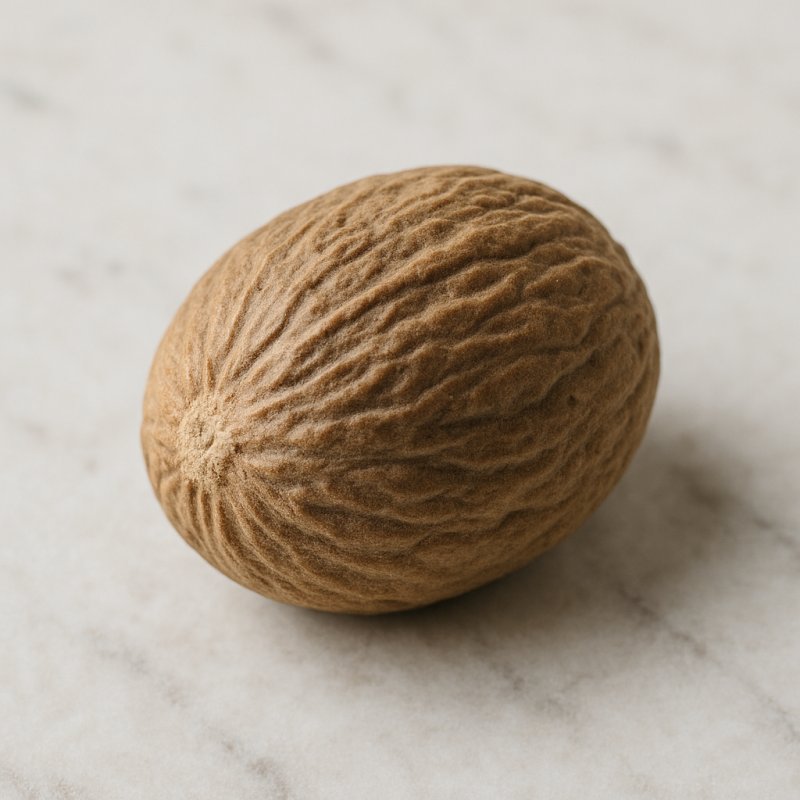
Nutmeg

Aromatic spice with intense flavor

Wiki about nutmeg Nutri-Score D Vegan Yes Gluten-free Yes Lactose-free Yes Nut-free Yes
NUTRITION / 100 g
525 kcal 5.8 g Protein 49.3 g Kohlenhydrate 36.3 g Fett

Introduction

Whole nutmegs and ground nutmeg
To me nutmeg is one of those spice notes that at first glance seems unassuming and then, quite surprisingly, reveals itself as the secret heart of many dishes. I still remember a rainy afternoon when I tried to make a simple potato soup special. A colleague of mine grinned and handed me a small tin of nutmeg. A whisper of that, freshly grated, transformed the soup: suddenly there was warmth, depth and an almost nutty sweetness that drew everyone to the table.

Nutmeg comes from the seed capsule of the nutmeg tree fruit and has a long, exotic history that tells of seafarers, spice trade and small kitchen experiments. I like the idea that this small, unassuming seed once had a say in wars and expeditions. Today it sits in a plain grinder by my stove, ready to give the right seasoning to simple casseroles, cream sauces or an apple pie.

What I love about nutmeg is its versatility. It is at once warming and delicate, fitting savory dishes as well as sweet ones. For a pasta with spinach and ricotta my friends once applauded in chorus, because a tiny pinch of nutmeg rounded out the whole filling. Nutmeg is also practically mandatory in béchamel sauces, because it holds together the cream-and-butter base and prevents the dish from seeming "flat".

  • Taste: warm, slightly sweet, nutty and aromatic.
  • Use: soups, vegetables, sauces, baked goods, drinks such as eggnog.
  • Tips: grate fresh rather than buy pre-ground; use sparingly, less is often more.
A small anecdotal tip: at a house party I discovered, of all things while making a potato gratin, that we had run out of cheese. A bold dash of nutmeg didn't melt the crust, but brought it to perfection. Since then nutmeg has been the spice that makes improvised kitchen miracles possible for me. I recommend always having a small nutmeg grinder on hand and dosing carefully, because too much can be overwhelming.

In the end nutmeg is an instrument of culinary art that gives dishes personality without shouting. When I enter my kitchen I already look forward to the fine scent of a freshly grated nutmeg, because it promises reliability and a little adventure at the same time.

Availability & types

Availability and types of nutmeg

Nutmeg is a spice many people know from the kitchen — it smells warm and slightly sweet and is often used in soups, casseroles or cakes. When talking about availability and types of nutmeg, one refers on the one hand to where the nutmegs come from and how they are grown, and on the other hand to the forms in which nutmeg is found in shops. I will explain this simply so it is easy to understand.

Origin and growing regions
Nutmeg originally comes from islands near Indonesia. The nutmeg plant is a tropical tree that grows well in warm, humid regions. Today nutmeg comes from various countries, mainly from:

  • Indonesia – there are many nutmeg plantations there, especially on the Moluccas (the "Spice Islands").
  • Grenada – an island in the Caribbean often called the "nutmeg island" because a lot of nutmeg is grown there.
  • Sri Lanka and parts of India – these countries also grow nutmeg.
  • West Africa – some countries there also have nutmeg plantations.
One can imagine that nutmeg trees, like many fruit trees, need sun and rain. Therefore they grow best where the climate is warm and regularly humid — similar to bananas or mangoes.

Available varieties and forms
Nutmeg is not available in only one form. Here are the most common types you should know, explained simply:

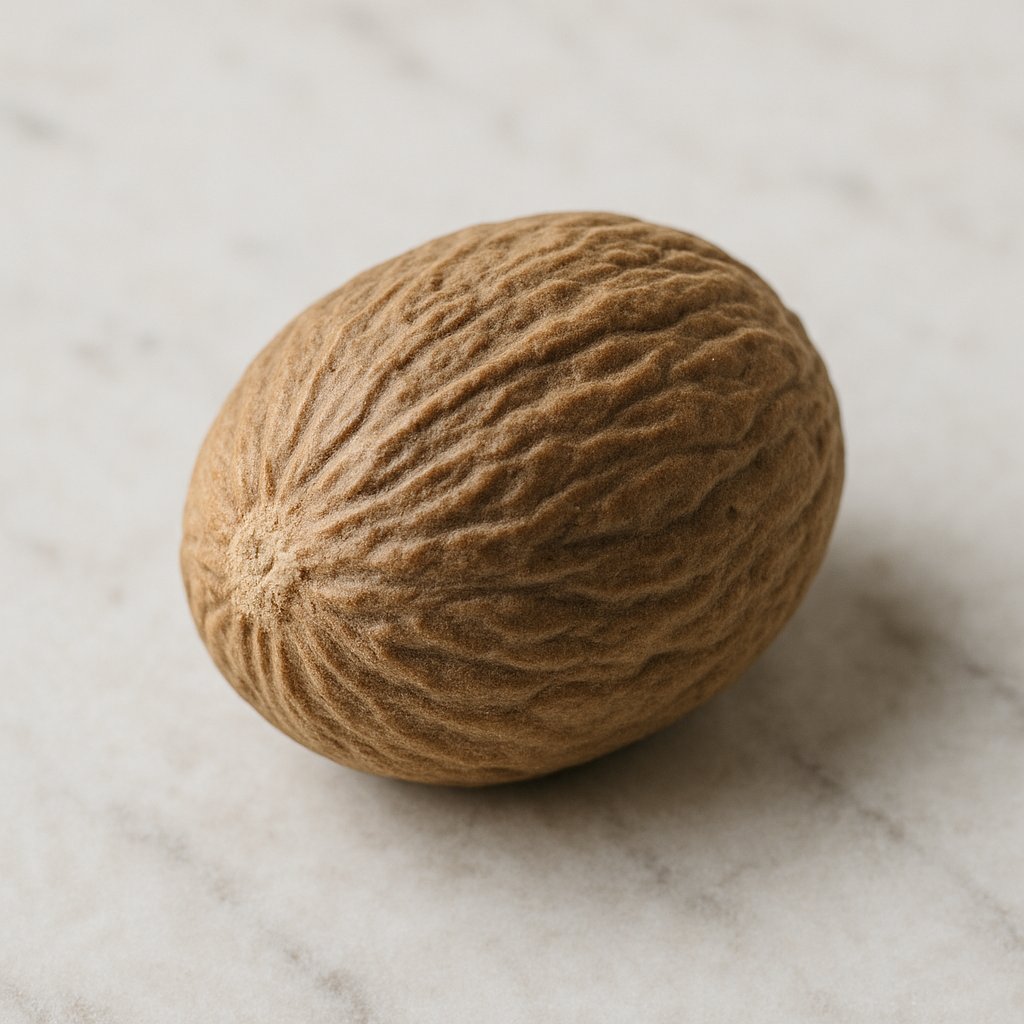
  • Whole nutmeg – this is the hard, round kernel inside the fruit. Its appearance and shape can be compared to a small almond, only firmer. Many cooks grate the whole nut fresh because freshly grated nutmeg tastes more intense.
  • Ground nutmeg – nutmeg that has already been finely ground and looks like a powder. This is practical and saves time in cooking, but the aroma dissipates faster than with the whole nut.
  • Mace (nutmeg aril) – this is the thin, red covering that surrounds the nutmeg. When dried it looks like an orange, net-like fragment. Mace has a similar but somewhat finer taste than the nut. Sometimes it is packaged separately and sold on its own.
  • Nutmeg essential oil – this is a concentrated extract or fragrance obtained from the nut. It is rarely used directly in the kitchen and more often used in the food industry or perfumery. Important: it is very strong and should not be used casually.
How to recognize good nutmeg products?
Good nutmegs are usually heavy for their size and not porous or brittle. Freshly ground nutmeg smells intense. For ground nutmeg the best-before date helps: the fresher, the better the flavor. Mace is easy to recognize by its net-like form and orange-reddish color.

Availability in retail
Nutmeg is available in supermarkets, spice shops and online. Whole nuts are often found in glass jars or small bags, ground nutmeg in spice tins. People who like to cook often take the whole nut and grate it fresh — that way the dish tastes more intense. Ground nutmeg is practical for quick recipes.

In summary: nutmeg comes from warm countries, there is whole nutmeg, ground nutmeg, the red nutmeg aril (mace) and sometimes nutmeg oil. You can find nutmeg almost everywhere — the decisive factor is whether you prefer the convenient ground variant or the fresh, whole nut for stronger flavor.
Details & nutrition

Property Value
Unit g
Average weight per piece 5
Calories per 100 525
Protein per 100 5.8
Carbohydrates per 100 49.3
Sugar per 100 2.9
Fat per 100 36.3
Saturated fat per 100 25.9
Monounsaturated fat 3.0
Polyunsaturated fat 0.4
Fiber per 100 20.8
Vitamin C (mg) per 100 3.0
Vitamin D (IU) per 100 0
Calcium (mg) per 100 184
Iron (mg) per 100 3.0
Nutri-Score D
CO₂ footprint 6.0
Origin Tropical and subtropical growing regions, especially Indonesia, India and the Caribbean
Gluten-free Yes
Lactose-free Yes
Nut-free Yes
Vegan Yes
Note Nutmeg is a very aromatic spice and should be used only in small amounts. The nutritional values refer to dried, ground nutmeg.

Technical & scientific information

Nutmeg (Botanical: Myristica fragrans) is the dried seed or seed-cover product of an evergreen tropical tree in the family Myristicaceae. Botanically one distinguishes between nutmeg (the brown, round seed) and nutmeg aril / macis (the red, net-like seed covering, also called macis); both parts come from the same fruit. Nutmeg has been used for centuries as a spice and in traditional medicine and has been chemically well studied because of its distinctive aroma and psychoactive potential.

Chemical composition and constituents
The characteristic spiciness is based on a complex mixture of volatile and non-volatile compounds. Dominant volatile components include terpenes such as α-pinene, β-pinene, sabinene and myristicin. Myristicin, a phenylpropanoid, is responsible in small amounts for the typical aroma and shows psychotropic effects at higher doses. Other important constituents are elemicin, safrole (in traces), essential oil overall (typically 5–15 % in the whole nut), fixed oil (up to 25–40 %), proteins, carbohydrates and fiber. The fixed oil consists mainly of triglycerides with saturated and monounsaturated fatty acids.

Nutritional values
Nutmeg provides per 100 g an energy- and nutrient-rich material, mainly from fat and carbohydrates. Typical nutritional values are about 500–525 kcal per 100 g, fat content around 30–35 g, carbohydrates about 50–55 g (with a significant portion being fiber) and small amounts of protein (≈5–6 g). Micronutrients include moderate amounts of vitamin B6, folate, iron, calcium and magnesium. Because of the high energy density, nutmeg is used in the kitchen in very small amounts.

Processing methods
Traditional processing begins with harvest and slicing of the ripe fruit. The red seed covering (macis) is removed and dried, which preserves its typical aroma and bright color. The seeds are taken from the fruit husk, dried and externally hardened until the brown seed coat cracks; after that the hard outer shell is removed to reveal the lighter, aromatic kernel. Nutmeg is traded whole, ground or as essential oil and butter (nutmeg butter). Grinding increases surface area and leads more quickly to aroma loss; therefore whole nuts retain their aroma significantly longer.

Sensory properties and applications
Sensory-wise nutmeg is characterized by warm, slightly sweet, nutty and woody notes with spicy nuances. It is used in small amounts in soups, sauces, baked goods, vegetable dishes and beverages. Macis offers a similar but finer aroma and is often used in more delicate dishes.

Health aspects and toxicity
In culinary amounts nutmeg is generally regarded as safe. Due to its content of myristicin and elemicin, consumption of large amounts (typically several grams of nutmeg) can lead to adverse effects. Symptoms of intoxication include nausea, vomiting, tachycardia, dizziness, hallucinations, delirium and, in rare cases, seizures. Onset of effects usually occurs several hours after ingestion, and effects can last 24–48 hours. Chronic or intentional high intake is risky and not recommended. Pregnant women should avoid excessive consumption, as there are indications of uterotonic effects.

Safe use and storage
For kitchen use it is recommended to store whole nuts in an airtight container in a cool, dark place. Ground nutmeg loses aroma quickly and should be used in small amounts and consumed rapidly. Therapeutic uses or taking high doses should be done only under professional supervision.

Research and regulatory notes
Research is currently investigating the pharmacological properties of individual components such as myristicin regarding antimicrobial, antioxidant and neuroactive effects, although clinically established applications are still limited. Some constituents are monitored because of their potential for misuse; therefore there are warnings in certain contexts, but no general bans for food use.

Overall nutmeg is a versatile spice with a complex chemical composition, a distinctive aroma and well-documented dose-dependent effects. When used properly it enriches culinary preparations, while excessive consumption carries health risks.

Wiki entry for: nutmeg
Active now: 21 visitors of which 2 logged-in members in the last 5 minutes