Menu & categories

Multi-vitamin juice

Fruity mixed fruit juice with added vitamins

Wiki about multivitamin juice Nutri-Score B Vegan Yes Gluten-free Yes Lactose-free Yes Nut-free Yes
NUTRITION / 100 ml
50 kcal 0.3 g Protein 11.5 g Kohlenhydrate 0.1 g Fett

Introduction

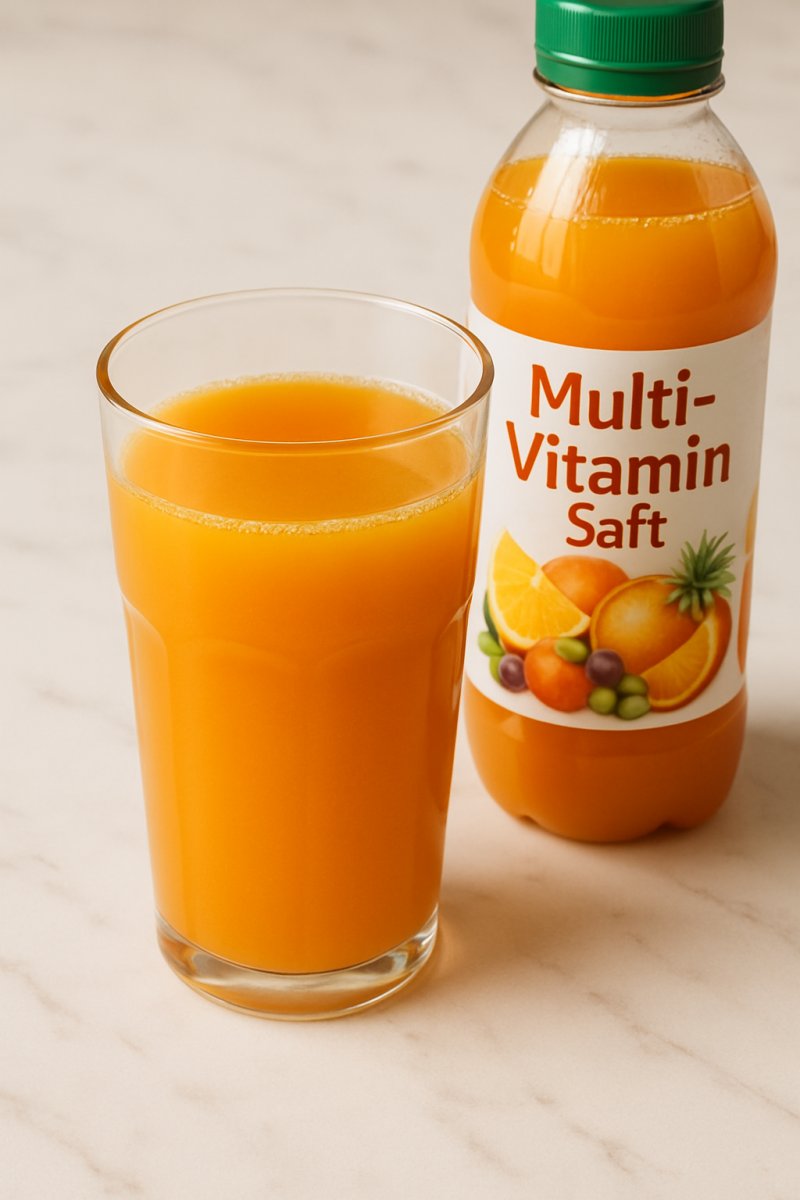
Glass of multi-vitamin juice with assorted fruits
I still clearly remember the morning I first deliberately reached for a multi-vitamin juice: it was a rainy day and my energy level felt like sluggish raindrops. A colleague had placed a small bottle on my desk with the words, "Try this, it will perk you up." I took a sip and was surprised by the clear, fruity tartness and the light tingling on my tongue. That first experience piqued my curiosity and set me off on a small journey of discovery through the taste, composition and everyday suitability of such juices.

To me a multi-vitamin juice is not just a drink but a practical companion for hectic days. It often combines several vitamins and minerals in one serving and promises a quick, tasty intake. Formulations vary widely: some juices focus on vitamin C, B vitamins and zinc for the immune system, others add vitamin D or iron. I learned to read labels like recipe cards — paying attention helps avoid overlapping nutrients and pick exactly what the body needs at the moment.

I also appreciate the versatility: a multi-vitamin juice can serve as a quick energy boost in the morning, end up in a bag on the go, or complement a light breakfast. I recall a weekend trip when the bottles in the backpack helped plug energy gaps and paired surprisingly well with mineral water or as a splash in smoothies.

Of course there are also critical aspects I don't want to hide. Not every juice has the same bioavailability, sugar content and dosing. Sometimes less is more, and a balanced diet remains the foundation. Still, I value the simple, enjoyable way to supplement nutrients — especially on days that call for quick support.

  • Taste: Fruity, often lemony or berry-forward.
  • Contents: Typically vitamin C, B vitamins, zinc, sometimes vitamin D.
  • Benefit: Convenient nutrient supplementation for on-the-go and energy shortfalls.
  • Caution: Watch sugar content and dosing instructions.
In the end I see multi-vitamin juice as a friendly, uncomplicated solution in everyday nutrition: not a miracle cure, but a tasty helper I like to keep in my kitchen.

Availability & types

Availability and types

What is multi‑vitamin juice and where does it come from?
Multi‑vitamin juice is a beverage made from pressing or blending various fruits and often contains added vitamins. The individual fruits come from many parts of the world. Oranges and grapefruits frequently grow in warm countries such as Spain, Italy, Brazil or Mexico. Apples often come from Europe, the USA or New Zealand. Mangoes, pineapples and papayas are cultivated in tropical regions like India, Thailand or Costa Rica. The fruits are harvested, processed in factories and pressed into juice. You can imagine it like a big puzzle: many pieces (that is, fruits) from different countries are put together so that in the end a colorful, vitamin-rich juice is produced.

Where can you buy multi‑vitamin juice?
Multi‑vitamin juice is very easy to find. You can buy it in supermarkets, discount stores, organic shops and even in some drugstores. It comes in glass or plastic bottles and in cartons. Sometimes it's also offered fresh in cafes or juice bars where the fruit is pressed on site. If you look at the label you can often see which fruits are included and whether extra vitamins have been added.

What varieties and options are there?
Multi‑vitamin juices come in many variants so there is something for every taste. Here are the most common types, simply explained:

  • Not-from-concentrate (direct) juice
    This is juice that is pressed directly from the fruit and has not been diluted with water. It often tastes stronger and more natural, like freshly pressed orange juice.
  • From concentrate
    For this juice the water is removed from the fruit juice to make it smaller to transport. Later water is added back to the juice. This is practical for long transports, and in terms of taste it can still be very good.
  • Fortified with additional vitamins
    Some multi‑vitamin juices have extra vitamins such as vitamin C or D. It's like giving the juice a dose of superpower. These variants are popular when people want to pay particular attention to their vitamin intake.
  • With or without pulp
    Some juices contain pulp (those small pieces of fruit) and feel thicker in the mouth. Others are completely clear and smooth, without pieces.
  • Organic juices
    Organic multi‑vitamin juices come from fruits grown without synthetic pesticides and with greater regard for the environment. They are often somewhat more expensive because the farmers have more work.
  • Light or reduced‑sugar variants
    These juices contain less sugar or are made with sweeteners. They are an alternative for people who watch their sugar intake.
  • Fresh‑pressed vs. long‑life
    Fresh‑pressed juice should be consumed quickly because it does not stay fresh for long. Long‑life juices are treated specially to be shelf‑stable — it's like preserving food so it can still be good later.
Simple tip for choosing
If you want to pick a juice, look at the label: which fruits are in it, does it say "with extra vitamins", is it organic or sugar‑reduced? That way you can easily find the juice that matches your taste and needs. Multi‑vitamin juices are therefore versatile: they come from many countries, are available in many varieties and suit different preferences — so everyone can find the right juice for everyday life.
Details & nutrition

Property Value
Unit ml
Calories per 100 50
Protein per 100 0.3
Carbohydrates per 100 11.5
Sugar per 100 11.5
Fat per 100 0.1
Saturated fat per 100 0.02
Monounsaturated fat 0.02
Polyunsaturated fat 0.03
Fiber per 100 0.2
Vitamin C (mg) per 100 30
Vitamin D (IU) per 100 80
Calcium (mg) per 100 10
Iron (mg) per 100 0.3
Nutri-Score B
CO₂ footprint 0.18
Origin Depending on the manufacturer, mostly EU
Gluten-free Yes
Lactose-free Yes
Nut-free Yes
Vegan Yes
Note Values refer to the typical commercial multi-vitamin mixed fruit juice with added vitamins; exact nutritional values may vary by manufacturer.

Technical & scientific information

Multi‑vitamin juice refers to a liquid food product that contains several vitamins in combination with fruit juices, water, sugar or sweeteners. Such juices are produced industrially to provide an easily consumable source of water‑soluble and fat‑soluble vitamins. The composition varies by manufacturer, target product group and legal labeling, but commonly includes vitamins such as vitamin C (ascorbic acid), B‑vitamin complex (e.g. B1, B2, B3, B5, B6, B12, folic acid) and occasionally vitamin A, vitamin D and vitamin E.

Chemical composition and ingredients: A multi‑vitamin juice is chemically a mixture of organic compounds, including sugars (glucose, fructose, sucrose), organic acids (e.g. citric or ascorbic acid), flavorings and colorants as well as the added vitamin compounds. Vitamins occur in different chemical forms: ascorbic acid (vitamin C) is itself a water‑soluble organic acid; B vitamins are a heterogeneous group, mostly water‑soluble nutrients with specific functional groups; fat‑soluble vitamins such as A, D and E are emulsified in suitable carriers or used as esters (e.g. retinyl acetate, D‑cholecalciferol, α‑tocopherol acetate) to improve stability and solubility.

Nutritional profile: The nutritional value of a multi‑vitamin juice derives from the macronutrients and the added micronutrients. Typical values per 100 ml may include:

  • Energy: 10–60 kcal, depending on sugar content.
  • Carbohydrates: 2–15 g, mostly listed as sugars.
  • Fat: usually negligible, except in emulsified products with fat‑soluble vitamins.
  • Protein: typically negligible.
  • Vitamins: percentage of the recommended daily intake (RDA/NRV) varies widely; some products provide 25–100% or more of the RDA per serving.
Processing methods: Manufacture involves juice extraction, cleaning, blending, fortification and filling. During fortification, water‑soluble vitamins are mixed directly into the aqueous phase, while fat‑soluble vitamins are formulated as oil‑in‑water emulsions or dissolved as alcoholic/oily solutions before addition. Pasteurisation or heat treatment is used for microbial stability but can partially degrade heat‑sensitive vitamins. Therefore manufacturers use gentle methods such as short‑time pasteurisation, aseptic processing or HPP (High Pressure Processing) to preserve nutrients and sensory properties. Stabilizers, antioxidants (e.g. ascorbic acid itself or sodium ascorbate) and acidity regulators are also used to minimise oxidation and degradation.

Stability and bioavailability: Vitamin stability in the juice depends on pH, light, temperature, oxygen ingress and matrix components. Vitamin C is light‑ and heat‑sensitive and prone to oxidation; B vitamins have varying sensitivities; fat‑soluble vitamins require appropriate carriers to remain homogeneously distributed in the water‑based juice. Bioavailability refers to the proportion of a vitamin that is utilised by the body after ingestion. In liquid matrices the uptake of many water‑soluble vitamins is generally good; for fat‑soluble vitamins absorption is improved by the presence of a fat source. Interactions between nutrients, for example between vitamin C and iron, can affect absorption.

Health aspects: Multi‑vitamin juices can help cover micronutrient gaps, particularly in individuals with increased needs, limited food intake or certain risk groups. Regular consumption can improve intake of essential vitamins but does not replace a balanced diet. Overdoses are rare for water‑soluble vitamins but can occur with high‑dose preparations; fat‑soluble vitamins can become toxic with excessive consumption. Sugar content should also be considered, as frequent consumption can increase calorie and sugar intake and affect dental health and metabolism.

Regulatory and labelling aspects: In many jurisdictions added vitamins and their amounts must be declared on the label. Manufacturers are required to provide dosages, nutritional information and, where applicable, warnings (e.g. for pregnant women). Quality controls using chromatographic techniques (HPLC) and spectrometric methods are employed to demonstrate the purity, content and stability of vitamins.

Overall, multi‑vitamin juice is a functional food category that uses technical formulations and processing techniques to combine multiple vitamins into a palatable beverage. Scientific considerations about stability, bioavailability and health benefits influence formulation and manufacturing, while consumer information obligations ensure transparent declaration.

Wiki entry for: multivitamin juice
Active now: 15 visitors of which 2 logged-in members in the last 5 minutes