Menu & categories

Marsala

Aromatic fortified wine from Sicily for cooking and flavoring.

Wiki about Marsala Nutri-Score D Vegan No Gluten-free Yes Lactose-free Yes Nut-free Yes
NUTRITION / 100 ml
170 kcal 0.1 g Protein 12.0 g Kohlenhydrate 0.0 g Fett

Introduction

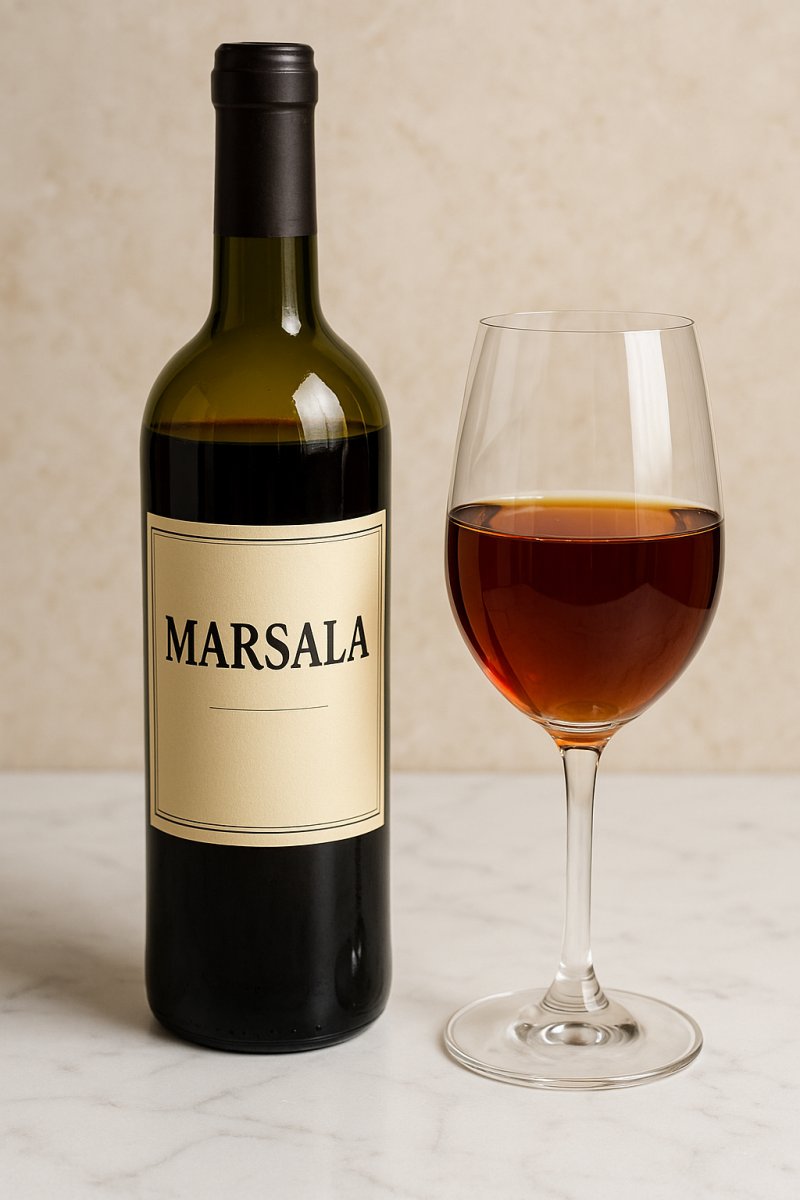
Glass of Marsala (Italian fortified wine)
I still remember the first scent of Marsala that greeted me in a tiny trattoria in Palermo: a sweet, nutty warmth that recalled both raisins and oak. From then on Marsala was no longer just an ingredient for me, but a small Italian secret that instantly gives dishes depth. I love how a splash of this fortified wine rounds sauces and makes desserts more elegant without being intrusive.

What makes Marsala so exciting is its versatility. It comes from Sicily, is a fortified wine and is offered in different styles: secco, semisecco and dolce, plus the color nuances amber and gold. Once I accidentally poured a sweet bottle into a savory mushroom sauce and was surprised how harmoniously the sweetness embraced the earthy aromas. A friend just grinned and called it 'happy accident'.

I'm happy to give practical tips briefly, because they really help when cooking:

  • For cooking: Drier Marsalas work better for savory sauces, sweeter ones for desserts.
  • For drinking: Aged Marsalas can be surprisingly complex when enjoyed as a dessert wine.
  • As a substitute: Madeira or an aged Sherry work if Marsala isn't in the cupboard.
I often tell the story of a colleague in our kitchen who once opened a bottle of 'cooking Marsala' with added sugar and made us all wrinkle our noses — it wasn't a disaster, but a lesson: good quality pays off. Good Marsala is not a sweetener but a wine with character and history. It pairs equally well with mushrooms, poultry, caramelized onions and panna cotta.

In the end Marsala for me is a little all-rounder that slips into any recipe with a wink and often provides the decisive final touch. When I leave my kitchen, the memory of that scent remains — a bit of wine, a bit of Sicily and a promise of more experiments at the stove.

Availability & types

Availability and types of Marsala

Marsala is a special wine from Italy, more precisely from the area around the town of Marsala on the island of Sicily. You can think of it a bit like a brand: the name indicates not only how the wine tastes but also where it comes from. Marsala became known over 200 years ago when merchants from England began bringing it north. Today it is mainly grown in the warm vineyards of western Sicily.

Where exactly does it come from?
The grapes grow mainly in the valleys and hills around the town of Marsala and in the province of Trapani. The climate there is warm and sunny, which helps the grapes to accumulate a lot of sugar. The most important grape varieties for Marsala are Grillo, Inzolia (also called Ansonica) and Catarratto. Sometimes red grapes are also used, but mostly these white varieties are used.

How is Marsala available?
You can find Marsala in several variants, similar to how tea or juice can be sweet or unsweetened. In shops there are two main ways to buy Marsala:

  • In the supermarket or wine shop: Here you often find simple bottles for the kitchen. These are practical and sometimes cheaper, but they can also contain additives like salt — these are the so-called 'Cooking Wines'.
  • In a specialist shop or from a wine merchant: There you will find the classic quality wines without additives. These bottles are better suited for drinking and often have more precise information about variety and ageing.
What types (varieties) are there?
Marsala is distinguished mainly by two things: how sweet it is and how long it has been aged. Here is a simple overview:

  • By sweetness:
    • Secco – dry, little sweetness;
    • Semisecco – semi-dry, somewhat sweeter;
    • Dolce – sweet, tastes almost like a treat.
  • By ageing:
    • Fine – short-aged, fresh in taste;
    • Superiore – aged longer, rounder;
    • Riserva – aged for several years, very complex flavour;
    • Vergine / Stravecchio – very long wood ageing, particularly noble.
Simply put: sweetness is like in juice (some prefer it sugary), and ageing is like with cheese or bread — the longer it is, the more intense the flavour becomes. For cooking you often reach for sweeter variants (e.g. for desserts) or basic bottles, while for drinking you prefer a 'Superiore' or 'Vergine'.

Practical notes on availability:
In Europe and in larger cities worldwide Marsala is usually fairly easy to find. In smaller towns it can be rarer. If you can't get Marsala, similar wines like Sherry or Madeira work as substitutes. When buying, pay attention to whether it is a genuine Marsala without additives or a cooking wine with additives, especially if you intend to drink it.
Details & nutrition

Property Value
Unit ml
Calories per 100 170
Protein per 100 0.1
Carbohydrates per 100 12.0
Sugar per 100 10.0
Fat per 100 0.0
Saturated fat per 100 0.0
Monounsaturated fat 0.0
Polyunsaturated fat 0.0
Fiber per 100 0.0
Vitamin C (mg) per 100 0.0
Vitamin D (IU) per 100 0
Calcium (mg) per 100 5
Iron (mg) per 100 0.2
Nutri-Score D
CO₂ footprint 0.17 kg CO2e/100 ml
Origin Italy (Sicily)
Gluten-free Yes
Lactose-free Yes
Nut-free Yes
Vegan No
Note Marsala is a fortified wine; nutritional values vary depending on sweetness level (secco/semisecco/dolce) and alcohol content.

Technical & scientific information


Marsala is a traditional fortified wine from the area around the town of Marsala in Sicily. It is one of the typical Italian specialties and is used both as a drink and as a cooking ingredient. Marsala is made from white and occasionally red grape varieties of the region and is characterized by a wide aromatic spectrum, ranging from fruity notes to pronounced oxidative nuances that arise from ageing in wooden casks.

Production and processing methods
The production of Marsala includes the classic winemaking stages: harvest, maceration or pressing, alcoholic fermentation and subsequent enrichment with neutral grape spirit (fortification). Fortification can occur during fermentation to retain some residual sugar, or after fermentation to stabilise the alcohol content. Determining factors for the final profile are the grape varieties, the timing of fortification, filtration and clarification procedures, and ageing. Typically ageing takes place in oak or chestnut casks; during prolonged oxidative ageing characteristic aromas of nuts, dried fruit and caramel develop.

Types and ageing
Marsala is offered in different quality and taste levels determined by ageing duration and residual sugar content. Common designations differentiate between dry (secco), semi-dry (semisecco) and sweet (dolce) expressions as well as maturity grades that require shorter to longer cask ageing. The longer the oxidative ageing, the more complex and rounded the aromatic profile becomes.

Chemical composition and constituents

  • Ethanol: Marsala is a fortified wine with an alcohol content typically in the range of about 15–20% vol., depending on style and fortification.
  • Residual sugar and carbohydrates: The residual sugar content varies by type; it significantly influences taste and calorie content.
  • Acids: Sensory properties are mainly shaped by wine acids such as tartaric acid (L-(+)-tartaric acid), malic acid and lactic acid, as well as by total acidity (titratable acidity).
  • Glycerol and fermentation by-products: Glycerol, various sugar alcohols, higher alcohols and volatile esters contribute to mouthfeel and bouquet.
  • Polyphenols and aroma compounds: Phenolic compounds, aroma sterols and oxidative breakdown products are responsible for colour, bitterness and oxidative aromas.
  • Sulphur dioxide (SO2): Is used in controlled amounts as an antioxidant and preservative; declarable traces are common.
Nutritional values and energy content
The caloric content of Marsala varies greatly with alcohol and sugar content. Roughly estimated, 100 ml of Marsala provides between 120 and 200 kcal. Alcohol provides about 7 kcal per gram; sugar adds about 4 kcal per gram. Micronutrients are not present in significant amounts; the wine provides small amounts of minerals and organic acids.

Health aspects
Marsala contains ethanol, which at moderate consumption can be perceived as relaxing in the short term, but in the long term is associated with health risks, including liver burden and increased cancer risk. Sulfite-sensitive individuals should pay attention to the sulphur dioxide content. Biogenic amines such as histamine can also be present in small amounts and may trigger reactions in sensitive persons. The polyphenols contained in wine show antioxidant activity in vitro, but the health risks of alcohol outweigh a simple health recommendation.

Use and storage
Marsala is suitable for direct enjoyment, to refine sauces and desserts and for flambéing. When heated, alcohol partly evaporates, causing flavour concentration and sweetness to increase relatively. Open bottles retain quality for several weeks to months when stored cool and well sealed, although oxidative aromas may increase.

Overall, Marsala is a technically and sensorially complex product whose character is determined by grape variety, fortification, oxidative ageing and chemical composition. Knowledge of the composition is helpful to classify sensory properties, nutritional values and health effects and to plan the correct use in the kitchen and cellar.

Wiki entry for: Marsala
Active now: 14 visitors of which 2 logged-in members in the last 5 minutes