Menu & categories

Macadamia nuts

Particularly high‑fat, buttery‑nutty tree nuts with a high energy content

Wiki about macadamia nut Nutri-Score D Vegan Yes Gluten-free Yes Lactose-free Yes Nut-free No
NUTRITION / 100 g
718 kcal 7.9 g Protein 13.8 g Kohlenhydrate 75.8 g Fett

Introduction

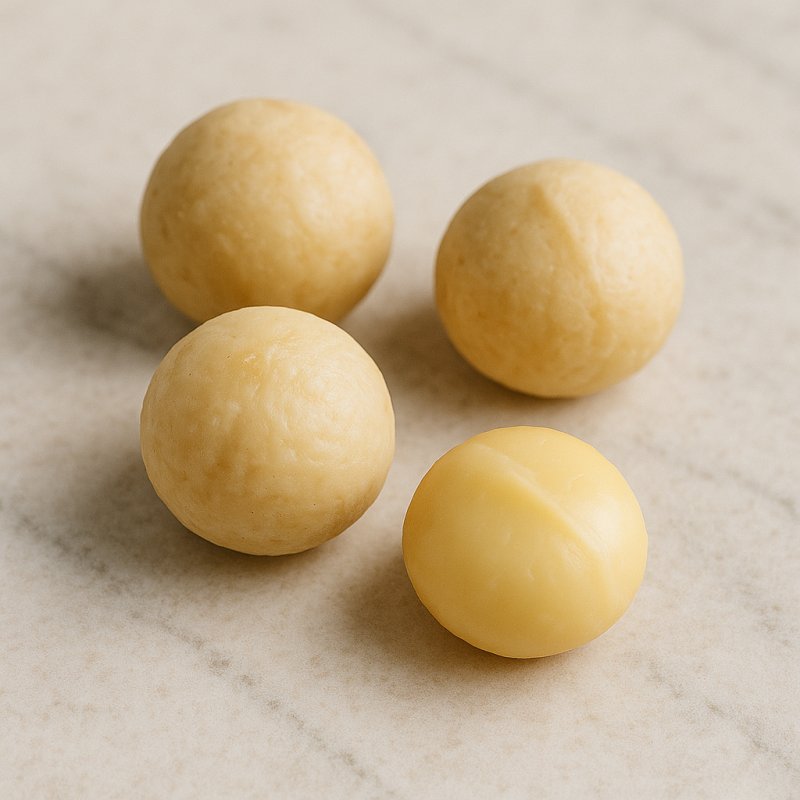
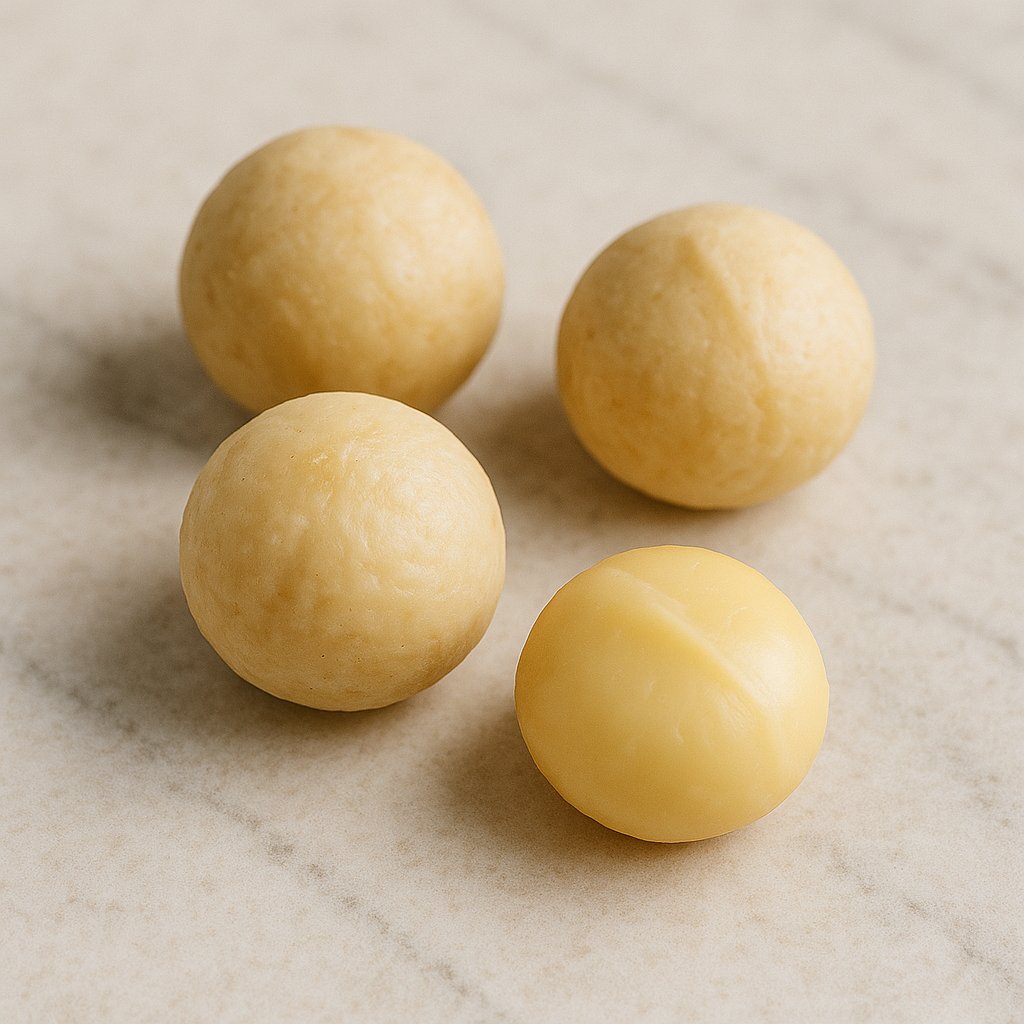
Bowl with whole and shelled macadamia nuts
When I have a bowl of nuts in front of me, I instinctively reach first for the macadamia nuts. These almost indecently buttery, round kernels have something luxurious about them without shouting: “I am a luxury product!” – they whisper it instead. I still remember my first real contact with macadamias: in a tiny café, somewhere between designer furniture and an overpriced Flat White, there was on my plate a still-warm cookie with white chocolate chips and coarsely chopped macadamia nuts. After the first bite I knew: this ingredient needs a permanent place in my kitchen.

Macadamia nuts originally come from Australia and are today mainly grown in regions like Hawaii, South Africa and Kenya. The trees are a bit diva-like: demanding, slow-growing and not particularly productive. Perhaps that is precisely why they are so precious. Behind the creamy texture is a high proportion of unsaturated fatty acids, plus fiber, some protein and minerals like magnesium. They are not diet miracles, but one of those ingredients that make me think: if fat, then please like this.

In my kitchen macadamia nuts have long been more than just a snack. I use them:

  • chopped into cookie dough with white or dark chocolate
  • lightly toasted as a topping for salads, for example with arugula, pear and goat cheese
  • as a creamy macadamia paste for porridge, bowls or as a spread
  • finely ground in shortcrust tart doughs or cheesecake bases
  • in a savory coating for fish or vegetables
A colleague of mine swears by simply roasting macadamias in the oven with a little coarse sea salt and then snacking them straight off the baking tray. Every time I copy him I ask myself why I ever bought chips. The scent that fills the kitchen is a mix of fresh butter, caramel and a hint of tropical holiday mood.

It is practical that macadamia nuts keep for a long time if stored correctly. In a well-sealed jar, kept dark and relatively cool, they remain aromatic for months. I sometimes even freeze them when I get hold of larger quantities. The only important thing is to roast them fresh or warm them briefly in a pan before they go into a recipe – then they develop their full aroma. That way small, inconspicuous kernels become real stars that make simple dishes special without me having to stand in the kitchen for hours.

Availability & types

Macadamia nuts can now be found in many supermarkets, but they originally come from quite far away. The first macadamia trees grew in Australia, more precisely in the eastern part of the country, in warm and humid regions. There the indigenous people of Australia, the Aborigines, discovered these nuts long ago and ate them as a valuable energy source. Later European settlers brought the plants to other countries with similarly warm climates. This is how cultivation gradually spread around the world.

Today macadamia nuts are mainly cultivated in countries with tropical or subtropical climates. That means: it is usually warm, often humid, and there is no real winter with frost. Among the most important growing regions are:

  • Australia – the country of origin, still one of the largest producers.
  • Hawaii (USA) – macadamias became particularly well known here; many people still associate the nut with Hawaii.
  • South Africa – one of the major producing countries, with many plantations.
  • Kenya and other countries in East Africa – the trees grow well in higher, warm areas there.
  • Latin America – for example Brazil, Guatemala and Costa Rica.
  • parts of Asia – such as China and Thailand, where the climate is suitable.
For macadamia trees to grow well they need plenty of sun, sufficient rain and a soil that drains well so the roots do not stand in “mud”. A macadamia tree needs several years before it yields many nuts. You can imagine it like an apple tree: at first it is small and needs care, and after a few years it bears more and more fruit. The nuts sit inside very hard shells, which are again surrounded by a green husk. This hard shell is one of the reasons why macadamia nuts are often more expensive than other nuts – cracking them requires special machines and a lot of energy.

There are different species of macadamia trees. For consumption two species are particularly important:

  • Macadamia integrifolia – originally from Australia; it yields particularly mild, creamy nuts and is widely cultivated.
  • Macadamia tetraphylla – also from Australia; the nuts are often a bit firmer in the bite and sometimes have a slightly stronger aroma.
Many plantations also grow hybrids, that is crosses of different species. You can imagine it like dog breeds: two different varieties are mixed so that the offspring have certain good traits, for example higher yield, better resistance to disease or especially good nut quality. For us in the shop this difference is usually not visible – the package usually just says “macadamia nuts”.

In trade macadamia nuts are available in several forms and variants. The main ones are:

  • whole nuts – usually already shelled; they look round and ivory-coloured and are suitable as a snack or for decorating cakes.
  • halves or pieces – often used for baking or cooking when appearance is not so important, for example in cookies or mueslis.
  • salted and roasted – very popular as a snack; the nuts are heated (roasted) to make them more aromatic and then seasoned with salt.
  • sweetened or coated – for example coated with honey, sugar or chocolate; this turns them into a sort of confectionery.
  • macadamia oil – pressed from the nuts; it tastes mildly nutty and is used in cooking but also in cosmetics because it feels pleasant on the skin.
  • macadamia paste – a creamy paste made from finely ground nuts, similar to peanut butter; it can be spread on bread or used in desserts.
Depending on the region and shop, macadamia nuts are more or less readily available. In large supermarkets and drugstores they are usually found year-round, often on the shelf with other nuts or with baking ingredients. Health food stores often also carry organic macadamias, where certain rules are followed during cultivation, for example avoiding chemical pesticides. In some countries where macadamias are grown you can even buy them fresh or still in the shell at weekly markets. In other regions they are more of a special ingredient, something you do not buy every day but rather for special occasions or as a small luxury item. Overall, although macadamia nuts originate in distant, warm countries, worldwide trade has brought them into many kitchens around the world and they are relatively easy to obtain in various forms and varieties.
Details & nutrition

Property Value
Unit g
Average weight per piece 2.5
Calories per 100 718
Protein per 100 7.9
Carbohydrates per 100 13.8
Sugar per 100 4.6
Fat per 100 75.8
Saturated fat per 100 12.1
Monounsaturated fat 59.3
Polyunsaturated fat 1.5
Fiber per 100 8.6
Vitamin C (mg) per 100 1.2
Vitamin D (IU) per 100 0
Calcium (mg) per 100 85
Iron (mg) per 100 3.7
Nutri-Score D
CO₂ footprint 5.0
Origin Australia, South Africa, Kenya
Gluten-free Yes
Lactose-free Yes
Nut-free No
Vegan Yes
Note Nutritional values refer to raw, unsalted macadamia nuts without shell. Very energy-dense due to the high proportion of monounsaturated fatty acids.

Technical & scientific information

Macadamia nuts are the oil-richest edible seeds from the family Proteaceae and mainly come from the species Macadamia integrifolia and Macadamia tetraphylla. Botanically they are not true nuts but hard-shelled drupes. Native to the rainforests of eastern Australia, macadamias are today cultivated especially in Australia, Hawaii, South Africa and Central America. Due to their high fat content and their fine, buttery aroma, they are considered a premium ingredient in cooking and the food industry.

The macadamia nut has a very hard, woody shell that is surrounded by a green, fleshy fruit hull. After harvest this hull is removed mechanically, then the nuts are cleaned, dried and usually cracked mechanically. The edible kernel is cream-coloured, firm yet meltingly tender. The exceptional hardness of the shell requires special cracking machines, which is why macadamia nuts are more elaborate to process and correspondingly more expensive than other nuts.

Characteristic of macadamias is their very high fat content of about 70 to 78 percent of dry matter. The predominant share consists of monounsaturated fatty acids, especially oleic acid (C18:1) and palmitoleic acid (C16:1). Saturated fatty acids like palmitic acid are also present but make up a smaller proportion. The content of polyunsaturated fatty acids (e.g. linoleic acid) is moderate compared with other nuts. This fatty acid composition leads to relatively good oxidation stability of the oil and contributes to the long shelf life of the kernels, provided they are stored cool and protected from light.

Macadamias contain on average about 7 to 9 percent protein. The protein profile includes essential amino acids such as leucine, isoleucine and valine, but the overall protein content is lower than that of almonds or peanuts. The carbohydrate content is comparatively low at around 5 to 8 percent, part of which is present as fiber. For this reason macadamias are of interest in the context of low-carbohydrate dietary approaches.

With regard to micronutrients, macadamias are a relevant source of several vitamins and minerals. Particularly noteworthy are:

  • vitamin B1 (thiamine), which plays a central role in carbohydrate metabolism and nervous system function.
  • vitamin B6, important for amino acid metabolism and neurotransmitter synthesis.
  • niacin equivalents, which are involved in numerous redox reactions.
  • vitamin E in the form of tocopherols, which act as antioxidants protecting cell membranes from oxidative stress.
  • minerals such as magnesium, potassium, phosphorus and smaller amounts of calcium and iron, which are relevant for muscle, nerve and bone metabolism.
The energy content of macadamia nuts is around 700 to 750 kilocalories per 100 grams, making them a very energy-dense food. Due to the high fat content and the simultaneously present fiber, however, they lead to relatively slow gastric emptying and can produce a longer-lasting feeling of satiety. In moderate amounts macadamias can therefore be used as an energy-rich snack or as an ingredient in mueslis, baked goods and savory dishes.

In processing, macadamias are often dry roasted or oil roasted to intensify aroma and texture. There are also salted, spiced or chocolate-coated variants. The macadamia oil obtained from the kernels is used both in food production and in cosmetics. It is characterised by a light colour, mild flavour and a high concentration of monounsaturated fatty acids, making it suitable for salad dressings and gentle cooking methods. In cosmetics it serves as a nourishing ingredient in skin and hair products, as it is well absorbed and supports the skin’s lipid barrier.

From a nutritional point of view macadamia nuts can have favourable effects on lipid metabolism when consumed as part of a balanced diet. The high concentration of monounsaturated fatty acids has been associated with reductions in LDL cholesterol and possible increases in HDL cholesterol. They also provide antioxidant compounds such as vitamin E and secondary plant substances that may help limit oxidative processes in the body. Nevertheless, the high energy content should be taken into account, particularly for people aiming to reduce weight.

Like other nuts, macadamias can trigger allergic reactions, although they are described as a less frequent allergen compared with peanuts or hazelnuts. Symptoms can range from mild skin reactions to severe systemic reactions. People with known nut allergies should therefore exercise caution. In addition, macadamia nuts are toxic to dogs and can cause neurological symptoms, so they should not be fed to pets.

Overall, macadamia nuts are a high-quality, energy-dense ingredient appreciated for their characteristic taste, particular fatty acid composition and content of vitamins and minerals. They are used in sweet and savoury cooking, in oil production and in cosmetics. If consumed in moderation they can be a useful addition to a varied diet, provided individual intolerances and the high calorie content are taken into account.

Wiki entry for: macadamia nut
Active now: 15 visitors of which 2 logged-in members in the last 5 minutes