Menu & categories

Kefir

Fermented milk beverage with mild acidity and fine effervescence.

Wiki about kefir Nutri-Score B Vegan No Gluten-free Yes Lactose-free No Nut-free Yes
NUTRITION / 100 ml
60 kcal 3.4 g Protein 4.7 g Kohlenhydrate 3.3 g Fett

Introduction

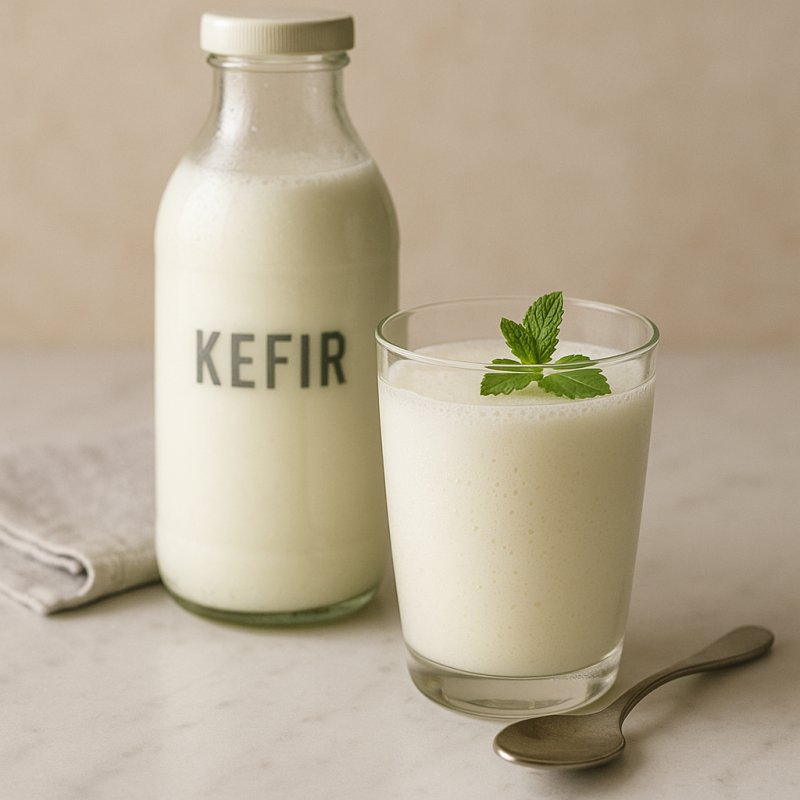
Glass of kefir on a table
I still remember my first sip of Kefir clearly: a slightly tingly, sour drop that felt so audacious and yet cozy, as if whispering to me from long‑forgotten kitchen tables of the Caucasus. A colleague brought a jar to lunch back then, and I, curious as always, tried it — since then this fermented wonder hasn't left me. Kefir is for me both an everyday friend and a small kitchen adventure.

In short: Kefir is made by placing kefir grains — a living community of lactic acid bacteria and yeasts — in milk or sweetened water. After about 24 hours at room temperature you have a creamy, sometimes slightly foamy drink that tickles the tongue and lightly fizzes because of its yeast content. There are variants like milk kefir and water kefir, so people who don't consume milk can enjoy it too.

What I particularly love: kefir is versatile and uncomplicated. A few practical points I've learned:

  • Fermentation time: 12–36 hours, depending on desired sourness.
  • Storage: refrigeration slows the fermentation.
  • Care of the grains: feed regularly, store in fresh milk if needed.
  • Safety: if mold appears discard and start anew.
Kefir is often promoted as probiotic because it contains various microorganisms that can support the gut environment. I've noticed that a small glass in the morning often agrees with my stomach. I also use kefir culinarily: as a base for smoothies, as a yogurt substitute in dressings, for marinating fish or even in pancake batter for extra fluffiness.

A friend of mine swears by kefir in potato salad, another acquaintance drizzles it over hot soup to add a silky acidity. For me kefir remains a lively, unmistakable companion in the kitchen — honest, a bit cheeky and always ready to try something new.

Availability & types

Origin and brief explanation
Kefir originally comes from the Caucasus, a mountainous region between Europe and Asia. There people discovered long ago that milk with small gel‑like beads, the so‑called kefir grains, would naturally become slightly sour and fizzy. This happens through a tiny “collaboration team” of yeasts and bacteria that convert the milk sugars into mild acids and carbon dioxide. You can think of it like sauerkraut: small helpers work there too, only using a different "raw material" than milk.

Where kefir comes from and is produced today
Today kefir is no longer found only in the mountains. It is produced worldwide because people in many countries enjoy its mild, slightly tart flavor. Major producing regions include countries in Europe, Russia, Turkey and many parts of Northern and Eastern Europe. But kefir can also be bought or made in North America, Australia and parts of Asia. The "production areas" are essentially dairies and small farms using cow, goat or sheep milk, as well as fermentation kitchens run by hobbyists.

Common types and variants
Kefir exists in many forms. The most important and common are:

  • Milk kefir from cow's milk – this is the most widespread type. It tastes mild and is often slightly thick, like thin yogurt.
  • Goat or sheep kefir – these varieties are a bit more flavorful or intense. Some people tolerate them better if they have issues with cow's milk.
  • Water kefir – here the kefir grains are placed in sugar water, fruit juice or coconut water. The result is a fizzy, non‑dairy drink resembling lemonade.
  • Flavoured or aromatized kefir – many producers add fruit, honey or vanilla to make it sweeter and more appealing to children.
  • Fat levels – as with dairy products there are full‑fat, semi‑skimmed and low‑fat kefir options.
  • Organic and artisanal kefir – organic kefir comes from animals raised in ecological systems; artisanal kefir often comes from small farms or producers and can taste different from industrial products.
  • Kefir cheese or curd – if kefir is drained for longer, a thicker, spreadable mass forms, similar to fresh cheese.
Where to buy or obtain kefir
Kefir is available in supermarkets, organic shops, health food stores and sometimes at farmers' markets. Many small farms sell fresh kefir directly from the farm. You can also order kefir online — both ready drinks and starter cultures and kefir grains to make it at home. Water kefir is often found in specialty shops or health food stores.

Practical tip
Fresh kefir is usually found in the refrigerated section and does not keep indefinitely. If you make it yourself, the grains can be reused repeatedly, almost like a "living recipe." That way you always get new kefir and the grains multiply over time.

Overall there are many types of kefir — milk and water variants, different milk sources, flavored or plain products as well as artisanal and industrial versions. That makes kefir a flexible ingredient: you can drink it plain, mix it with fruit, use it as a yogurt substitute or in recipes for dressings and baked goods.
Details & nutrition

Property Value
Unit ml
Calories per 100 60
Protein per 100 3.4
Carbohydrates per 100 4.7
Sugar per 100 4.7
Fat per 100 3.3
Saturated fat per 100 2.1
Monounsaturated fat 0.9
Polyunsaturated fat 0.1
Fiber per 100 0.0
Vitamin C (mg) per 100 0.0
Vitamin D (IU) per 100 4
Calcium (mg) per 100 120
Iron (mg) per 100 0.05
Nutri-Score B
CO₂ footprint 1.2 kg CO2e/L
Origin Europe (depending on the manufacturer)
Gluten-free Yes
Lactose-free No
Nut-free Yes
Vegan No
Note Nutritional values may vary slightly depending on fat content (e.g., 1.5% or 3.5%) and production method. Due to fermentation, kefir usually contains less lactose than milk, but is generally not lactose-free.

Technical & scientific information


Kefir is a fermented dairy product produced by the cultivated activity of a complex microbial consortium. Traditionally, so‑called kefir grains are used, in which lactic acid bacteria, yeasts and sometimes acetic acid bacteria are embedded in a polysaccharide‑rich matrix. The result is a slightly acidic, often mildly carbonated beverage with characteristic aroma and variable texture.

Chemical composition and constituents
The basic composition of milk kefir depends on the starting milk; typical constituents are water, proteins (mainly caseins and whey proteins), lipids, minerals and modified carbohydrates. During fermentation some lactose is hydrolyzed by microbial enzymes, notably β‑Galactosidase, reducing lactose concentration and producing glucose and galactose. Fermentation by‑products include organic acids (mainly lactic acid, sometimes acetic acid), small amounts of ethanol, carbon dioxide and various volatile aroma compounds.

Microbiology
Kefir contains a diverse microbiome. Bacterial genera frequently detected include Lactobacillus (e.g. L. kefiranofaciens), Lactococcus, Leuconostoc and Acetobacter; typical yeasts belong to Saccharomyces, Kazachstania or Kluyveromyces. Total viable microorganism counts in fermented products often range from 10^7 to 10^10 CFU per milliliter, while species composition and relative abundances strongly depend on origin, culture management and duration.

Processing methods
Two basic procedures are distinguished:
  • Production with kefir grains: fresh grains are incubated in milk, typically at 18–30 °C for 12–48 hours. Grains are then removed and reused.
  • Starter cultures and industrial processes: standardized starters or freeze‑dried culture mixes enable reproducible products; pasteurization after fermentation inactivates cultures and alters shelf life and sensory properties.
Storage at refrigerator temperatures (< 7 °C) slows fermentation, while warmth increases acidification and gas production.
Nutrition and biochemical markers
Nutritional values depend strongly on the fat content of the starting milk. Typical metrics include moderate protein content, variable fat content and reduced lactose compared with untreated milk. Important bioactive components are peptides from proteolysis, exopolysaccharides (e.g. kefiran), B‑complex vitamins and bioactive metabolites such as short‑ and medium‑chain organic acids.

Health aspects
Kefir is frequently investigated for its probiotic potential. Documented effects include partial improvement of lactose tolerance through microbial lactase activity, possible modulation of gut microbiota and immunomodulatory effects in experimental models. Clinical evidence for specific health benefits is heterogeneous and often product‑ or population‑dependent. Persons with severely weakened immune systems or pronounced milk protein allergies should exercise caution.

Analytical methods
Characterization employs classical microbial plating methods, 16S/ITS sequencing, metagenomics and chemical analytics such as HPLC for organic acids and GC‑MS for volatile compounds. This combination allows assessments of microbial diversity, metabolic profiles and product quality.

Thus kefir is a microbially complex, biochemically active food whose properties are determined by the starting materials, the microflora and processing parameters. Scientific investigations focus on safe production and quality control as well as functional effects on the human organism.

Wiki entry for: kefir
Active now: 18 visitors of which 2 logged-in members in the last 5 minutes