Menu & categories

Honey

Natural sweetener made from nectar with a high sugar content

Wiki about honey Nutri-Score E Vegan No Gluten-free Yes Lactose-free Yes Nut-free Yes
NUTRITION / 100 g
304 kcal 0.3 g Protein 82.0 g Kohlenhydrate 0.0 g Fett

Introduction

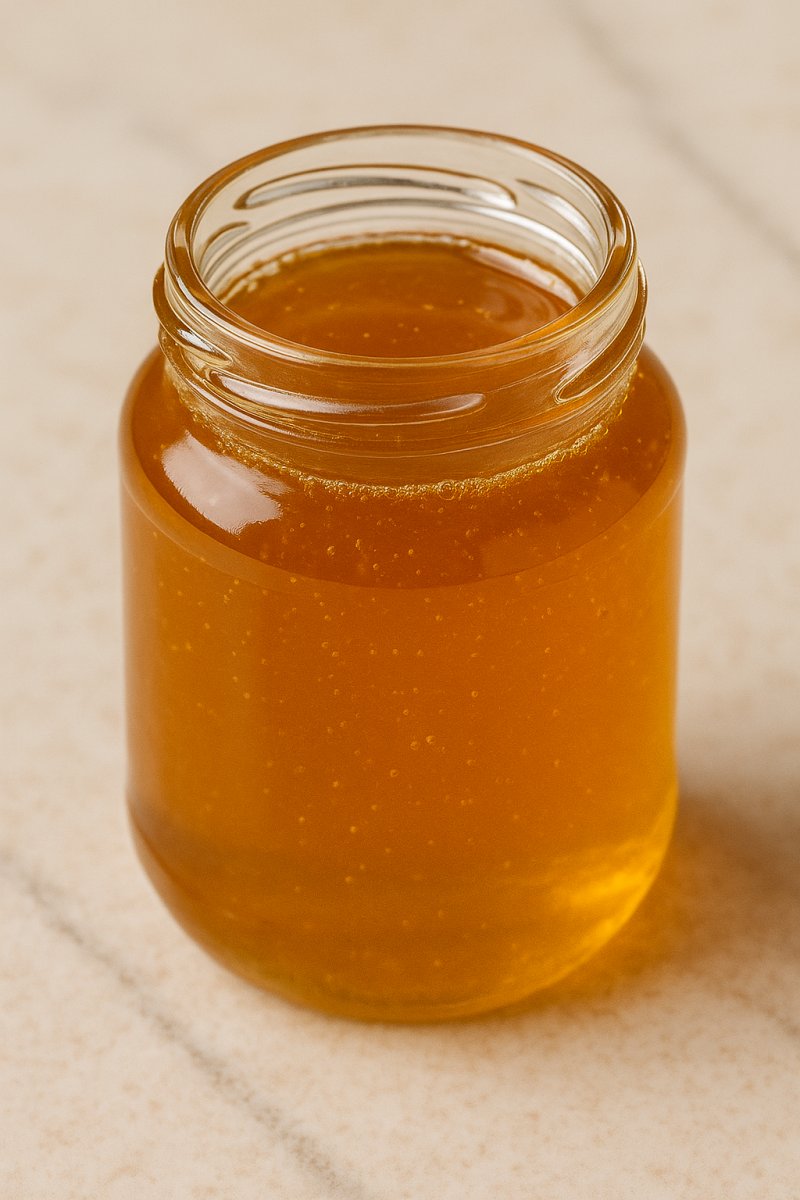
Liquid golden-yellow bee honey in a jar with a honey dipper
I love bee honey. It is one of those ingredients that brings a lot of warmth and history to the plate with little effort. I still remember a rainy autumn market where I bought a small jar of dark forest honey, and the scent on the first spoonful felt like a hug from summer. Since then honey for me is not only in the teacup but in the kitchen, on the breakfast table and sometimes even on the bedside table, because it is simply convenient.

Honey is more than just a sweetener. It is a natural product with surprising diversity. There are floral, mild varieties, robust, almost malty variants and honeys with fine, almost fruity nuances. I once hosted a tasting with friends where we sampled acacia, rapeseed, heath and fir honey blind; the laughter when someone mistakenly thought the fir honey was chocolate is one of my favourite kitchen anecdotes.

For me honey has several practical sides:

  • Culinary: It rounds off dressings, caramelizes wonderfully in the oven and gives yoghurt or cheese depth.
  • Preserving: In jams or in marinades honey helps to bind flavours.
  • Home remedy: A spoonful in tea for a sore throat or as a soothing aid for sleep is a classic for me.
I make a point of choosing regional honey because it often has a link to the landscape and the season. A colleague once brought honey from a remote valley — the texture reminded me of liquid caramel sauce and the flavour carried a distinct wildflower note. Such small discoveries shape how I perceive ingredients.

When cooking honey is a chameleon. It suits savoury dishes like glazed leg of lamb just as well as sweet baked goods. I like to experiment with mixes of honey and mustard for marinades or mix it with citrus for vinaigrettes. It is important to heat it gently so that the delicate aromas are not lost.

In conclusion: honey for me is a small reservoir of flavour, memories and versatility. It connects tradition with creativity, tastes of origin and makes the kitchen a bit cosier. A good jar of honey in the pantry is therefore essential for me.

Availability & types

Availability and types of bee honey

Bee honey is a very special ingredient found in almost every part of the world. Honey is produced when bees collect nectar from flowers, process it in their hive and store it as a sweet, thick liquid. Because flowers and climate differ by location, there are many different kinds of honey. Some are mild and light, others strong and dark — a bit like different juices or jams.

Origin and growing regions
Honey does not come from plants but from bees. Nevertheless its origin is closely linked to the plants that grow in a region. Popular production areas include:

  • Europe: Countries like Germany, Spain and Italy have many beekeepers (people who keep bees). Here floral honeys from rapeseed, linden or acacia are often produced.
  • North America: USA and Canada supply honey from sunflowers, maple blossoms or from wildflowers in large prairies.
  • Southern Europe and Africa: There you often find robust honeys from thyme or citrus blossoms.
  • Asia: In countries such as China and India there are large quantities of honey, often from rice fields and many different wildflowers.
Beekeepers pay attention to where they place their bee colonies. Some place bees directly next to orchards or lavender fields so that the honey takes on the flavour of those plants. Others let bees fly freely in nature, producing so-called "wild" or "regional" honey.

Available varieties and types
Honey comes in many variants. Here are the main ones, explained simply:

  • Flower honey: This honey comes from many different flowers. It usually tastes mild and is the most common type.
  • Monofloral honey: This comes mainly from one plant species, for example acacia honey (very light and mild), lavender honey (floral and aromatic) or Manuka honey (from New Zealand, somewhat stronger and often used for health).
  • Forest honey: Bees here also collect honeydew, a sugary substance excreted by aphids on trees. Forest honey is often darker and stronger in flavour.
  • Cream or spreadable honey: This honey has been processed to become solid and spreadable — ideal for breakfast bread.
  • Raw honey: This is honey that has not been heavily heated or filtered. It may contain small wax or pollen residues and is considered particularly natural.
  • Heated or filtered honey: This looks very clear because it has been filtered. It often remains liquid longer because natural crystallization has been delayed.
What to look for when buying
When you buy honey you can pay attention to a few things: does the jar state where the honey comes from? Is it labelled as "raw" or "fed"? (Fed means the beekeeper has given the bees additional sugar.) Regional honeys are often fresh and support local beekeepers. Sometimes the plant species is also listed — this helps to choose the flavour.

Honey is therefore very versatile: it comes from busy bees that work in very different regions and is offered in many varieties. Whether light and mild or dark and spicy — there is a suitable honey for almost every taste.
Details & nutrition

Property Value
Unit g
Calories per 100 304
Protein per 100 0.3
Carbohydrates per 100 82.0
Sugar per 100 82.0
Fat per 100 0.0
Saturated fat per 100 0.0
Monounsaturated fat 0.0
Polyunsaturated fat 0.0
Fiber per 100 0.0
Vitamin C (mg) per 100 0.5
Vitamin D (IU) per 100 0
Calcium (mg) per 100 6
Iron (mg) per 100 0.4
Nutri-Score E
CO₂ footprint 0.5
Origin Varies depending on the apiary and region
Gluten-free Yes
Lactose-free Yes
Nut-free Yes
Vegan No
Note Nutritional values may vary slightly depending on variety and origin; not suitable for infants under 12 months.

Technical & scientific information

Bee honey is a natural product that honey bees (predominantly Apis mellifera) produce by transforming nectar and honeydew. It consists mainly of sugars and water and contains numerous secondary components that determine colour, aroma and biological properties. Honey serves the bees as an energy reserve; for humans it has been valued for millennia as a food and medicinal substance.

Chemical composition and nutritional values
Chemically, honey is composed of about 70–85% various carbohydrates. The main components are monosaccharides such as fructose (approx. 30–45%) and glucose (approx. 20–35%). In addition there are disaccharides like sucrose, maltose and more complex oligosaccharides in smaller amounts. Water content typically ranges between 14 and 20%, which influences shelf life because higher water content promotes fermentation. Energetically honey provides roughly 3000 kJ (about 700 kcal) per 100 g, although the exact energy value depends on composition and water content.

Other constituents
Honey contains a variety of trace substances that shape its sensory and bioactive properties. These include:

  • Enzymes such as invertase (splitting sucrose), glucose oxidase (generation of hydrogen peroxide) and diastase (amylase), which are added by bees.
  • Organic acids such as gluconic acid, which lower the pH (typical pH 3.2–4.5) and promote antimicrobial conditions.
  • Minerals and trace elements in small amounts, including potassium, calcium, magnesium, phosphorus, iron and zinc; contents vary with plant source and location.
  • Phenolic compounds and flavonoids, which contribute antioxidant activity and specific aroma profiles.
  • Pollen particles, which serve as an indicator of botanical origin and as a potential allergy source.
  • Hydrogen peroxide, formed enzymatically in diluted honey, which plays a role in antibacterial activity.
Physical properties and variety formation
Colour, aroma and crystallization behaviour strongly depend on botanical origin. Lighter honeys (e.g. acacia) often contain more fructose and crystallize more slowly, while darker honeys (e.g. buckwheat) have higher proportions of minerals and polyphenols and a more intense taste. Crystallization is a natural process: if glucose predominates, crystalline structures form; heating and stirring influence the consistency.

Processing methods
After extraction from the combs honey is usually filtered to remove wax residues and coarse particles, and thermally treated to stabilize enzymes and delay crystallization. Common processing steps are centrifugal extraction or pressing, filtration and gentle heating (often below 40 °C to preserve enzymes). Industrial procedures may include stronger heating and fine filtration, which remove pollen and thereby make it harder to trace origin.

Health aspects
Honey possesses antibacterial, antioxidant and inflammation-modulating properties. The antibacterial effect is based on low water content, acidic pH, hydrogen peroxide and in certain varieties on additional active compounds (e.g. methylglyoxal in Manuka honey). Clinically, honey is used in wound treatment because it can inhibit the growth of many microbes and promote healing. Nutritionally, honey is a concentrated source of sugars and should be consumed in moderation due to its high carbohydrate content. Infants under one year should not be given honey because of the risk of botulism intoxication from Clostridium botulinum spores.

Quality indicators and regulations
The quality of honey is assessed by parameters such as water content, hydroxymethylfurfural content (HMF, an indicator of heating/ageing), diastase activity and sucrose content. International and national standards (e.g. Codex Alimentarius, EU regulations) define minimum requirements and labelling obligations, including botanical or geographical indications for protected designations of origin.

In sum, bee honey is a complex natural product with variable composition that exhibits nutritional, technological and medically relevant properties. Its diversity arises from the interaction of plant source, environmental influences, bee health and processing steps, which give different honeys characteristic profiles and application possibilities.

Wiki entry for: honey
Active now: 24 visitors of which 2 logged-in members in the last 5 minutes