Menu & categories

Hazelnut butter

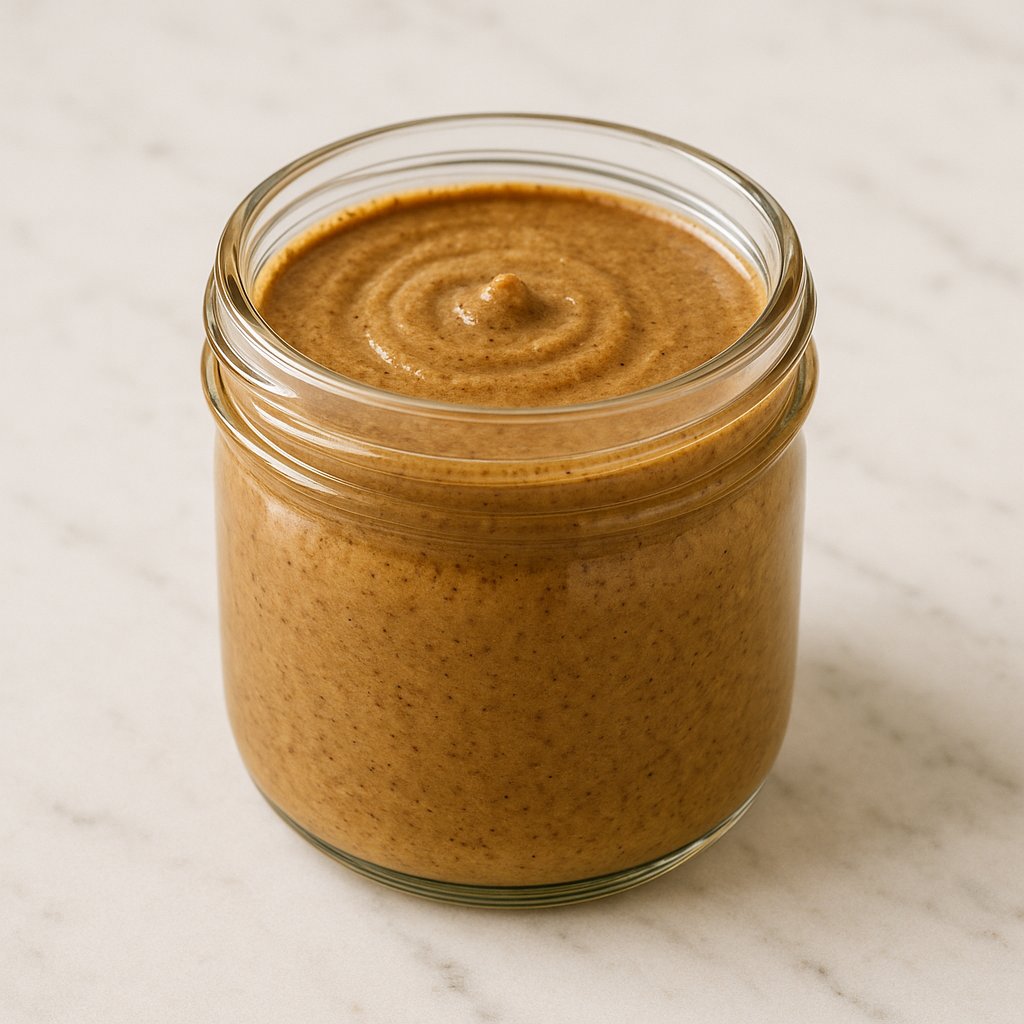
Creamy spread made from finely ground hazelnuts

Wiki about hazelnut butter Nutri-Score D Vegan Yes Gluten-free Yes Lactose-free Yes Nut-free No
NUTRITION / 100 g
640 kcal 15 g Protein 6 g Kohlenhydrate 61 g Fett

Introduction

A jar of creamy hazelnut butter with roasted hazelnuts beside it
I still remember the day I bought the first jar of hazelnut paste in a small market in southern France: it smelled of freshly roasted nuts, and I couldn't resist. Since then hazelnut paste has become a staple in my kitchen. For me it is more than just a spread; it is an ingredient that elevates dishes to a silky, nutty level and almost has the magical ability to liven up simple recipes.

Hazelnut paste is made when roasted hazelnuts are ground until they release their natural oils and form a creamy paste. I experimented at home back then and found that even a simple dressing of hazelnut paste, lemon juice, honey and a little water immediately gives a salad depth. A colleague later tried my combination at a lunch party and insisted on taking the recipe with him — he called it "liquid gold for leafy greens".

What I love about hazelnut paste:

  • The intense, slightly sweet nutty flavor, which is more complex than many other nut pastes.
  • The versatility: from baked goods to smoothies to savory sauces.
  • The natural creaminess that gives desserts and sauces a rich texture.
I also find it practical that hazelnut paste is available in different varieties: pure, lightly salted, with added oil or as a blend with dark chocolate. In my kitchen I often use it instead of butter or cream when I want a nutty note but want the dish to feel lighter. One evening I improvised a Bolognese with a spoonful of hazelnut paste — the result pleasantly surprised all the guests because the sauce gained a silky fullness without feeling heavy.

From a health perspective I appreciate the unsaturated fatty acids and the fiber content that hazelnut paste provides. Of course I enjoy it in moderation, but I find it wonderful how a small amount can deliver so much flavor. I pay attention to the ingredient list and prefer varieties without added sugar or palm oil.

If I had to give a shopping tip: try a natural hazelnut paste and use it creatively. Whether as a base for a nutty pesto, as a finishing touch for warm soups or simply on fresh bread with a pinch of sea salt — hazelnut paste is for me a reliable kitchen friend that always provides a tasty surprise.

Availability & types

Availability and types

Hazelnut paste is a spreadable paste made from ground hazelnuts. You can buy it in many supermarkets, health-food stores and also online. It is available year-round because hazelnuts are harvested and then dried, so stocks keep for a long time. If you look for hazelnut paste in a store, you will often find different jars or tins labeled "roasted", "natural" or "with salt". These words tell you how the nuts were treated beforehand.

Origin and growing areas

Hazelnuts grow on shrubs called hazel bushes. The main countries where many hazelnuts are grown are:

  • Turkey: Turkey is one of the largest producers. Hazelnuts grow there in warm hilly areas.
  • Italy: Especially in regions like Piedmont there are many hazelnut orchards. Piedmont hazelnuts are famous for their good flavor.
  • Spain and USA: Hazelnuts are also grown in parts of Spain and in some areas of the USA.
  • Germany: In some regions of Europe, including Germany, there are smaller cultivation areas, usually in orchards or specialized plantations.
Imagine hazel shrubs as small trees growing in rows. Farmers tend them, harvest the nuts and dry them in the sun or in drying facilities. After that the nuts are shelled and further processed — for example into hazelnut paste.

Available types and variants

Hazelnut paste comes in different types. Here are the main ones, explained simply:

  • Natural hazelnut paste: This paste consists only of ground hazelnuts. It has a pure, nutty flavor. It can be somewhat thick and sometimes oil separates on top — this is normal. Simply stir and it becomes smooth again.
  • Roasted hazelnut paste: For this paste the hazelnuts are roasted first, i.e. briefly heated to make them more flavorful and aromatic. The paste often tastes stronger, similar to the aroma you get from toasting bread.
  • Hazelnut paste with added oil: Some manufacturers add a little vegetable oil so the paste becomes softer and easier to spread. This is practical if you want to spread it on bread.
  • Salted or sweetened variants: Sometimes a little salt or sugar is added to make the paste tastier or sweeter. The sweet version is more like a spread, while the salted one has a savory note.
  • Mixed nut pastes: There are also mixes such as hazelnut-and-almond paste or nut pastes that combine several types of nuts. These often have more varied flavors.
  • Organic hazelnut paste: This means the hazelnuts were grown without chemicals such as certain pesticides. Many people prefer organic because they consider it more natural.
  • Peeled vs. unpeeled paste: In peeled paste the brown skins of the nuts have been removed. The paste is then lighter and often milder in taste. Unpeeled paste is a bit darker and has a more intense aroma.
If you want to choose a hazelnut paste, consider: do you want a pure nut flavor, a soft paste for spreading, or a sweet variant? In many stores you can also try small jars or read the ingredient list so you know exactly what's inside. Overall hazelnut paste is versatile and available in many variants, so there's something for every taste.
Details & nutrition

Property Value
Unit g
Calories per 100 640
Protein per 100 15
Carbohydrates per 100 6
Sugar per 100 4
Fat per 100 61
Saturated fat per 100 4.5
Monounsaturated fat 46
Polyunsaturated fat 8
Fiber per 100 9
Vitamin C (mg) per 100 6
Vitamin D (IU) per 100 0
Calcium (mg) per 100 110
Iron (mg) per 100 4.5
Nutri-Score D
CO₂ footprint 2.1
Origin Depending on the manufacturer, predominantly Europe and Turkey
Gluten-free Yes
Lactose-free Yes
Nut-free No
Vegan Yes
Note Pure hazelnut butter is typically 100% ground hazelnuts without additives. Very energy-dense and rich in monounsaturated fatty acids, vitamin E and minerals. May contain traces of other nuts, peanuts or sesame — check the manufacturer's information.

Technical & scientific information

Hazelnut paste is a finely ground, spreadable product made from hazelnuts (Corylus avellana and related species), produced by comminuting and emulsifying the nut kernels. It sits in culinary use between a nut oil and a nut butter and is characterized by a homogeneous, pasty consistency and an intense, slightly sweet-nutty aroma. In industry and domestic use hazelnut paste is used both pure and as a base for spreads, baked goods, praline fillings and beverages.

Production and processing

  • Roasting: Before grinding, hazelnuts are often roasted to develop flavors and loosen outer layers. Roasting temperatures typically range between 120 °C and 160 °C, with time and temperature significantly affecting the aroma profile.
  • Peeling/Fractionation: After roasting the skins are partly removed mechanically because they contain bitter compounds (e.g. polyphenols). Complete removal is technically demanding and affects the content of secondary plant compounds.
  • Grinding/Dispersing: The nut flesh is reduced in several stages. Fine particle sizes are achieved by cold or hot grinding in ball mills, steel rollers or conching machines. During grinding the released nut oil emulsifies the solid particles and produces the pasty consistency.
  • Stabilization: Some manufacturers add small amounts of vegetable emulsifiers or antioxidants to prevent oil separation and extend shelf life. Alternatively, physical homogenization can be used.
Chemical composition and nutritional values

Hazelnuts consist mainly of lipids, proteins and carbohydrates, complemented by fiber, vitamins and minerals. Typical nutritional values for hazelnut paste (per 100 g) are roughly:

  • Calories: 600–650 kcal
  • Fat: 55–65 g, predominantly unsaturated fatty acids; the high proportion of monounsaturated oleic acid (C18:1) and polyunsaturated linoleic acid (C18:2) is characteristic.
  • Protein: 10–15 g, with an amino acid profile rich in arginine and a partly incomplete supply of essential amino acids.
  • Carbohydrates: 10–15 g, of which fiber 5–10 g.
  • Vitamins and minerals: Notable are vitamin E (tocopherols), B vitamins (particularly B6, folate in small amounts), magnesium, copper, manganese and phosphorus.
Composition values vary depending on variety, growing region and processing (e.g. roasting reduces certain heat-sensitive micronutrients).

Bioactive components and health aspects

Hazelnut paste contains several bioactive substances with nutritional significance. Vitamin E acts as an antioxidant and stabilizes lipids; unsaturated fatty acids support a favorable blood lipid profile. Phytosterols may modulate cholesterol absorption. Polyphenols and flavonoids contribute to antioxidant capacity, with levels influenced by roasting and skin removal.

Studies show that moderate consumption of nuts, including hazelnuts, can be associated with positive effects on cardiovascular risk factors, such as lower LDL cholesterol and improved inflammatory markers. Because of the high energy content, portion control is important. Hazelnut paste is contraindicated for people with nut allergies.

Safety, storage and quality aspects

  • Oxidation: The high fat content makes hazelnut paste susceptible to oxidation; storage protected from light, air and heat extends freshness.
  • Microbiology: Products with low water activity are relatively microbiologically stable, but spoilage can occur when moist ingredients are added.
  • Contaminants: Fungal toxins (e.g. aflatoxins) can occur with poor harvesting or storage; quality controls are important.
Overall, hazelnut paste is a nutrient-rich, versatile nut product with a characteristic fatty acid profile and several bioactive components. Its nutritional effects are generally positive, provided it is consumed in appropriate amounts and produced and stored under hygienic and oxidation-stable conditions.

Wiki entry for: hazelnut butter
Active now: 18 visitors of which 2 logged-in members in the last 5 minutes