Menu & categories

Gyros Seasoning

A savory herb and spice blend for gyros, meat and vegetables.

Wiki about gyros seasoning Nutri-Score C Vegan Yes Gluten-free Yes Lactose-free Yes Nut-free Yes
NUTRITION / 100 g
255 kcal 10.0 g Protein 41.0 g Kohlenhydrate 6.0 g Fett

Introduction

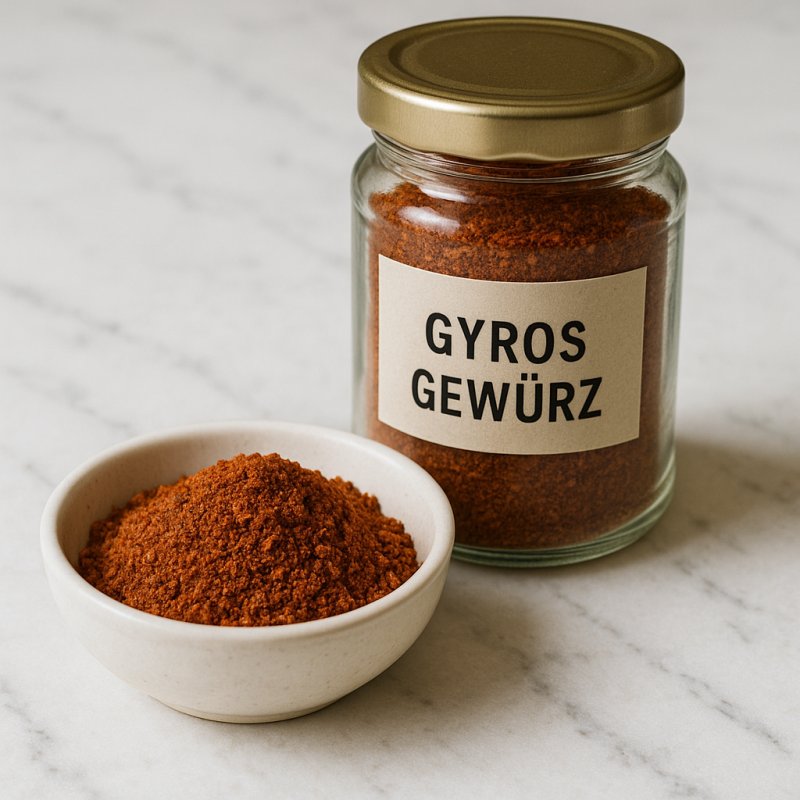
Gyros seasoning as a spice blend in a small bowl
I love Gyros Gewürz for its ability to turn everyday meat into a little piece of Mediterranean street magic. For me this blend is more than a collection of herbs and spices; it is the smell of hot plates on a mild summer evening that I immediately associate with a memory. A colleague once brought fully seasoned pieces into the office, and even before I tried the first forkful I knew: this is no accident, this is intentional – perfectly balanced and simply seductive.

Gyros Gewürz typically combines bold, aromatic notes like oregano, garlic and onion with warm spices such as cumin and paprika. Salt and black pepper provide the base; sometimes cinnamon, cloves or allspice sneak in to add depth. I remember asking an older vendor at a small market in Athens about her secret; she smiled, tapped a mound of spices with her forefinger and said only: «Love and nothing but love.» It was charmingly overstated, but the truth lies in the balance.

I like to use Gyros Gewürz as flexibly as possible:

  • As a marinade: with olive oil, a little lemon juice and yogurt for tender, juicy meat.
  • As a rub: rubbed dry onto pork or chicken pieces before frying or grilling.
  • For vegetables: sprinkled on roast potatoes or grilled vegetables for a quick flavor boost.
A tip from my kitchen routine: less is sometimes more. The blend loses its finesse if every dish is over-seasoned the same way. Better to taste first, adjust, and adapt to your own preferences. Gyros Gewürz is a friendly companion that enriches both simple home cooking and more elaborate plates and always brings a little holiday to the dish.

Availability & types

Availability and types

What is Gyros Gewürz?
Gyros Gewürz is a blend of several dried herbs and spices used to make meat (or vegetables) taste like the Greek dish “gyros”. You can imagine it like a paint set: different colors (spices) are brought together so that in the end a nice picture (the typical flavor) emerges.

Origin of the ingredients
The individual components of Gyros Gewürz come from different parts of the world. Many herbs such as oregano, thyme and rosemary often grow in the Mediterranean region – in countries like Greece, Turkey, Italy or Spain. Other ingredients, for example paprika, originally come from the Americas but are now grown in many countries, such as Hungary, Spain, China or parts of Europe. Cumin and coriander come from Asia and the Middle East, while garlic and onion are cultivated almost worldwide.

Growing regions
- Mediterranean herbs: mostly Southern Europe (Greece, Turkey, Spain, Italy)
- Paprika: Hungary, Spain, parts of Asia and North America
- Cumin, coriander: Middle East, South Asia
- Garlic, onion: global, including Europe and China
These ingredients are dried, ground or processed into flakes and then packed into spice blends.

Available varieties and variants
Gyros Gewürz is available in many variants. Imagine you're looking for a T‑shirt: there are different colors, sizes and fabrics. It's the same with spices:

  • Classic / Original: Contains oregano, thyme, paprika, garlic, cumin and sometimes cinnamon or nutmeg. This is the standard blend.
  • Mild: Less spicy, good for children or people who don't like strong heat.
  • Hot / Spicy: With extra paprika or chili flakes, for those who like heat.
  • Smoky: With smoked paprika or smoked salt – gives a grilled flavor even when the meat is cooked indoors.
  • Low-salt / Salt-free: For people who need to watch their salt intake.
  • Organic: Made from ingredients grown without chemical pesticides.
  • Ready marinade or paste: Already mixed with oil or vinegar so you just need to marinate the meat.
  • Gluten-free / Vegan: Spices are usually naturally vegan and gluten‑free, but some blends may contain fillers – so always read the label.
Where and how can you get Gyros Gewürz?
Gyros Gewürz is easy to find: in supermarkets, health‑food shops, delicatessens, spice dealers and online. It comes in small sachets, jars and large bags. You can buy it ready-made or mix it yourself – it's like a home cooking experiment. Homemade has the advantage that you can choose the exact ingredients and the level of heat.

Storage tip
Store the spice dry, dark and airtight – for example in a screw-top jar. That way the flavor lasts longer. If you leave the spice sitting too long it loses aroma and taste, similar to old paints that fade.

In summary: Gyros Gewürz consists of herbs and spices from various regions, is available in many variants and is easy to obtain. Whether classic, hot, organic or in paste form – there is a suitable type for every taste.
Details & nutrition

Property Value
Unit g
Calories per 100 255
Protein per 100 10.0
Carbohydrates per 100 41.0
Sugar per 100 15.0
Fat per 100 6.0
Saturated fat per 100 1.0
Monounsaturated fat 2.0
Polyunsaturated fat 2.0
Fiber per 100 25.0
Vitamin C (mg) per 100 5.0
Vitamin D (IU) per 100 0
Calcium (mg) per 100 200
Iron (mg) per 100 20.0
Nutri-Score C
CO₂ footprint 2.5 kg CO2e/kg
Origin Blend (EU/non-EU)
Gluten-free Yes
Lactose-free Yes
Nut-free Yes
Vegan Yes
Note Nutritional values are average values for a typical gyros spice blend and may vary depending on the recipe (especially the salt and paprika content).

Technical & scientific information

Gyros Gewürz refers to a dry spice blend traditionally used to season gyros meat and similar Mediterranean dishes. Recipes vary widely by region and commercial producer; typical components are dried herbs and ground spices, supplemented by table salt and, where applicable, flavor enhancers or anti‑caking agents. Culinarily, the blend serves both to add aroma and to promote formation of a savory crust on beef or pork during frying.

Typical ingredients

  • Herbs: Oregano, thyme, rosemary and marjoram provide the characteristic Mediterranean aroma.
  • Spices: Paprika (sweet or hot), cumin (cumin), coriander, black pepper, cinnamon or cloves in small amounts for rounding.
  • Alliums: Garlic powder and onion powder are common and contribute to the deep umami note.
  • Salt and additives: Table salt is often a main ingredient; commercial blends may contain monosodium glutamate (MSG), hydrolyzed vegetable proteins, silicon dioxide as an anti‑caking agent or other flow agents.
Chemical and sensory components

The aromatic effect is based on essential oils and secondary plant compounds present in the herbs and spices. Important chemical groups include terpenes (e.g. thymol, carvacrol), alcohols and esters (e.g. linalool), aldehydes (e.g. cuminaldehyd) and sulfur compounds from garlic (precursors of allicin). Paprika supplies carotenoids such as capsanthin and, in hot varieties, capsaicinoids that affect heat and color. These compounds are volatile and sensitive to light and oxygen, which is why storage and grinding govern sensory stability.

Nutritional value and quantity

As a powdered spice blend Gyros Gewürz is low in calories and provides only small amounts of macronutrients at typical usage doses (gram range per portion). The bulk of the dry mass consists of carbohydrates (cellulose, hemicelluloses, starch) and smaller shares of plant protein and fat. The salt content largely determines the mineral composition and therefore health considerations for sodium‑sensitive individuals.

Processing methods and quality assurance

Production includes drying, milling and homogenizing the raw spices, followed by blending steps under controlled conditions. Industrial measures to reduce microbiological risks include hot‑air treatment, steam sterilization or irradiation; legal requirements and consumer preferences influence the choice of method. Quality controls check for microbiological contamination, pesticide residues, heavy metals as well as sensory parameters and particle size. Anti‑caking agents ensure free‑flowing properties, while packaging provides air barrier and light protection for stability.

Health aspects

At normal culinary quantities most components are regarded as safe and some may even exhibit antioxidant, antimicrobial or inflammation‑modulating effects described for individual phytochemicals. Attention should be paid to sodium from salt, since excessive intake increases cardiovascular risk. Certain spice components can trigger allergies or intolerances in sensitive people. Clinically relevant are also possible interactions with medications, for example potentiation of anticoagulants by large amounts of garlic, and interactions with rare bioactives.

Storage and shelf life

Optimal storage conditions are dry, cool and dark to minimise loss of volatile aromas through oxidation or evaporation. Under such conditions aroma and quality generally remain for 12 to 36 months; however efficacy progressively declines over time.

In summary, Gyros Gewürz is a multilayered blend of plant components whose character is defined by volatile aroma compounds, secondary plant constituents and salt. Its nutritional significance at typical portions is small, while sensory and technological properties dominate in the kitchen. For consumers composition, salt content, possible additives and proper storage are key criteria when selecting and using it safely.

Wiki entry for: gyros seasoning
Active now: 18 visitors of which 2 logged-in members in the last 5 minutes