Menu & categories

Gummy bears

Fruity gelatin candy with a high sugar content

Wiki about gummy bear Nutri-Score E Vegan No Gluten-free Yes Lactose-free Yes Nut-free Yes
NUTRITION / 100 g
340 kcal 6 g Protein 77 g Kohlenhydrate 0.2 g Fett

Introduction

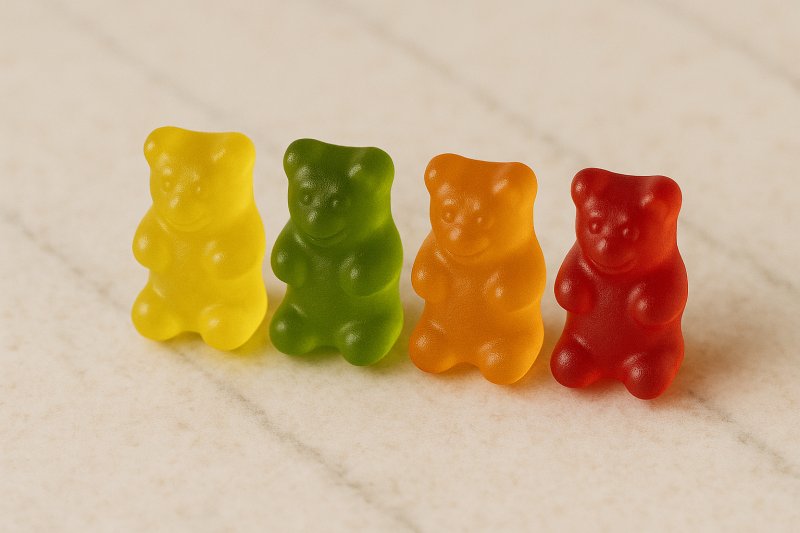
Colorful gummy bears in various colors and flavors
I still remember the first afternoon when I secretly helped myself to a bag of gummy bears and felt like committing a small, joyful crime. The sweet smell, the slightly sticky texture and those little, colorful figures felt like a promise of uncomplicated moments of happiness. Since then gummy bears have always played a nostalgic but also culinarily curious role for me: they are not only treats, but also a mirror of how simple ingredients and craftsmanship can become an omnipresent pop-culture snack.

Gummy bears are basically made of sugar, gelatin, fruit juice concentrates or flavorings and colorants. Gelatin gives them the characteristic springy consistency that yields pleasantly when chewed. I have often discussed with friends why precisely the consistency is so important: a colleague dryly suggested it must be the "wobble", that the child in us calms down immediately. It's not that trivial, but the point stands: texture and bite are decisive in gummy bears.

There are surprisingly many variants: classic fruit gummies, vegan alternatives based on pectin or agar, reduced-sugar varieties and handmade premium editions with real fruit extracts. I once tried vegan gummies that were so convincing my partner asked incredulously how I could tell the difference. For some people the ingredient list and ethical aspects are decisive criteria, for others pure enjoyment remains central.

Gummy bears also have a cultural dimension: they appear in films, on birthday cakes and as spontaneous comfort fixes during stressful office days. A small anecdote: a colleague brought a bag after a long night, and suddenly the whole weight of the project dissolved into a carefree, childlike round of snacking. These scenes show how much a simple product can change moods.

In summary, gummy bears are more than just candy. They combine texture, taste and memory and at the same time offer room for creative reinterpretations. Whether classic or modern, vegan or nostalgic: every bear tells a little story, and I like to listen when they whisper to me as I snack.

Availability & types

Availability and types

Gummy bears are sweets that can be found almost everywhere. In supermarkets, kiosks, petrol stations and confectionery shops they sit on shelves or in large bags. Many people know the classic brands, but there are also many smaller manufacturers and even homemade variants. Because gummy bears are popular, they are available almost all year round — they do not spoil quickly if stored dry and sealed.

Origin
Gummy bears were invented in Germany at the end of the 19th century. A confectioner named Hans Riegel from Bonn popularized the small colorful creatures. Since then they have spread around the world. The basic idea has remained the same: a sticky, gummy mass is poured into molds which then become fruit gummies. Although the region of origin is Germany, gummy bears are now produced in many countries, for example in the USA, in other European countries and in Asia.

Growing regions (for the raw materials)
Gummy bears consist of several ingredients. Some important raw materials come from agriculture. For example:

  • Sugar: Sugar often comes from sugar cane or sugar beet. Sugar cane grows in warm countries like Brazil or India; sugar beets grow in cooler regions such as Europe or North America.
  • Fruit juices or fruit concentrates: These come from fruits such as apples, oranges or berries. The fruits are grown in many regions — apples, for example, in Europe and North America, oranges often in warmer areas.
  • Gelling agents: Gelatin usually comes from animal bones and skins and is processed worldwide; plant-based alternatives like agar-agar are derived from seaweeds harvested in countries with seaweed fisheries.
Available varieties and variants
There are many different types of gummy bears to suit every taste. Here are some of the most common variants, explained like for a child:

  • Classic fruit gummies: These are the well-known colorful bears or fruit shapes with flavors like strawberry, lemon or apple. They are soft and sticky — a bit like chewing gum, but they do not stick to the teeth.
  • Sour varieties: These have an extra tart coating or are dusted with sour powder. At the first bite the tongue tingles a little because they taste sour.
  • Vegan or vegetarian variants: Regular gummy bears often contain gelatin (from animals). For people who do not want to eat gelatin, there are variants with plant-based gelling agents such as agar-agar or pectin (which comes from fruits).
  • Organic gummy bears: These are made from ingredients grown without synthetic pesticides or artificial fertilizers. They are often a bit more expensive, but many people like them because they seem more natural.
  • Special shapes and sizes: Besides bears there are worms, hearts, halves of fruit or giant gummy pieces. Sometimes they are also filled, for example with a creamy center.
  • Flavor and color variants: There are typical fruit colors, but also unusual flavors like cola, licorice or exotic fruits. Some manufacturers use natural colorants from plants, others use artificial colorants.
If you want to buy gummy bears you will often find them in different package sizes: small bags for on the go, large pouches for parties or mixes with different varieties. There is something for everyone — whether you like them sweet, sour, vegan or classic. Gummy bears are therefore very versatile and widely available.

Details & nutrition

Property Value
Unit g
Average weight per piece 2
Calories per 100 340
Protein per 100 6
Carbohydrates per 100 77
Sugar per 100 46
Fat per 100 0.2
Saturated fat per 100 0.1
Monounsaturated fat 0
Polyunsaturated fat 0
Fiber per 100 0
Vitamin C (mg) per 100 0
Vitamin D (IU) per 100 0
Calcium (mg) per 100 10
Iron (mg) per 100 0.1
Nutri-Score E
CO₂ footprint 1.5
Origin Industrial product, various countries of origin
Gluten-free Yes
Lactose-free Yes
Nut-free Yes
Vegan No
Note Typically made from sugar, glucose syrup and gelatin; nutritional values may vary slightly depending on brand and recipe.

Technical & scientific information

Gummy bears are small, elastic confections based on gelling agents and sugar, used as a single ingredient in recipes or as a ready-to-eat product. Originally developed in Germany, commercial gummy bears typically consist of a combination of carbohydrates (sugar and glucose syrup), gelling agents (classically gelatin or plant-based alternatives), acidulants, flavorings, colorants as well as, if applicable, fats and waxes as glazing agents.

Chemical composition and function of the components

  • Sugars and syrups: Sucrose, glucose syrup and fructose provide sweetness, contribute to texture and reduce water activity, thereby inhibiting microbial growth. The exact sweetener composition affects crystallization, stickiness and melting point.
  • Gelling agents: Traditionally animal gelatin is used, a protein hydrolyzed from collagen that forms a thermo-reversible gel on cooling. Alternative gelling agents include starch (modified), pectin and carrageenan, which provide different gelling mechanisms and textures.
  • Acids and buffering substances: Citric acid, malic acid or tartaric acid control pH, enhance fruit flavors and influence gel structure. Acidity also modulates the perception of sweetness.
  • Flavourings and colorants: Natural essential oils, esters or artificial flavourings provide specific taste profiles. Colorants can be synthetic (e.g. azo dyes) or natural (e.g. extracts from beetroot, curcumin, spirulina).
  • Fats/waxes: Carnauba wax or beeswax are used as glazing and release agents to prevent sticking and to seal the surface.
Manufacturing process

Production involves several standardized steps: dissolution of the sugar components in water at defined temperatures, incorporation of the gelling agent and homogenization. After heating and, if necessary, deaeration, the mass is flavored, colored and poured into molds. This is followed by cooling, setting and, if applicable, a drying or maturation phase in which moisture content and texture are finely adjusted. Finally the pieces are demolded, coated with wax pastes and packaged.

Nutritional values and physical properties

Gummy bears are energy-dense: the main fraction is easily available carbohydrates (approx. 70–90% of the dry matter), which often provide 300–400 kcal per 100 g. Protein fractions are present in gelatin-containing products, but are low relative to total weight. Fat content is usually low, except when additional coatings are present. The physical texture is determined by the network of the gelling agent; gelatin-based gels show characteristic elasticity and shear strength values that can be quantified by rheological methods.

Health aspects and intolerances

  • High sugar content can, with excessive consumption, contribute to calorie excess, tooth decay and metabolic risks.
  • Gelatin is of animal origin and is not suitable for vegans or certain religious diets; there is also theoretically a small risk of protein-related reactions in allergic individuals.
  • Alternative gelling agents can cause digestive discomfort in sensitive people, but are generally well tolerated.
  • Synthetic colorants and flavourings are the subject of scientific discussion regarding possible behavioural effects in children; regulatory limits and labeling requirements are adhered to.
Technological variations and applications

The choice of gelling agent and formulation allows a wide range of textures, from chewy to soft products. Gummy bears are used not only as confectionery but also as a texture-providing ingredient in patisserie, in the production of decorative foods or for experimental applications in food technology. In product development, stability, shelf life and sensory properties are optimized through targeted modification of the formulation.

In conclusion, gummy bears are a technologically well-characterized food whose main functions are determined by sugars and gelling agents. The nutritional implications largely depend on consumption behavior, while technical adjustments to the formulation enable diverse textures and applications.

Wiki entry for: gummy bear
Active now: 12 visitors of which 2 logged-in members in the last 5 minutes