Menu & categories

Food coloring

Dye for coloring foods and beverages.

Wiki about food coloring Nutri-Score A Vegan No Gluten-free Yes Lactose-free Yes Nut-free Yes
NUTRITION / 100 g
0 kcal 0 g Protein 0 g Kohlenhydrate 0 g Fett

Introduction

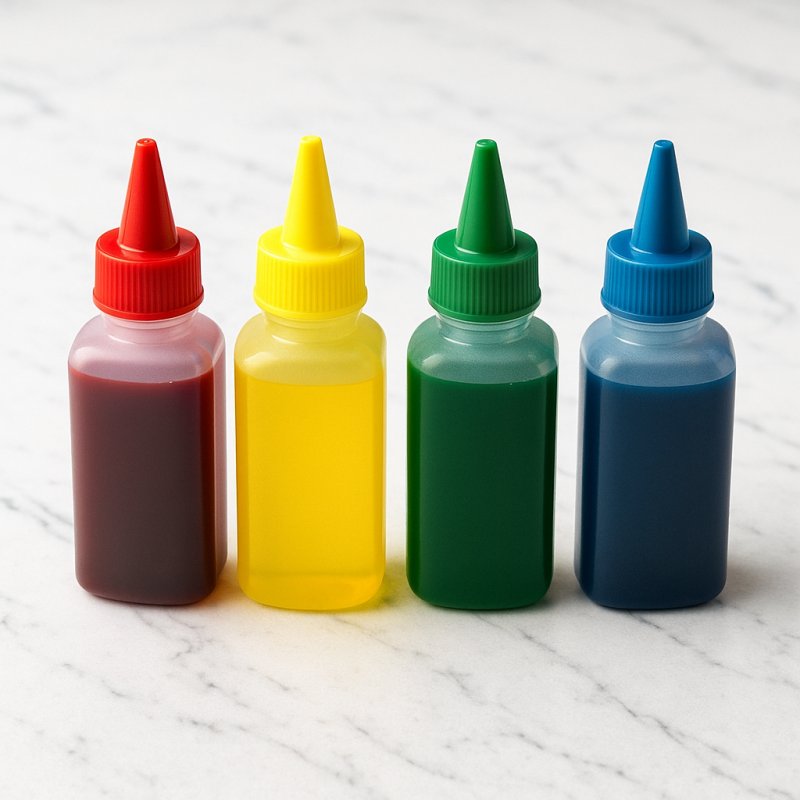
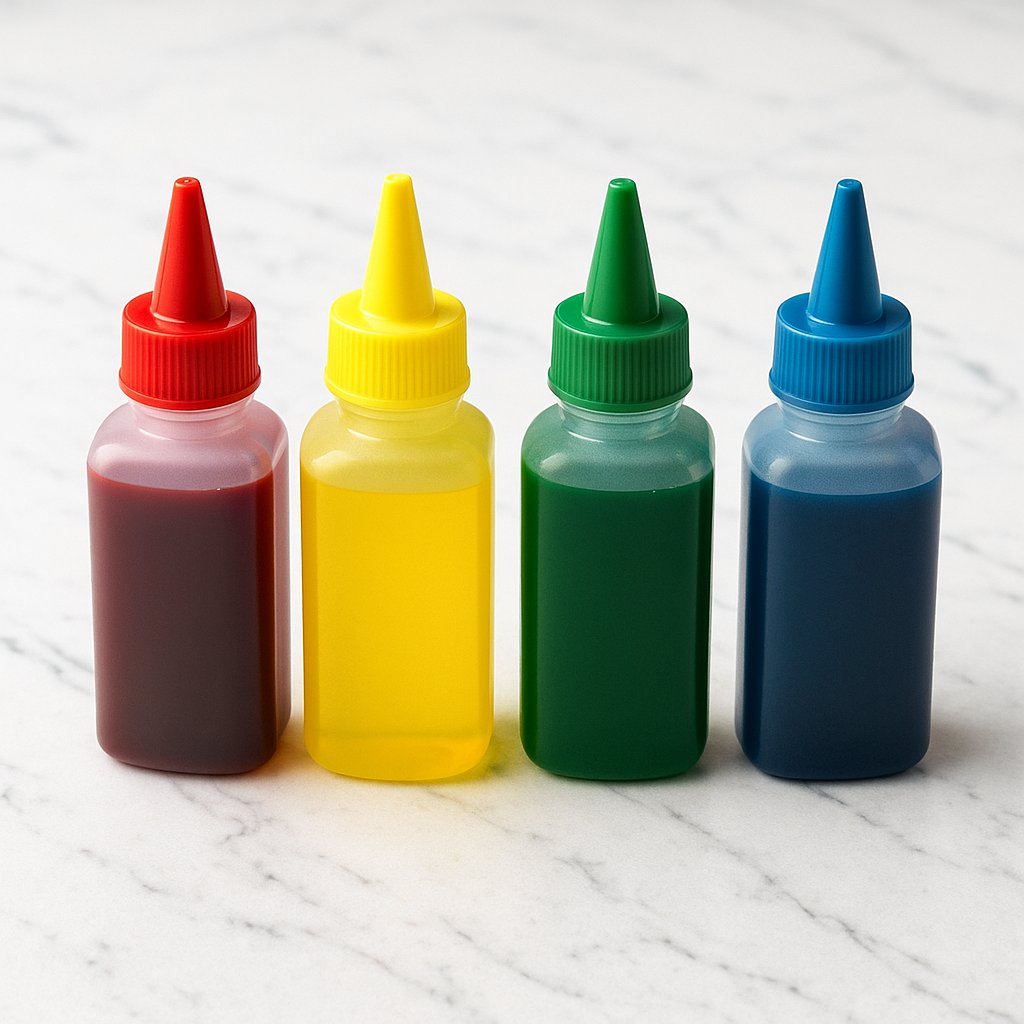
Small bottle of food coloring for coloring dough and glazes
Food coloring has something both childlike and surprisingly practical about it. I still remember my first attempt to dip a light lemon cake into a vivid turquoise: the guests were first skeptical, then delighted, and I was bursting with pride. Since then food coloring has accompanied me in cakes, creams, cocktails and experiments in everyday cooking – it is a small tool that makes mood, tradition and creativity visible.

What I especially appreciate about food colorings is their variety and simplicity. They come as liquid, gel-like or powdered variants, in synthetic and natural forms. Each variant has its particularities:


  • Liquid: Good for drinks and liquid batters, but often less concentrated.
  • Gel: Highly concentrated, ideal for buttercream and fondant.
  • Powder: Excellent for dry mixes and intense shades.
A colleague of mine swears by spirulina for a deep green, while a friend persistently uses beetroot powder to color cakes without artificial additives. Natural colorants are wonderful, yet they often react sensitively to heat and acid. Artificial dyes usually offer better stability, but I always read labels and use them sparingly.

I've picked up a few practical rules of thumb over the years: less is more, colors are easier to build up than to reduce; blending creates complex nuances; and always test first in a small amount. For light pastel tones often a tiny drop is enough, for strong shades gel is usually the better choice. The texture of the food also changes little when you dose correctly.

I invite you to play with colors, do small tests and adapt recipes. Food coloring is an unassuming but powerful tool that brings joy, does not dictate flavor, and can be used safely with a little knowledge.

Availability & types


Availability and types

Food coloring is an ingredient that gives color to foods – for example cakes, cotton candy or ice cream. It comes in many variants and from very different places of origin. You can buy food coloring in the supermarket, in the baking shop or online. Some packages are small and enough for a few muffins, others are large and intended for bakeries. If you bake at home, you will usually find gel, liquid or powdered colors. For industry there are even more concentrated pastes and powders that are very economical.

Where do the colors come from?
There are two main sources: natural and artificial colors.

  • Natural colors: These are obtained from plants, fruits, algae or even insects. Examples are beetroot (for red), turmeric root (for yellow), spirulina (an alga for blue/green) and annatto (a seed color from tropical plants, often orange). These raw materials grow in specific places: turmeric is widely cultivated in India, beetroot rather in temperate regions like Europe, annatto originally comes from Central and South America, and spirulina is farmed in warm, sunny lakes or ponds in Asia and Africa.
  • Artificial colors: These are manufactured in factories and are very uniform in color. They are often cheaper and glow more brightly. These colors are produced in many countries, for example in Europe, China or the USA. They are not made from plants but chemically produced to be safe and stable.
What forms are there?
Food coloring comes in different "forms" depending on what you need it for:

  • Liquid: Easy to mix, good for thin batters or drinks. Like water, but with color.
  • Gel: Thick, very popular in baking. One drop is often enough, and the color spreads well in icing.
  • Powder: Dry and economical. Good for chocolate or sugar because it does not dilute.
  • Pastes/Concentrates: Very intense, used by professionals. A small amount is enough, like a droplet of color in concentrated form.
Special variants and notes
Some colors are specially made for children because they are mild and have no unpleasant odors. Others are for professionals and very strong. With natural colors the shade can vary somewhat depending on the season or harvest – that's normal, like apples being different sizes. There are also colors that come from animals, for example carmine from cochineal insects. Such colors are not suitable for everyone (for example vegetarians or people with certain religious rules).

Finally it is important: the packaging states what is inside. Look for words like natural, artificial, or ingredient lists. That way you know whether the color comes from plants, algae, insects or a factory. In this way you find the right food coloring for your project – whether you want to bake a rainbow cake or colorful cookies.
Details & nutrition

Property Value
Unit g
Calories per 100 0
Protein per 100 0
Carbohydrates per 100 0
Sugar per 100 0
Fat per 100 0
Saturated fat per 100 0
Monounsaturated fat 0
Polyunsaturated fat 0
Fiber per 100 0
Vitamin C (mg) per 100 0
Vitamin D (IU) per 100 0
Calcium (mg) per 100 0
Iron (mg) per 100 0
Nutri-Score A
CO₂ footprint k.A.
Origin Depends on the manufacturer (often EU or non-EU)
Gluten-free Yes
Lactose-free Yes
Nut-free Yes
Vegan No
Note Nutritional values are generally negligible because food coloring is used only in very small amounts. Composition (e.g. E-numbers, carrier substances) varies by product; some colorants can be of animal origin (e.g. carmine), so whether it is vegan depends on the manufacturer.

Technical & scientific information

Food coloring refers to technically produced or naturally obtained dyes that are added to foods, beverages and baked goods to improve appearance or to restore lost color. As ingredients, food colorings primarily serve visual perception and consumer acceptance; chemically they are usually based on conjugated systems of aromatic or polyenic structures that absorb visible light at characteristic wavelengths and thus produce a hue.

Chemical fundamentals and classes: Dyes can be distinguished by origin and structure. Important groups include:

  • Azo dyes (e.g. tartrazine, sunset yellow): contain the characteristic –N=N– (azo) bond; they are often water-soluble and can be synthetically produced.
  • Triphenylmethane and quinoline dyes (e.g. Brilliant Blue): are based on highly conjugated aromatic systems with intense hues.
  • Carotenoids (e.g. β‑carotene, annatto): lipophilic, of natural origin, often possess provitaminic or antioxidant properties.
  • Anthocyanins and betalains: water-soluble plant pigments whose color is strongly pH-dependent (red in acidic, blue to violet in alkaline conditions).
  • Carmine / cochineal: animal-derived dye (carminic acid) with allergenic potential, obtained from insects.
Physical and technological properties: Important parameters are solubility (water- vs. oil-soluble), light and temperature stability, pH sensitivity and binding to matrix components. Oil-soluble dyes are used in fat-containing products, water-soluble ones in beverages and confectionery. Many sensitive dyes are stabilized by spray drying or microencapsulation (e.g. in maltodextrin, gelatin or lipid carriers) to reduce volatility, oxidation and bleeding.

Manufacturing and processing methods: Synthetic dyes are produced by standardized organic-chemical synthesis and several purification and crystallization steps. Natural dyes are obtained by extraction (water, alcohol, aqueous acids) from plants, fungi or insects, filtered and concentrated. Fermentation techniques allow the biotechnological production of certain pigments.

Nutritional values and functional contributions: Pure dyes generally provide negligible amounts of calories, proteins, fats or carbohydrates. Exceptions are natural carotenoids, which at higher doses can have provitaminic activity, and carrier substances in dried powders (e.g. maltodextrin), which contribute small amounts of energy.

Safety and health aspects: Food colorings are subject to legal testing and limits. Authorities such as EFSA or JECFA define Acceptable Daily Intake (ADI) values for approved dyes. Toxicological assessment considers metabolism, possible formation of toxic metabolites (e.g. by microbial reduction of azo-containing compounds), allergic reactions (especially with carmine/cochineal) as well as epidemiological indications of behavioral changes in sensitive children. Some synthetic dyes have been restricted or banned, others must be specially labelled on packaging.

Quality control and analytics: Standard methods include UV-Vis spectroscopy to determine absorption maxima, HPLC coupled with photodiode array or mass spectrometry for identification and purity testing, as well as ICP-MS for detection of heavy metals. Microbiological tests and detection methods for solvent residues and contaminants are part of release procedures.

Practical application notes: Dosages are product-specific and follow legal maximum levels as well as technological necessity. In formulations, matrix effects must be considered: proteins, fats, pH and metal ions can influence hue, stability and appearance. Consumers with known allergies or sensitive reactions should pay attention to product labelling.

Overall, food coloring is a technically diverse and strictly regulated ingredient, whose selection and use require both substance-specific chemical knowledge and knowledge of food technology and legal requirements.

Wiki entry for: food coloring
Active now: 15 visitors of which 2 logged-in members in the last 5 minutes