Menu & categories

Food coloring

Color additive for foods and beverages with no significant nutritional value

Wiki about food coloring Nutri-Score C Vegan Yes Gluten-free Yes Lactose-free Yes Nut-free Yes
NUTRITION / 100 ml
5 kcal 0 g Protein 1 g Kohlenhydrate 0 g Fett

Introduction

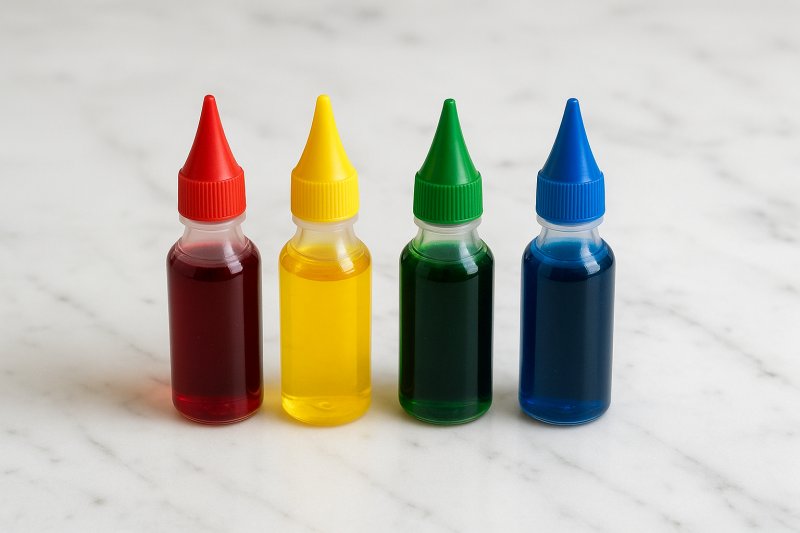
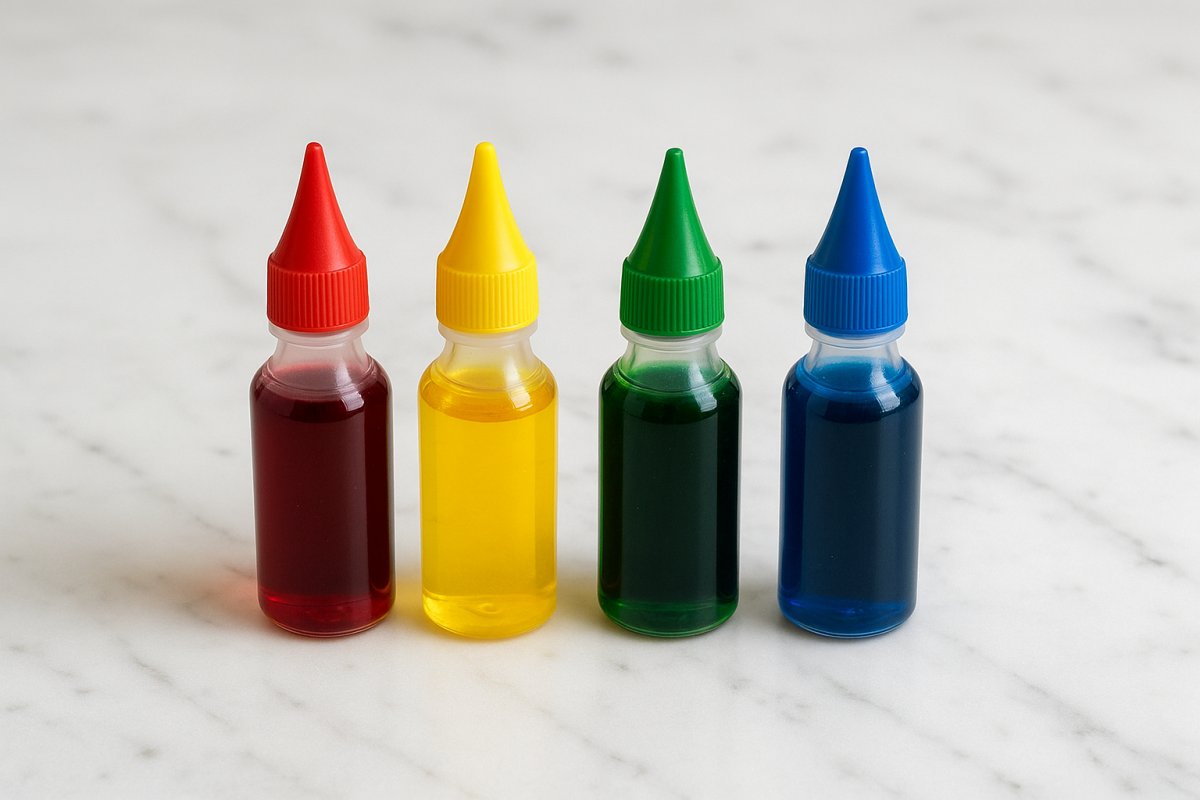
Small bottle with colorful liquid food coloring
I still clearly remember my first experiment with food coloring: a failed rainbow cake in which each layer ended up in a different, slightly too garish shade. Yet that very mishap showed me the creative power of those little bottles. For me food coloring is not just a tool, but a real design instrument in the kitchen that brings emotion, nostalgia and surprise to the plate.

I often use food coloring to break routines and make dishes more visually striking. A simple shortcrust cookie recipe suddenly becomes an eye-catcher when I gently tint the dough with pastel colors. I prefer liquid, gel and powdered variants depending on the application. Liquid colors work well for batter, gel colors for intensely colored icings, and powdered colors are ideal for chocolate or dry mixes.

A colleague of mine laughed when, as a joke, I once colored a savory mayonnaise yellow with a touch of turmeric; his reaction showed me how much color directs expectations. I therefore pay attention to the following points when using them:

  • Dosage: Less is often more, because colors can intensify during baking or cooking.
  • Compatibility: Fat-soluble colors work better in buttercreams and chocolate, water-soluble ones in batters and icings.
  • Quality: High-quality products offer stronger tones and less aftertaste.
  • Natural vs. synthetic: Natural colorants are subtler, synthetics allow more vivid results.
When I use food coloring I think about balance: color should complement the taste experience and not dominate it. I love sharing small techniques, such as how to achieve different shades by layering or create a watercolor pattern with drops and splatters. Every time I stir a bowl and see a new, surprising result, I feel that childlike joy again.

For me food coloring is therefore much more than decoration; it is a creative impulse that brings dishes to life and tells stories — often with a wink.

Availability & types

Availability and types

Food coloring is something you can find in many stores and is used to make food more colorful and appealing. There are different types of food coloring, and they are not all the same. Some are manufactured artificially, others come from plants or other natural sources. This makes them different in appearance, taste and behavior during cooking.

Where does food coloring come from?
Some colors are produced in a laboratory from chemicals. These are called artificial colorants. They are often very intense and stable, even when food is baked or frozen. Other colors come from nature: from plants, fruits, vegetables or even certain animals. Examples are beetroot juice for red, turmeric for yellow or spirulina (a type of algae) for blue-green. Natural colors can sometimes be weaker and change colour when heated.

Growing regions and places of origin
Natural colorants come from different regions of the world depending on which plant is used. Here are some examples:

  • Beetroot: Grows in many parts of Europe and North America. Farmers grow it in fields, and juice or powder is made from it for colouring.
  • Turmeric: This yellow root originally comes from India and Southeast Asia. It is cultivated in many countries because it prefers warm climates.
  • Red colorants from cochineal: These are tiny insects that live on cacti. They are collected mainly in parts of Latin America. They produce a strong red (in some products labeled as E120).
  • Spirulina and other algae: These grow in lakes or specialized farms in warm countries and provide blue to green shades.
  • Berries, grapes, carrots: Many fruits and vegetables can be grown locally, so the origin is often close to the point of sale.
Available forms and variants
In the store you will find food coloring in several forms. Each form has advantages and disadvantages, similar to different tools for different tasks.

  • Liquid colors: They come in small bottles. You add them to food with a dropper. They are easy to use but sometimes too runny for thick doughs.
  • Gels: These are thicker and very suitable for doughs or frosting (icing). They color intensely and only a small amount is needed.
  • Powders: Dry colors are practical because they have a long shelf life and fit well into dry mixes. They can be reconstituted with water.
  • Natural colors: These can be liquid, gel or powdered. They are made from plants, fruits or algae and are often a good choice if you want to avoid artificial substances.
  • Artificial colors: Usually very intense and inexpensive. They are also available in liquid or powder form and change little during baking.
How to find the right color?
If you want to buy color, first think about what you need it for: cookies, cakes, drinks or confectionery? For frozen ice cream you might need a different form than for a dry dough. Check the packaging to see if the color is suitable for baking and whether it is natural or artificial. Some people also pay attention to allergies or prefer only plant-based products.

Overall, food colorings are widely available: in supermarkets, drugstores, baking shops and online. You can choose from many variants — from natural plant colors to strong artificial dyes — and thus find the right product for your baking or cooking project.
Details & nutrition

Property Value
Unit ml
Calories per 100 5
Protein per 100 0
Carbohydrates per 100 1
Sugar per 100 0
Fat per 100 0
Saturated fat per 100 0
Monounsaturated fat 0
Polyunsaturated fat 0
Fiber per 100 0
Vitamin C (mg) per 100 0
Vitamin D (IU) per 100 0
Calcium (mg) per 100 0
Iron (mg) per 100 0
Nutri-Score C
CO₂ footprint 0.2
Origin Industrial product; origin depends on the manufacturer
Gluten-free Yes
Lactose-free Yes
Nut-free Yes
Vegan Yes
Note Nutritional values refer to commercially available liquid, water-based food coloring; actual composition varies by manufacturer and the dyes used.

Technical & scientific information

Food coloring refers to a group of additives that give foods, beverages, baked goods and confectionery visual hues or restore existing colors. The purpose of application is to make products appear more attractive or consistent, to compensate for natural color losses due to processing or storage, and to provide orientation when introducing products. Food colorants differ fundamentally in their origin, chemical composition and physical properties.

Classification and composition
Two main categories can be distinguished: natural colorants and synthetic (artificial) colorants. Natural colorants are derived from plants, animals or mineral sources and typically contain pigments or dyes such as carotenoids (e.g. beta-carotene), anthocyanins (red to blue), chlorophylls (green) and curcuminoids (yellow). Natural colorants are often mixtures of several compounds and may include accompanying substances such as proteins, sugars or lipids in addition to the primary colorant. Synthetic colorants are usually defined organic molecules based on aromatics or azo compounds, optimized for high color intensity, stability and reproducibility. Examples include azo dyes or triphenylmethane derivatives.

Physical and chemical properties
Food colorants differ in terms of water solubility, fat solubility, pH sensitivity and light stability. Water-soluble colorants (e.g. many synthetic azo dyes) are suitable for beverages and jellies, while fat-soluble pigments (e.g. carotenoids, annatto) are used in oils, margarine or fatty foods. Some colorants are pH-indicative and change their color with acidity, which can be visible in baked goods or jams. Exposure to light, heat and oxygen leads to degradation; therefore antioxidants, chelators or special packaging are used for stabilization.

Manufacturing and processing methods
Extraction (water, ethanol, supercritical CO2), filtration and concentration as well as, where applicable, drying or spray granulation are used to obtain natural colorants. Purification and standardization steps ensure the content of the active ingredient and remove unwanted accompanying substances. Synthetic colorants are produced via multi-step organic chemical syntheses, followed by purification (crystallization, chromatography) and quality controls. Formulations are optimized prior to market launch to ensure solubility, dispersibility and compatibility with other ingredients.

Nutritional values and ingredient listing
Chemically speaking, food colorants provide negligible calories and macronutrients at the usual levels of use. Nevertheless, natural extracts may contain small amounts of organic accompanying substances, such as sugars or fats, which are of little nutritional relevance. On packaging, colorants are usually listed according to legal requirements, either by name (e.g. beta-carotene) or by an E-number (in the EU), together with other excipients and solvents, if relevant.

Health aspects and regulation
The safety of food colorants is assessed and regulated internationally by authorities. Synthetic colors have undergone toxicological testing for toxicity, carcinogenicity, genotoxicity and reproductive toxicity. For approved colorants, maximum permitted levels or specific permitted uses have been established. Some colorants are suspended or banned in certain countries. Allergic reactions are rare but may occur in sensitive individuals; some natural extracts can contain allergenic accompanying substances. Public debate often focuses on possible behavioral effects in children; studies have yielded heterogeneous results, so the precautionary principle and clear labeling remain under continued scrutiny.

Application instructions and quality criteria
For industrial or home use, concentration, mixability, temperature and pH resistance as well as light stability are decisive. Colorants are offered as liquids, powders, pastes or concentrates. Quality tests include purity checks, residual solvent analysis, microbiological controls and stability tests. In organic foods only certain colorants classified as natural may be used and additives must comply with the relevant regulations.

Outlook and research
Current research focuses on developing more stable natural colorants, microencapsulated formulations to improve shelf stability and sustainable extraction methods with low solvent consumption. New analytical methods are also being developed for traceability and authenticity testing to detect adulteration and improve consumer information.

Food coloring is thus a technically and regulatory complex additive whose selection and use are determined by both functional requirements and safety and labeling rules. The balance between safety, stability, processability and consumer preferences continues to drive innovation in this field.

Wiki entry for: food coloring
Active now: 17 visitors of which 2 logged-in members in the last 5 minutes