Menu & categories

Dried banana

Sweet dried fruit with high energy and fiber content

Wiki about dried banana Nutri-Score C Vegan Yes Gluten-free Yes Lactose-free Yes Nut-free Yes
NUTRITION / 100 g
320 kcal 3.5 g Protein 75 g Kohlenhydrate 1.2 g Fett

Introduction

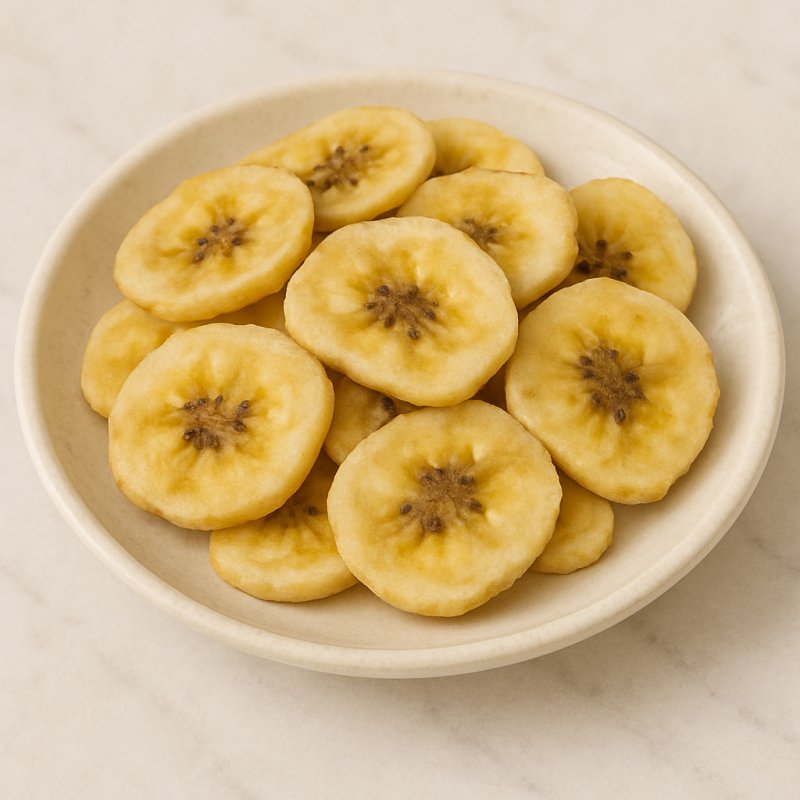
Dried banana slices on a plate
I still clearly remember the day I consciously tried dried banana for the first time: it was at a market, among spice stalls and freshly baked bread, and the scent of caramel and sun rose up to me. Since then this unassuming ingredient has not left me. Dried banana is for me a small kitchen miracle that enriches both sweet and savory dishes with a warm, concentrated fruitiness.

What fascinates me about dried bananas is their versatility. In a bowl of muesli they immediately provide deep sweetness and texture, while in salads or savory couscous dishes they create unexpected depth. A colleague of mine was skeptical until I served him a combination of dried bananas, roasted nuts and goat cheese; he was surprised at how well the flavors harmonized. The natural caramel note that develops during drying often replaces added sugar and provides a full-bodied flavor.

The preparation is very simple, although I must admit that my first batch in the home kitchen was more chewy than crispy. Since then I have learned how important even slicing and sufficient air circulation are. Professionally dried bananas usually offer a perfect balance of bite and tenderness, while homemade variants have their own rustic texture.

Practical tips for use:

  • As a snack straight from the bag they are an energy-rich companion on the go.
  • In mueslis or porridge they provide natural sweetness and a pleasant chew.
  • In baked goods they can be chopped to contribute caramel notes.
  • In savory dishes they bring a contrasting sweetness that rounds out dishes.
For me dried banana remains a faithful kitchen helper: uncomplicated, aromatic and surprisingly versatile. Sometimes a small piece is enough to turn an ordinary yogurt or a simple salad into something special. Next time you walk past a market stall or the organic shelf, feel free to take a handful — it might become your new favorite ingredient.

Availability & types

Availability and types

Dried banana is nowadays easy to find in many countries. It often appears in supermarkets, health food stores, at weekly markets or in online shops. Sometimes it sits in the snack aisle next to dried mangoes or raisins, sometimes it is packaged in smaller bags as 'banana chips'. Because dried bananas are long-lasting, they are also kept in large supplies by households, taken to school canteens or brought on trips – like a piece of sun you can eat at any time.

Origin and growing regions

Bananas grow in warm, humid regions of the world. The largest growing areas are in countries near the equator, where it is warm all year round. Important countries include:

  • Latin America (for example Ecuador, Colombia and Costa Rica) – many bananas for export come from here.
  • Southeast Asia (for example the Philippines, Indonesia and Thailand) – many bananas are also grown and processed there.
  • Africa (for example Uganda and Ethiopia) – in some regions bananas are an important staple food.
The dried bananas we buy therefore mostly come from plantations in these warm countries. Sometimes the fruit is dried there already, sometimes fresh bananas are exported and dried later in another country.

Available varieties and options

There are different types of dried bananas. The selection is a bit like choosing chips or dried fruit: depending on how they are made they look and taste different. Here's an overview:

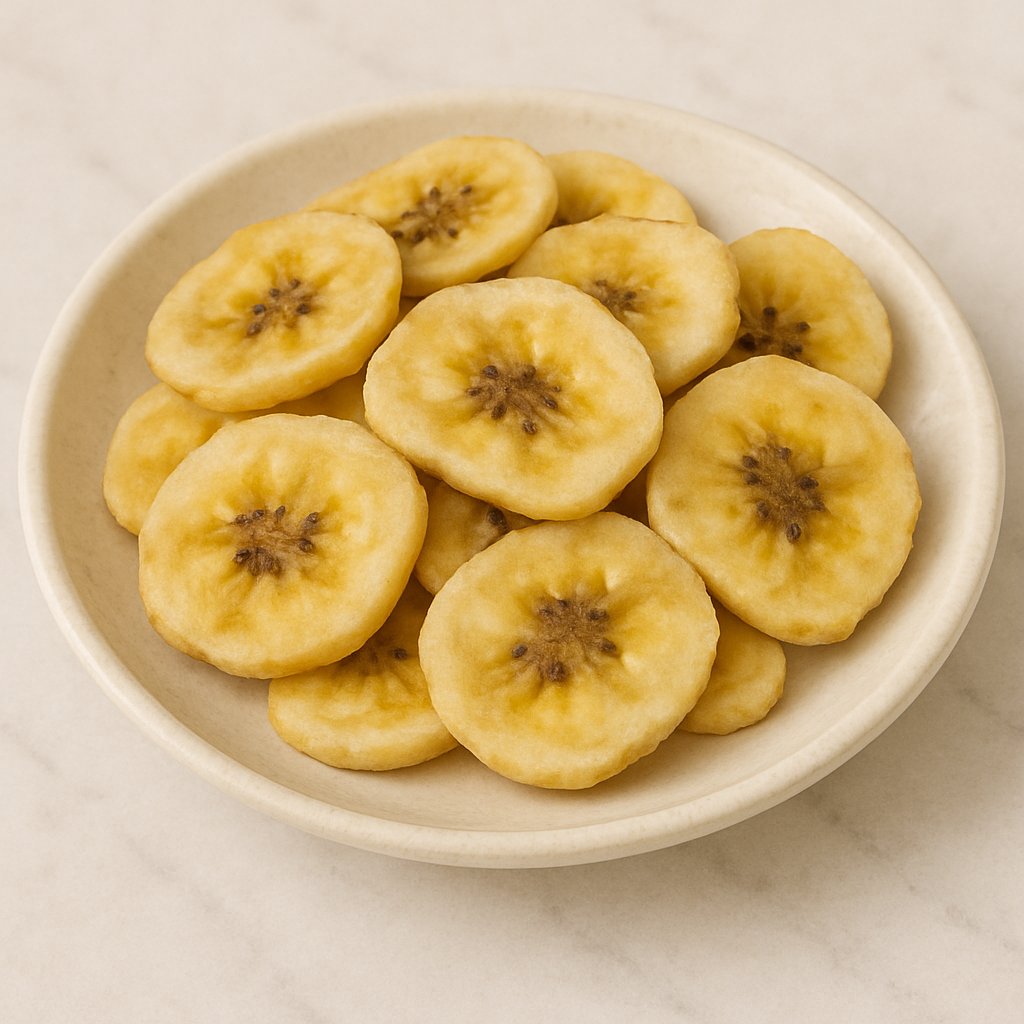
  • Natural dried bananas: These are simply sliced and dried without added sugar. They taste sweet like regular banana, often somewhat more intense because the water disappears during drying and the flavor is concentrated.
  • Banana chips: These are crispy slices, often fried or baked. Sometimes they are lightly sugared or coated with honey to make them crisper and sweeter. If you like a crunchy snack, these are the right ones.
  • Freeze-dried bananas: These are frozen very quickly and then the ice is removed. They remain light, airy and very crunchy, almost like a banana purée you can chew. The taste is very fresh.
  • Organic variants: Here bananas are grown without chemical pesticides. They are often more expensive, but many people like them because they feel more natural.
  • Spiced or flavored varieties: Sometimes there are bananas with cinnamon, cocoa or caramel. These variants are popular with people who want a special taste.
There are also differences in the original banana variety. Some dried bananas come from the well-known sweet dessert banana (the one eaten raw), others from cooking bananas (plantains). Plantains are less sweet, are often cooked and when dried yield a somewhat more robust, stronger taste – good if you want to try something new.

In summary: dried banana is widely available and comes from warm growing regions worldwide. You can choose between natural, crunchy, freeze-dried, organic or flavored variants – just like with chips or dried fruit, only with the familiar banana taste. Each variant has its own bite and flavor, so there's something for everyone.
Details & nutrition

Property Value
Unit g
Calories per 100 320
Protein per 100 3.5
Carbohydrates per 100 75
Sugar per 100 58
Fat per 100 1.2
Saturated fat per 100 0.4
Monounsaturated fat 0.2
Polyunsaturated fat 0.4
Fiber per 100 8.7
Vitamin C (mg) per 100 10
Vitamin D (IU) per 100 0
Calcium (mg) per 100 25
Iron (mg) per 100 1.2
Nutri-Score C
CO₂ footprint 0.9
Origin Tropical and subtropical producing countries
Gluten-free Yes
Lactose-free Yes
Nut-free Yes
Vegan Yes
Note Nutritional values may vary slightly depending on the drying method and any addition of sugar or oil; values refer to unsweetened, non-fried dried bananas.

Technical & scientific information

Dried banana refers to fresh bananas from which water has been removed by various drying processes in order to change shelf life, texture and the concentration of their nutrients. In food technology drying is used as a preservation method that inhibits microbial growth and slows enzymatic reactions. Dried bananas are available in the form of slices, chips, powder or pieces and serve as a snack, an ingredient in mueslis, baked goods and as a flavor carrier in industrial mixes.

Composition and nutritional values
Compared with fresh bananas, dried bananas have a significantly reduced water activity; typically the water content after drying ranges between 10 and 20 % depending on the process. This leads to a concentration of the dry matter. Per 100 g of dried banana there are approximately 300–400 kcal, with a high proportion of carbohydrates (70–90 g), mostly in the form of sugars such as sucrose, glucose and fructose. The fiber content is also increased (approx. 5–10 g/100 g), since the fiber fraction rises relative to the dry mass. Protein and fat are present in small amounts (protein 2–4 g/100 g, fat 1–3 g/100 g). Minerals and vitamins are more concentrated, for example potassium, magnesium, phosphorus and small amounts of iron as well as the water-soluble vitamins B6 and vitamin C; the latter is heat- and light-sensitive and decreases substantially during drying.

Important constituents
  • Potassium: Dried bananas are an important source of potassium, with content per dry mass considerably higher than in the fresh fruit.
  • Fiber: Pectin and cellulose contribute to a positive effect on bowel function.
  • Sugars: The natural sugars provide a rapid energy supply and influence the glycaemic effect.
  • Flavonoids and phenols: Polyphenolic compounds are present in smaller amounts and can convey antioxidant properties; their content varies depending on ripeness and the drying process.
Drying methods
Common methods are air drying (sun drying, hot air), freeze-drying and vacuum drying. In hot air drying (conventional) fruits are dried at temperatures of about 50–70 °C; this is cost-effective but can lead to browning through Maillard reactions and loss of heat-sensitive vitamins. Freeze-drying (lyophilization) removes water by sublimation after freezing; it better preserves texture, flavor and heat-sensitive nutrients but is energy-intensive and expensive. Pretreatments such as blanching, sulfiting or the application of antioxidants are used to reduce enzymatic browning and to lower microbiological risk.

Physical and chemical changes
During drying sugars and minerals become concentrated, water-binding capacity decreases, and texture becomes firm to chewy. Chemical reactions such as the Maillard reaction and caramelisation occur at elevated temperatures and affect color, aroma and nutrient content. Enzymatic browning by polyphenol oxidase can lead to dark color if inactivation is insufficient. Water activity (aw) is a decisive factor for shelf life; at aw < 0.6 microbial activity is strongly limited.

Health aspects
Dried bananas provide concentrated energy and are practical for athletes and as a quickly available carbohydrate source. However the high sugar content can contribute to increased calorie intake if consumed in excess. For people with fructose malabsorption or diabetes portion control is important, as dried fruits can have a higher glycaemic effect per unit weight. The increased fiber and potassium content is beneficial for digestion and electrolyte balance, but people with impaired kidney function should watch potassium intake. Sulfite treatments can cause intolerance reactions in sensitive individuals.

Storage and quality
Dried bananas are sensitive to light and moisture; to preserve aroma and avoid moisture uptake dry, cool storage in airtight containers is recommended. Sensory parameters such as color, smell and texture as well as microbiological checks give indications of product quality. Declarations should list additives, sugar content and possible use of sulfites.

Overall dried bananas are a nutrient-rich, shelf-stable natural product with clear technological and health implications, whose quality and nutrient profile strongly depend on initial ripeness, pretreatment and chosen drying method.

Wiki entry for: dried banana
Active now: 17 visitors of which 2 logged-in members in the last 5 minutes