Menu & categories

Couscous

Durum wheat semolina product, versatile side dish from North African cuisine

Wiki about couscous Nutri-Score C Vegan Yes Gluten-free No Lactose-free Yes Nut-free Yes
NUTRITION / 100 g
376 kcal 12.8 g Protein 77.4 g Kohlenhydrate 0.6 g Fett

Introduction

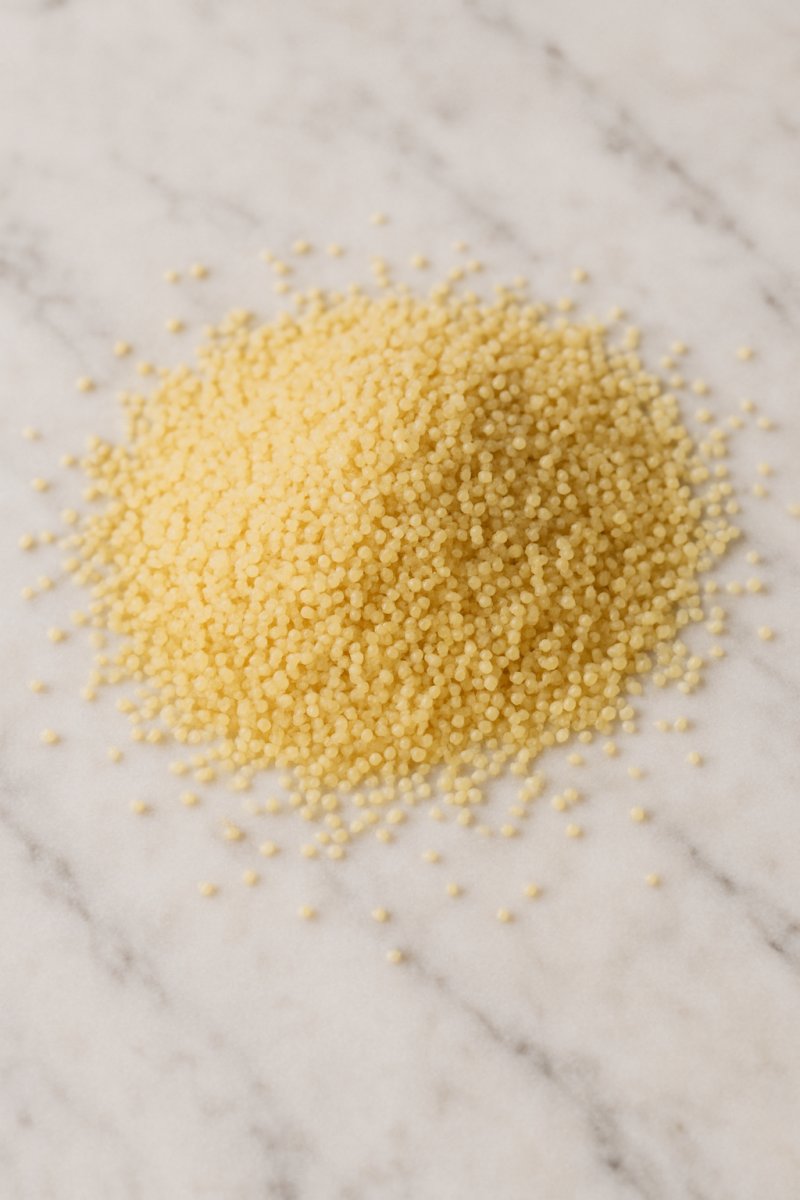
Dry couscous in a bowl
I still remember the first couscous that won my heart: not in a fancy restaurant, but at a noisy market between pots, spice stalls and laughing voices. A vendor handed me a bowl that steamed and smelled of cinnamon, coriander and freshly chopped parsley. That first bite was like a small culinary adventure that showed me how versatile and comforting these unassuming semolina pearls can be.

Couscous is more than just a side dish; to me it is a feeling of home in bowls and pots. I love how quickly it can be prepared and how it soaks up flavors as if it were a little spongy taste acrobat. Whether as a light summer salad with tomatoes, cucumbers and lemon dressing or as a rich winter version with beef, chickpeas and a pinch of ras el hanout – couscous always adapts.

A few things I like to mention about couscous again and again:

  • Versatility: Couscous works for sweet and savory dishes.
  • Quick preparation: Poured over with hot liquid it is ready in minutes and remains fluffy.
  • Texture: The small pearls offer a pleasant bite that contrasts well with soft stews.
  • Nutritional value: Couscous provides carbohydrates and pairs well with proteins and vegetables.
I have enjoyed couscous at picnics in parks, at improvised dinners with friends and at family holidays. A colleague of mine swears by serving it with apricots and almonds — a sweet-and-salty combination I now often recreate. My favorite version remains simple though: well seasoned, with plenty of lemon juice and a generous drizzle of olive oil.

When I recommend couscous to others, I emphasize the joy of experimenting. Try different broths, herbs and nuts. Lose yourself a little in spices and textures; couscous is patient and grateful and never fails to surprise with its ability to turn simple ingredients into something special.

Availability & types

Availability and types of couscous

Couscous is a very common ingredient that can be found in many supermarkets, health food stores and weekly markets. Originally from North Africa, especially countries like Morocco, Algeria and Tunisia, it has been eaten there for hundreds of years and is often part of special family meals. You can imagine couscous as small grains of durum semolina – similar to very coarse sand or small pearls made of flour and water.

Where is couscous produced and grown?
Couscous itself is not a field crop that is planted, but is made from cereals. The most important cereal for this is durum wheat. Durum wheat grows mainly in warm regions:

  • North Africa: Countries like Morocco and Algeria are traditional couscous-producing regions.
  • Mediterranean region: Durum wheat is also grown in countries such as Italy and Spain.
  • Other regions: Durum wheat is also cultivated in parts of North America and in Australia. There the grain is milled and processed into couscous.
What varieties and versions exist?
Couscous comes in different sizes and formats. Here are the main types explained simply:

  • Fine couscous: The grains are very small, almost like powder. It needs only a short time to swell and is often used for delicate dishes or as a side. Many families know it as the standard variant.
  • Medium couscous: The grains are slightly larger than fine couscous. It holds its shape better during cooking and suits vegetables or meat well.
  • Coarse or pearl couscous (also called Israeli couscous): These grains are noticeably larger and look like small pearls or tiny pasta. Sometimes it is also called ptitim. It is often lightly toasted first and has a firmer bite, almost like small pasta beads.
  • Whole wheat couscous: Made from whole durum wheat. It contains more fiber and has a slightly nuttier aroma. It is a good choice for people who want to eat healthier or stay full longer.
  • Instant or quick couscous: This couscous is prepared so that it loosens very quickly with hot water or broth. It is convenient when time is short.
  • Gluten-free alternatives: For people who cannot tolerate gluten, there are variants made from corn, millet or rice. These are not true durum wheat couscous, but they work similarly in cooking.
How to find couscous in the store?
Couscous is usually located near rice, pasta or legumes. The package often states the type (fine, medium, coarse) and whether it is whole wheat or gluten-free. Health food stores often carry organic couscous made from organically grown grains. At markets or specialty shops you can sometimes find handmade couscous or special varieties that are noticeably different from industrial products.

Couscous is therefore versatile: it originates from North Africa, is made from durum wheat, and comes in many sizes and variants – from fine grains to coarse pearls or as whole wheat and gluten-free versions. This allows almost any dish to be prepared appropriately, depending on whether you want it quickly or particularly nutritious.
Details & nutrition

Property Value
Unit g
Calories per 100 376
Protein per 100 12.8
Carbohydrates per 100 77.4
Sugar per 100 2.0
Fat per 100 0.6
Saturated fat per 100 0.1
Monounsaturated fat 0.1
Polyunsaturated fat 0.3
Fiber per 100 5.0
Vitamin C (mg) per 100 0
Vitamin D (IU) per 100 0
Calcium (mg) per 100 24
Iron (mg) per 100 1.0
Nutri-Score C
CO₂ footprint 1.0
Origin Mostly from durum wheat, cultivated mainly in the Mediterranean region and North Africa
Gluten-free No
Lactose-free Yes
Nut-free Yes
Vegan Yes
Note Nutritional values refer to dry couscous, uncooked.

Technical & scientific information

Couscous is a traditional cereal product of North African origin, made from durum semolina (durum wheat) or, less commonly, from other cereals such as barley or millet. It consists of small granular particles that are formed by moistening and then rolling or agglomerating the semolina. In industrial production, couscous is often produced by mechanically spraying semolina with water and then drying and sieving to obtain uniform grain sizes.

Chemical composition and nutrient content: Nutritionally, couscous is similar to other wheat products. Its main component is carbohydrates, mainly in the form of starch (amylose and amylopectin). Typical nutritional values for commercial, dry couscous varieties are about 70–75 g of carbohydrates, 10–13 g of protein and 1–2 g of fat per 100 g. Dietary fiber is present, and its amount varies with the degree of refinement; whole wheat couscous contains significantly more fiber (approx. 6–8 g/100 g) than products made from refined durum semolina. Minerals such as magnesium, iron and zinc and B vitamins (especially thiamine and niacin) occur in moderate amounts, while industrial processing and sieving can reduce micronutrients.

Physical and technological properties: The granular structure of couscous results from the partial wetting of the semolina, whereby proteins (mainly gluten) and the starch network form an adhesive matrix. During cooking, couscous swells quickly by absorbing water: the starch granules take up liquid and heat, the starch gelatinizes, and the particles separate into loose grains. Temperature and moisture control during processing affect grain firmness, flavor retention and the texture of the final product.

Manufacturing process: Traditionally, couscous is made by manually rolling semolina with water until small pellets form, which are then steamed, dried and, if necessary, steamed again. Industrial processes replace manual rolling with mechanical granulation: fine semolina is sprayed or moistened with water, aggregated in rotating drums or granulators, then dried and classified. Pre- and post-treatments such as parboiling (pre-drying/steaming) or precooking can reduce preparation time and modify the texture.

Health aspects: From a nutritional standpoint, couscous is a carbohydrate-rich side dish with a moderate protein share. Whole grain variants provide additional fiber, which increases satiety and can attenuate the postprandial glycemic response. Because durum wheat contains gluten, couscous is unsuitable for people with celiac disease or severe gluten intolerance. Wheat protein allergies should also be considered. Industrially produced couscous may contain traces of additives or preservatives, but these are rarely required in standard-compliant products.

Safety and storage aspects: Dry couscous is shelf-stable when stored properly, as low moisture inhibits microbial growth. After rehydration or cooking couscous should be cooled quickly and stored in the refrigerator, because its moist surface is susceptible to microbial spoilage. Improper preparation can lead to starch retrogradation and grain smearing, which impairs sensory quality.

Culinary and nutritional use: Couscous is versatile and is used as a side dish, in salads (e.g., tabbouleh), as a base for stews or as a stuffing. Combining it with protein-rich foods, legumes and vegetables improves the amino acid profile of a meal and increases its vitamin and mineral content. For a healthier preparation, the use of whole wheat couscous and supplementation with vegetables, healthy fats and proteins is recommended.

Overall, couscous is a cereal product that is technically simple to produce, with a well-defined composition and good functional properties in the kitchen. Its nutritional advantages and disadvantages depend largely on the degree of processing and the composition of the meal, while storage and preparation conditions significantly influence quality.

Wiki entry for: couscous
Active now: 18 visitors of which 2 logged-in members in the last 5 minutes