Menu & categories

Condensed milk

Condensed milk with 10% fat – creamy, mild and versatile for cooking and baking.

Wiki about condensed milk Nutri-Score C Vegan No Gluten-free Yes Lactose-free No Nut-free Yes
NUTRITION / 100 g
165 kcal 7.2 g Protein 10.0 g Kohlenhydrate 10.0 g Fett

Introduction

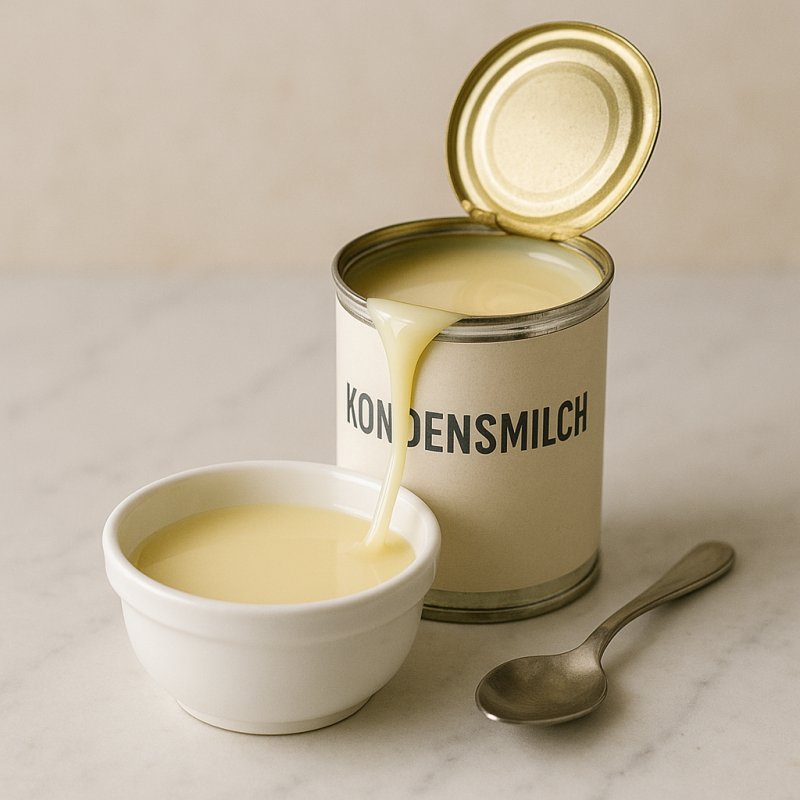
Condensed milk in a bowl
I have a soft spot for ingredients that look unassuming at first glance, and condensed milk 10% fat definitely belongs to that group. The first time I found a can of this in a tiny corner shop, I thought it was simply a low-fat alternative — but I quickly realized this product can do much more than just save fat. The texture is silky, the sweetness subtle, and its heat tolerance makes it a brilliant ingredient in both sweet and savory recipes.

What always impresses me is the versatility: a splash of condensed milk turns a simple coffee into a creamy experience without making it watery. I remember a rainy afternoon when a friend spontaneously tried avocado cream with condensed milk and we were both surprised at how rounded and velvety the result was. These small kitchen adventures show that 10% fat is often enough to provide flavor and mouthfeel without weighing you down.

For those who love practical tips, I have summarized a few of my favorite uses:

  • In drinks: For iced coffee, Thai-style drinks or hot chocolate – a spoon is enough to add creaminess.
  • In baking: As part of fillings, in caramel sauces or in muffin batter for extra moisture.
  • As a substitute: For cream in light sauces or desserts when you watch fat but don't want to give up flavor.
A colleague of mine was once skeptical until he tried a simple plum compote cream made only from fruit and condensed milk — since then the can has sat in his cupboard like a little kitchen magician. I particularly like that the product is long-lasting and therefore always on hand when unexpected guests arrive or a recipe needs rescuing.

In summary: condensed milk 10% fat is an unobtrusive, flexible ingredient that brings creaminess and flavor without dominating. For me it remains a ready helper that surprises and delights in many recipes.

Availability & types


Availability and types of the ingredient condensed milk 10% fat

Condensed milk with 10% fat is a spreadable, thicker form of milk often sold in cans or cartons. It is produced when part of the water is evaporated from regular cow's milk. This makes the milk thicker and longer-lasting. Many people use it for baking, coffee or desserts. You can find it in almost every supermarket, in delicatessen shops and online – sometimes in the baking aisle or with coffee specialties.

Origin and production areas
Condensed milk is usually made from cow's milk. Cows supply the milk on farms; the largest milk-producing regions are in Europe (for example Germany, the Netherlands), North America, South America (such as Brazil) and parts of Asia and Africa. That means: the milk often comes from nearby, but sometimes the finished condensed milk is also imported. Products labeled “organic” come from farms with specific rules for feed and husbandry – this is indicated on the packaging.

Important word explained: “Pasteurized” means the milk has been briefly heated to reduce microbes. This makes it safer to eat and extends shelf life. Many condensed milk products are pasteurized or additionally packaged sterilely.

Available varieties and variants
There are several variants of condensed milk 10% fat. Here is an overview to give you an idea of what exists:

  • Sweetened condensed milk: Sugar has been added. It is very sweet and is often used for desserts, cakes or as a spread. In some countries it is called “Leche condensada”.
  • Unsweetened condensed milk (Evaporated Milk): This type contains no added sugar. It is more suitable for savory recipes or for refining sauces.
  • Light variants: 10% fat is already a lighter option compared to full-fat dairy products. There are also higher-fat or reduced-fat versions, depending on how much fat you want.
  • Flavored variants: Sometimes condensed milk is available with vanilla, caramel or chocolate – ready-flavored products.
  • Organic and regional products: Brands with organic certification or “regional” indicate that the milk was produced ecologically or sourced locally.
  • Lactose-free or vegan alternatives: For people who cannot tolerate milk sugar, there are lactose-free condensed milks. There are also plant-based condensed milks made from soy or coconut that are similarly thick and can be used in similar ways.
  • Packaging types: Cans, cartons (Tetra Pak) or screw-top bottles – cans often keep longer at room temperature, opened products usually need to be refrigerated.
A simple picture: imagine regular milk is like a thin juice. Condensed milk is like that juice with much of the water removed — it is more concentrated and creamier. That's why often a small spoon is enough to give a recipe a lot of flavor.

In summary: condensed milk 10% fat is easy to find, usually comes from milk regions of the world, and there are many variants – sweetened or unsweetened, organic or vegan, in cans or cartons. The packaging states exactly which type it is and how to store it after opening.

Details & nutrition

Property Value
Unit g
Calories per 100 165
Protein per 100 7.2
Carbohydrates per 100 10.0
Sugar per 100 10.0
Fat per 100 10.0
Saturated fat per 100 6.5
Monounsaturated fat 2.7
Polyunsaturated fat 0.3
Fiber per 100 0.0
Vitamin C (mg) per 100 1.0
Vitamin D (IU) per 100 0
Calcium (mg) per 100 250
Iron (mg) per 100 0.2
Nutri-Score C
CO₂ footprint 1.3
Origin EU (milk from regional agriculture, depending on the manufacturer)
Gluten-free Yes
Lactose-free No
Nut-free Yes
Vegan No
Note Unsweetened condensed milk (concentrated milk) with 10% fat; ideal for refining sauces, soups, coffee and desserts.

Technical & scientific information

Condensed milk 10% fat denotes a concentrated dairy product in which the fat fraction is normalized to about ten percent by weight. The term covers both sweetened and unsweetened variants; in households “condensed milk” commonly refers to the sweet products, while the unsweetened form is technically called evaporated milk. It is characterized, compared to fresh milk, by a reduced water fraction and thus an increased density of milk components such as proteins, lactose and minerals.

Chemical composition and ingredients
The main components are milk fat (triglycerides with saturated and unsaturated fatty acids), milk proteins (mainly caseins and whey proteins), lactose as the dominant carbohydrate and minerals such as calcium and phosphorus. By removing part of the water, the concentrations of these components increase relatively. In sweetened condensed milk sucrose is also added, which significantly increases the total solids and reduces water activity.

Manufacturing process

  • Standardization: Raw milk is adjusted to the desired fat content; for a “10% fat” product fat and dry matter are specified.
  • Homogenization: Reduction of fat globules to stabilize the emulsion and improve texture.
  • Concentration by evaporation: Water is reduced under vacuum and at gentle temperatures to minimize heat damage and preserve sensory properties.
  • Addition of sugar (optional): In sweet condensed milk sucrose is incorporated up to a defined portion; sugar increases viscosity and acts as a preservative by lowering water activity.
  • Thermal treatment and filling: Sterilization or UHT steps ensure shelf life; aseptic filling into cans or cartons prevents recontamination.
Physical and sensory properties
Condensed milk has higher viscosity and a creamier mouthfeel compared to fresh milk. Heat exposure during production promotes Maillard reactions between amino acids and sugars, which can lead to a browner color and caramel-like aromas, especially in sweetened variants.

Nutritional and health aspects

  • Due to the reduced water content, condensed milk is more energy-dense; the caloric value depends strongly on the sugar content.
  • The fat fraction consists predominantly of saturated fatty acids, which with excessive consumption can increase intake of saturated fats.
  • Milk protein provides all essential amino acids and is of high nutritional quality.
  • For lactose-intolerant individuals, the remaining lactose content can pose a tolerance problem.
  • Sweetened condensed milk should be consumed in moderation because of its high sugar and energy content, especially where there are risks of overweight or dental caries.
  • As a dairy product, condensed milk is an allergen and unsuitable for people with milk allergy.
Technological and regulatory notes
The exact requirements for composition and labeling vary regionally through food law and standards. For industrial applications properties such as heat stability, emulsifying and dispersing behavior and shelf life are relevant parameters. In the kitchen condensed milk is widely used in coffee, baked goods, desserts and as an ingredient in confectionery products.

In summary, condensed milk with 10% fat is a dense, shelf-stable milk derivative with an increased content of milk components and typical technological properties produced by evaporation, homogenization and thermal treatment; nutritionally it provides concentrated nutrients but, due to fat and possibly sugar content, also brings health considerations that should be taken into account when using it.

Wiki entry for: condensed milk
Active now: 12 visitors of which 2 logged-in members in the last 5 minutes