Menu & categories

Coconut milk

Plant-based milk alternative made from the flesh of the coconut

Wiki about coconut milk Nutri-Score D Vegan Yes Gluten-free Yes Lactose-free Yes Nut-free Yes
NUTRITION / 100 ml
190 kcal 2.0 g Protein 3.0 g Kohlenhydrate 19.0 g Fett

Introduction

A glass of coconut milk next to a halved coconut
I have a strange relationship with coconut milk: for me it is at once a comforter on gray days and the secret hero of the parties I organize. When I open a can, that creamy-sweet scent rises to my nose and reminds me of a spontaneous evening when a colleague of mine unexpectedly showed up with a Thai curry. He laughed when he saw my skeptical expression and explained that coconut milk holds everything together. He was right.

Coconut milk is no longer an exotic secret but a versatile ingredient in many kitchens. It is produced when the flesh of ripe coconuts is grated and pressed with water. The result ranges from thick and rich to thin and light in consistency, depending on how much water is used. These differences are useful: for desserts and creamy sauces I reach for the thick version, while the thin version is excellent for steaming vegetables or as a base for soups.

What I particularly love about coconut milk is its ability to carry flavors while adding its own touch of sweetness. I still remember an improvised dessert where I combined coconut milk with lime zest, honey and a little vanilla — a small triumph after a long day. In savory dishes it also harmonizes wonderfully with spices like turmeric, cumin or kaffir lime leaves.

There are a few practical tips I've gathered over the years for using it:

  • Shake or stir: Coconut milk can separate; I shake the can or stir it thoroughly before use.
  • Heat: It tolerates moderate heat well, but if boiled too vigorously it can curdle; I take pots off the heat in time.
  • Vegan use: As a plant-based alternative it is excellent for stews, smoothies and baked goods.
Some people avoid coconut milk because of the fat content, but in my kitchen it is an ingredient used with restraint and joy. It brings texture, depth and a soothing mildness to a dish. Every time I ladle a spoonful of curry onto a plate or drizzle coconut cream over fruit, I think of that evening with my colleague and how a simple ingredient can transform a meal.

Availability & types

Availability and types

Coconut milk comes from the fruit of the coconut palm, which grows mainly in warm, tropical regions. You can think of it like juice from the coconut that is produced by grating the white flesh with water. Coconut palms are found especially in countries such as Thailand, Indonesia, the Philippines, India, Sri Lanka, some Pacific islands and parts of Africa and South America. There the palms are often part of everyday life: people use the fruits for food, the fibers for mats or ropes and the leaves for roofs.

In stores coconut milk is available in different forms depending on how much fat and how creamy it is. The main variants are:

  • Full-fat coconut milk: This is very creamy and has a high fat content (often 18–22%). It is well suited for curries, desserts or dishes where you want a silky, rich consistency. You can compare it to cream, except that it comes from coconut.
  • Coconut cream: Even thicker and higher in fat than full-fat coconut milk. It is used when you want particularly thick sauces or desserts. Imagine it as the solid part that forms at the top of a can when the coconut milk has been allowed to sit.
  • Light or reduced-fat coconut milk: Here part of the fat has been removed, making it thinner and less creamy. It is similar to low-fat milk and is chosen when you want to save calories or need a lighter consistency.
  • Coconut water: This is not the same as coconut milk. Coconut water is the clear liquid from young green coconuts. It is light and refreshing, whereas coconut milk is made from the flesh and is white and creamy.
  • Ready-to-drink beverages: Supermarkets also sell coconut-based drinks mixed with water and sometimes sugar or flavorings. They are ready to drink but are usually thinner than real canned coconut milk.
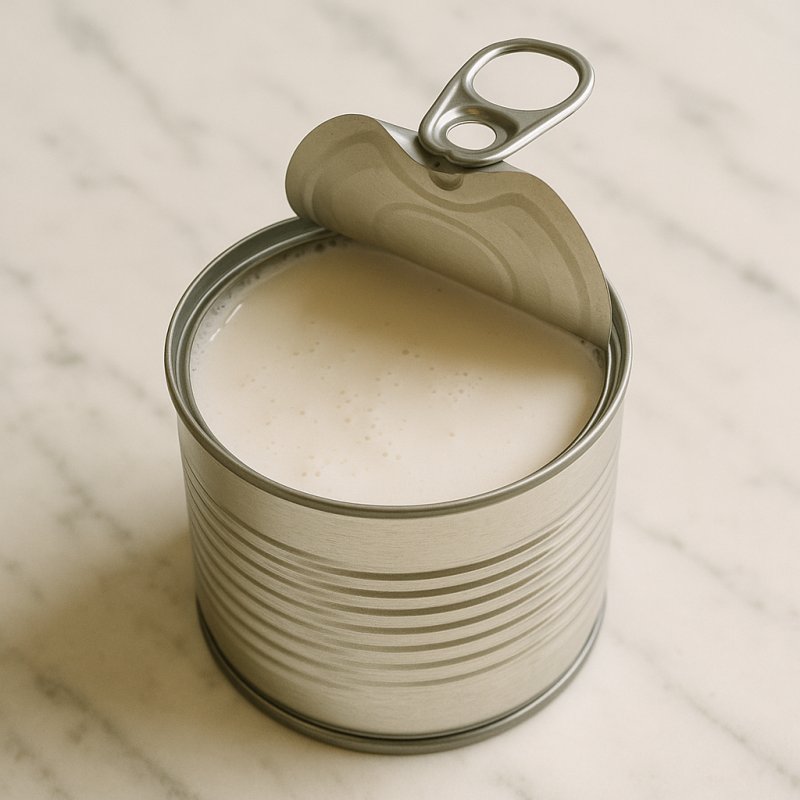
You can buy coconut milk in cans, Tetra Paks or bottles. Cans are often the creamiest variants; Tetra Paks are practical because they have a longer shelf life, and bottles are good for quick use. Check the label when shopping: some products contain only coconut and water, others have additives like stabilizers or sugar. If you want a natural variant, choose products with few ingredients.

Organic products are also available. With organic coconut milk the coconuts come from organic farming, meaning they are grown without certain chemicals or synthetic fertilizers. This can be important for people who pay attention to environmental and health issues. There are also specific variants such as unsweetened coconut milk for savory dishes or sweetened versions for desserts.

One last tip: if you want to try fresh, homemade coconut milk, you can blend grated coconut flesh with hot water and press it through a cloth. The result is natural and often very aromatic. Purchased products are practical because they have long shelf life and are quick to use. So there is something for every taste and use – from thick coconut cream for festive meals to light coconut milk for a quick smoothie.

Details & nutrition

Property Value
Unit ml
Calories per 100 190
Protein per 100 2.0
Carbohydrates per 100 3.0
Sugar per 100 2.0
Fat per 100 19.0
Saturated fat per 100 17.0
Monounsaturated fat 0.8
Polyunsaturated fat 0.3
Fiber per 100 0.0
Vitamin C (mg) per 100 2.0
Vitamin D (IU) per 100 0
Calcium (mg) per 100 15
Iron (mg) per 100 1.6
Nutri-Score D
CO₂ footprint 0.6
Origin Tropical regions, especially Southeast Asia
Gluten-free Yes
Lactose-free Yes
Nut-free Yes
Vegan Yes
Note Nutritional values refer to unsweetened canned coconut milk with approximately 17–20% fat.

Technical & scientific information

Coconut milk is a milk-like product obtained from the flesh of the coconut (Cocos nucifera), predominantly used in Southeast Asian, Caribbean and Pacific cuisines. Technically, it is an emulsion of water, plant lipids and dissolved solids, produced by mechanically pressing or mixing grated coconut flesh with water. The physical stability and composition of coconut milk vary depending on production methods and the water ratio.

Chemical composition and constituents
Coconut milk consists mainly of water (about 50–85%), lipids (15–25% in standard products, up to 30–60% in creamy extracts) and a share of dissolved carbohydrates and proteins (typically 2–5%). The lipid fraction is mainly rich in saturated fatty acids; the dominating fatty acid type is lauric acid (C12:0), with myristic, palmitic and caprylic acids also present. Lauric acid makes up a significant portion of medium-chain triglycerides (MCTs), which are metabolized differently than long-chain fatty acids.

Nutritional value
The caloric content varies with fat content; commercial coconut milk typically contains 150–230 kcal per 100 ml, with full-fat variants providing noticeably more. Per 100 g there are typically 15–24 g fat, 2–4 g carbohydrates (of which sugars) and 1–3 g protein. Coconut milk also supplies small amounts of minerals such as potassium, magnesium and iron, as well as fat-soluble vitamins and phytochemicals like tocopherols and secondary plant compounds.

Processing methods
Traditionally, coconut milk is obtained by rubbing the fresh white endosperm and pressing it with water. Industrial processes use mechanical centrifugation, high-shear dispersion and emulsifiers for standardization. A distinction is often made between "thick coconut milk" (first press, high fat content) and "thin coconut milk" (further extraction with additional water). Sterilization and pasteurization processes extend shelf life; homogenizing processes improve emulsion stability. Preservatives and stabilizers such as carrageenan or guar gum are sometimes added to prevent separation and sedimentation.

Physical and chemical properties
Coconut milk is a colloidal emulsion: lipid droplets are dispersed in an aqueous phase and stabilized by membrane- or protein-based layers. Temperature changes affect the melting point of the saturated fats: on cooling, precipitation or solidification can occur; on heating the emulsion remains prone to phase separation if cooked too strongly or for too long. The pH is slightly acidic to neutral, typically around 6–7, which limits microbiological stability without preservatives.

Health aspects
Due to the high proportion of saturated fatty acids, coconut milk is evaluated controversially in nutrition discussions. Medium-chain triglycerides are partly metabolized more quickly and can, when consumed in moderation, serve as an energy source. However, epidemiological data and clinical studies are inconsistent regarding effects on blood lipids and cardiovascular risk; therefore many professional societies recommend limiting overall saturated fat intake. For people with lactose intolerance or cow's milk protein allergy, coconut milk is a plant-based alternative. For individuals with nut allergies, individual tolerance should be assessed, since coconut is botanically a drupe, but allergic reactions are possible.

Applications and storage
Coconut milk is used in soups, curries, desserts and beverages and also serves as a base for plant-based milk alternatives. For industrial use, stabilized concentrates are often employed. Unopened cans have a long shelf life; once opened coconut milk should be stored in the refrigerator and consumed within a few days, as it is perishable and flavor and texture can change.

In summary, coconut milk is a versatile plant-based emulsion with a characteristic composition of water, saturated fatty acids, soluble solids and trace elements; its physical properties and nutritional effects depend strongly on fat content and processing, so conscious selection and moderate consumption are advisable.

Wiki entry for: coconut milk
Active now: 20 visitors of which 2 logged-in members in the last 5 minutes