Menu & categories

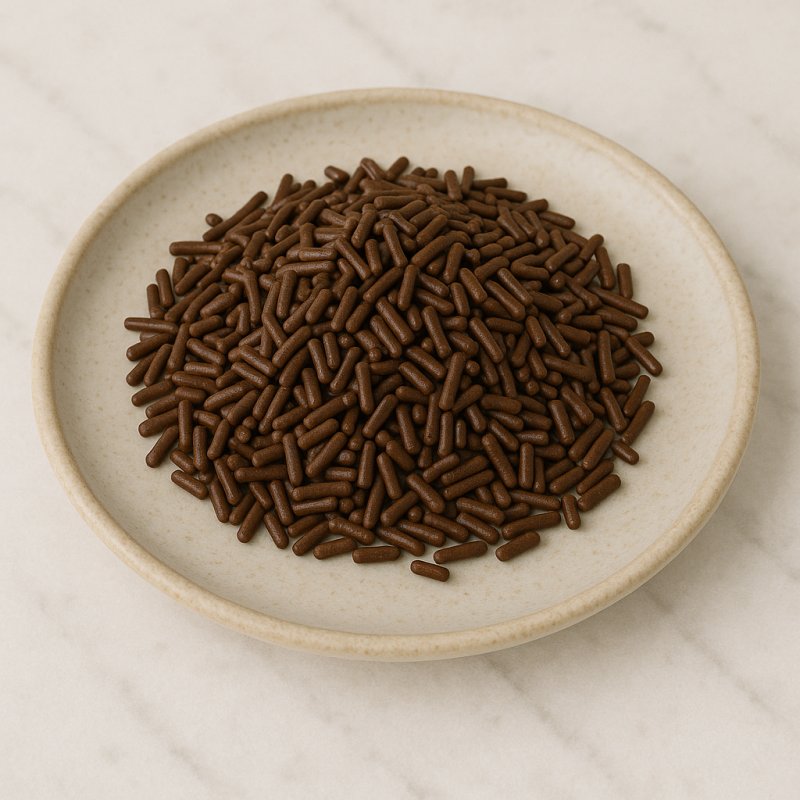
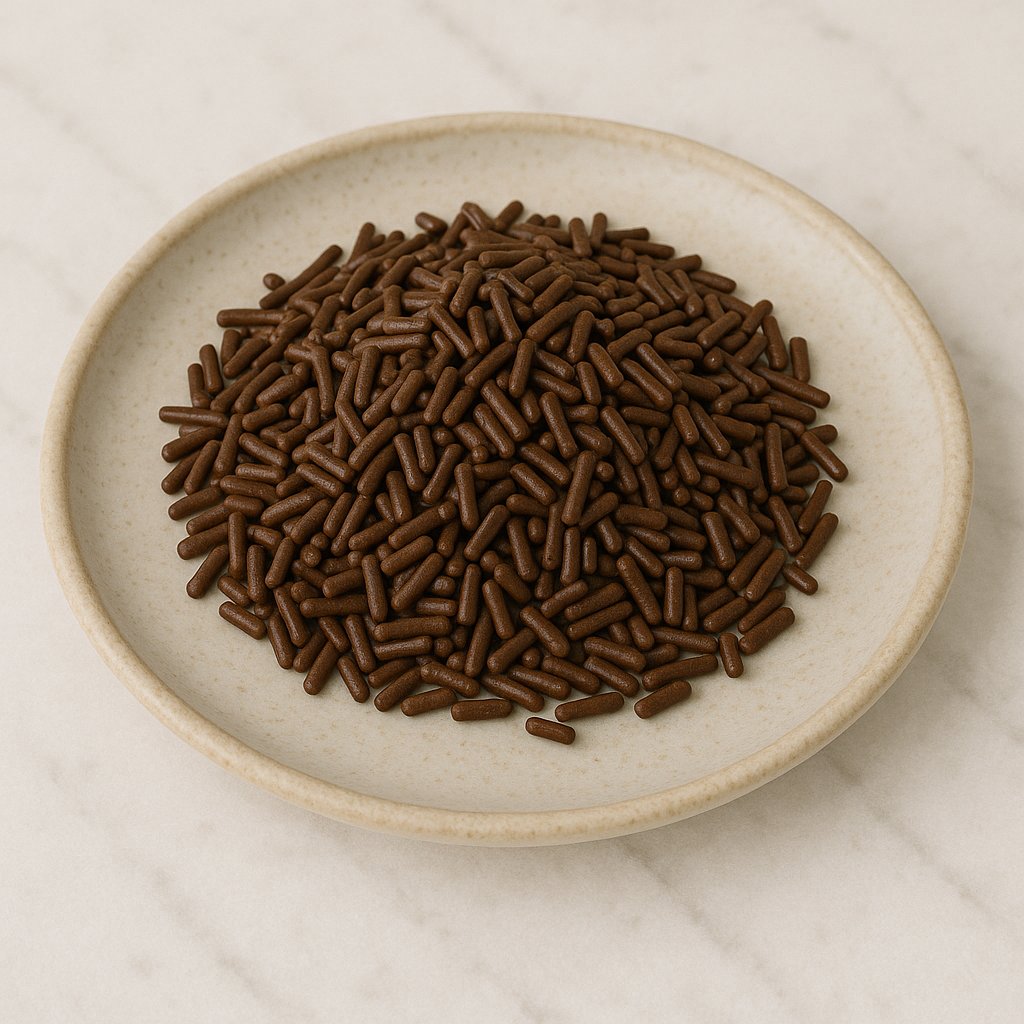
Chocolate sprinkles

Colorful decorative chocolate sprinkles for desserts and baked goods

Wiki about chocolate sprinkle Nutri-Score E Vegan No Gluten-free No Lactose-free No Nut-free No
NUTRITION / 100 g
470 kcal 4.0 g Protein 70.0 g Kohlenhydrate 20.0 g Fett

Introduction

Chocolate sprinkles as decoration on baked goods
I still vividly remember the first moment chocolate sprinkles swept my heart: it was a rainy afternoon, and a friend brought a simple yogurt cake topped with a crispy layer of dark sprinkles. Already at the first bite the intense cocoa melted with the soft cream, and I thought: Why didn't I discover this earlier?

Chocolate sprinkles are for me a little culinary chameleon. They can turn a plain dessert into something festive or immediately give a bowl of ice cream character. I've seen them in the most inconspicuous moments – on sandwiches in a kindergarten alley, lovingly sprinkled over pancakes by a grandmother, and on elegant desserts in cafés, where a fine layer of dark chocolate looks like powdered sugar. This versatility makes them so appealing.

What I especially like about chocolate sprinkles is the combination of texture and flavor. They offer:

  • a crunchy contrast to soft creams and mousses,
  • a decorative touch that makes desserts instantly more appealing,
  • and an intense chocolate flavor that varies from sweet to bitter depending on the variety.
I like to experiment with different types: milk chocolate for nostalgia, dark chocolate for a more grown-up note and white chocolate when I want something playful. A colleague of mine swears by coarse sprinkles instead of fine grains because they deliver more "crunch" when eating and feel more interesting between the teeth. When choosing, I pay attention to ingredients — good cocoa, few artificial flavors and a decent texture.

In the kitchen chocolate sprinkles are an uncomplicated friend. They are ideal for saving leftovers: a flattened cookie, a damaged sponge cake or a jar of pudding become attractive again with a handful of sprinkles. For special occasions I decorate cake edges with sprinkles or intentionally sprinkle unevenly to achieve a rustic, inviting look.

In the end chocolate sprinkles, for me, are more than just sugar and cocoa; they are a small confession to the joy of eating — accessible, versatile and always ready to beautify a moment.

Availability & types

Availability and types

Chocolate sprinkles are easy to find in many supermarkets, bakeries and patisseries. They are often offered in the baking aisle next to sugar sprinkles, icings and other decorations. You can also order them online if a particular design or color is wanted. Because sprinkles are small, lightweight and long-lasting, many stores stock them year-round — not just for special occasions like birthdays or Christmas.

Origin
Although sprinkles are manufactured in many countries, the story of chocolate usually begins with the cocoa bean. Cocoa beans grow in warm, humid regions around the equator. Countries like Ivory Coast, Ghana, Ecuador and Brazil are important sources of cocoa. The beans are harvested, fermented, dried and then processed into chocolate. From this chocolate the small sprinkles are finally made, either directly from chocolate or from a mixture of sugar and cocoa powder.

Growing regions
The plants that produce cocoa beans are called cocoa trees. They grow in regions that are hot and humid because the plants like shade, rain and steady temperatures. These are mostly countries in West Africa, South America and parts of Asia. These areas are important because a lot of the cocoa used by manufacturers for chocolate and chocolate sprinkles is produced there.

Available varieties and variants
Chocolate sprinkles come in many shapes and flavors. Here are the most common types, simply explained:

  • Dark chocolate sprinkles: These are darker and have a more intense chocolate taste. They are like dark chocolate — not so sweet, rather robust.
  • Milk chocolate sprinkles: These taste sweeter and creamier, similar to milk chocolate. Children often particularly like this variety.
  • White chocolate sprinkles: These are light and sweet because they contain no cocoa solids, but mainly sugar and cocoa butter. They taste reminiscent of vanilla and sweetness.
  • Colored chocolate sprinkles: Sometimes sprinkles are additionally colored so they can decorate colorful cakes or cupcakes. The color comes from food dyes, not directly from the chocolate.
  • All-chocolate sprinkles: These are made completely from chocolate, so they have a firmer taste and melt nicely when placed on something warm.
  • Chocolate chips or shavings: These are a bit larger and more irregular than the typical "sprinkles." They look like small chocolate shards and are often sprinkled on ice cream or cakes.
  • Sugar-coated chocolate sprinkles: Some sprinkles have a thin sugar coating on the outside, so they stay crunchier longer and are often more colorful.
Additionally some manufacturers offer special variants, for example with less sugar, with vegan recipes (without dairy) or with organic ingredients. These variants are intended for people with certain dietary preferences — for example, because they don't tolerate milk or prefer products from organic farming.

A simple comparison: imagine chocolate sprinkles as different pens in a pencil case. Some are thick and dark (dark chocolate), some are light and soft (milk chocolate), others are colorful and special (colored or sugared). That way you can choose the "pen" that best fits the cake or ice cream.

Because there are so many types, you will usually find a variety that suits your taste or occasion — and if you are looking for something specific, it's worth checking online or in specialty stores.
Details & nutrition

Property Value
Unit g
Calories per 100 470
Protein per 100 4.0
Carbohydrates per 100 70.0
Sugar per 100 65.0
Fat per 100 20.0
Saturated fat per 100 12.0
Monounsaturated fat 5.0
Polyunsaturated fat 1.0
Fiber per 100 3.0
Vitamin C (mg) per 100 0
Vitamin D (IU) per 100 0
Calcium (mg) per 100 80
Iron (mg) per 100 1.5
Nutri-Score E
CO₂ footprint 3.5
Origin Mostly produced industrially in Europe
Gluten-free No
Lactose-free No
Nut-free No
Vegan No
Note Nutritional values may vary depending on manufacturer and chocolate content; often contain additional colorings and flavorings as well as emulsifiers.

Technical & scientific information

Chocolate sprinkles are small, mostly cylindrical or flat-shaped decorative pieces based on cocoa, frequently used to decorate baked goods, desserts and ice cream. They consist mainly of cocoa mass, sugar and vegetable fats or cocoa butter, as well as emulsifiers and, where applicable, flavorings. Industrially produced sprinkles are formulated to control shape stability, gloss and melting point, so that they remain firm at room temperature but show a pleasant melting behavior in the mouth.

Chemical composition and ingredients: The main components are cocoa mass (contains cocoa butter, cocoa solids and cocoa proteins), sugar (sucrose or glucose syrup) and fats (cocoa butter or inexpensive vegetable fats such as palm oil). In addition, emulsifiers such as lecithin (soy or sunflower lecithin) are used to stabilize the dispersion of fat and solids. Stabilizers and antioxidants (e.g. tocopherols) can be added to extend shelf life. Colored sprinkles additionally contain food colorings and possibly anti-caking agents such as talc or silicates so that the pieces do not clump.

Nutritional values: Chocolate sprinkles are calorie-dense, since they mainly consist of sugar and fat. Typical nutritional values per 100 g range from 400–550 kcal, with fat content of 20–40 g and carbohydrate content (mainly sugars) of 50–70 g. Protein content is low; micronutrients from cocoa such as flavanols are often present only in small amounts in sprinkles, because many industrial products are made from heavily processed cocoa bases and with high sugar and fat content.

Manufacturing process: Production combines process steps from chocolate and extrusion technology. First, the solid and liquid components are mixed and homogenized. For forming cylindrical sprinkles an extrusion step is often used: the mass is pressed through a nozzle and cut into small pieces. Alternatively, flat sprinkles are produced by a cold rolling or casting technique, where thin layers are cooled and broken into pieces. Subsequent drying and tempering secure the desired crystalline structure of the fats to optimize fracture resistance and melting behavior.

Physical properties: Particularly relevant are the melting point, the crystal form of the fats (polymorphism of cocoa butter) and the particle size. A controlled melting point ensures that sprinkles remain shape-stable at room temperature but melt quickly when consumed. The polymorphism influences gloss, texture and snap. When alternative fats are used, different crystal patterns are achieved, which change the sensory properties.

Health aspects: Chocolate sprinkles are a treat and should be consumed in moderation because of their high sugar and fat content. Health-relevant are possible allergens such as soy lecithin or traces of milk in "chocolate-like" products. Palm-oil-containing variants are criticized for ecological reasons; therefore many manufacturers offer palm-oil-free products or products using fair-trade cocoa. For people with cocoa intolerance or certain metabolic disorders (e.g. fructose malabsorption in recipes containing fructose), specific labeling can be important.

Sensory and application: Sensory evaluation relates to taste (cocoa-intense to sweet), texture (crunchy to soft) and visual properties. Chocolate sprinkles are valued for their stability and ease of use and are used on cakes, pastries, ice cream as well as in packaged baked goods. Colored variants expand the range of applications for decorative purposes.

In summary, chocolate sprinkles are technically formulated decorative ingredients dominated by sugar, fat and cocoa components. Their manufacture combines principles of chocolate processing and extrusion or cold forming, with physical parameters such as fat crystallization and melting behavior deliberately controlled. From a health perspective they should be classified as calorie-dense treats; labeling of allergens, fat sources and dyes used is relevant for consumers, as is choosing palm-oil-free or fair-trade cocoa products for ecological sensitivity.

Wiki entry for: chocolate sprinkle
Active now: 14 visitors of which 2 logged-in members in the last 5 minutes