Menu & categories

Chocolate sauce

Sweet cocoa sauce for enhancing desserts and beverages.

Wiki about chocolate sauce Nutri-Score E Vegan No Gluten-free Yes Lactose-free No Nut-free Yes
NUTRITION / 100 g
310 kcal 2.0 g Protein 72.0 g Kohlenhydrate 3.5 g Fett

Introduction

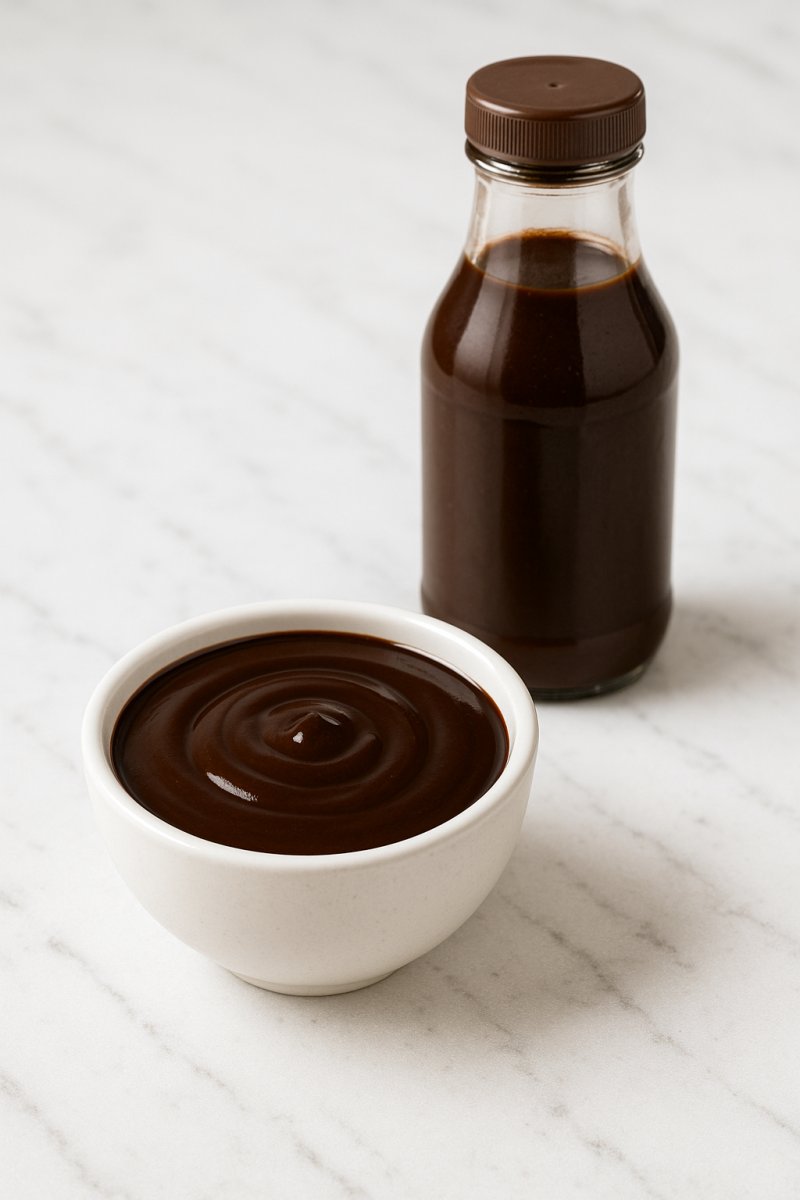
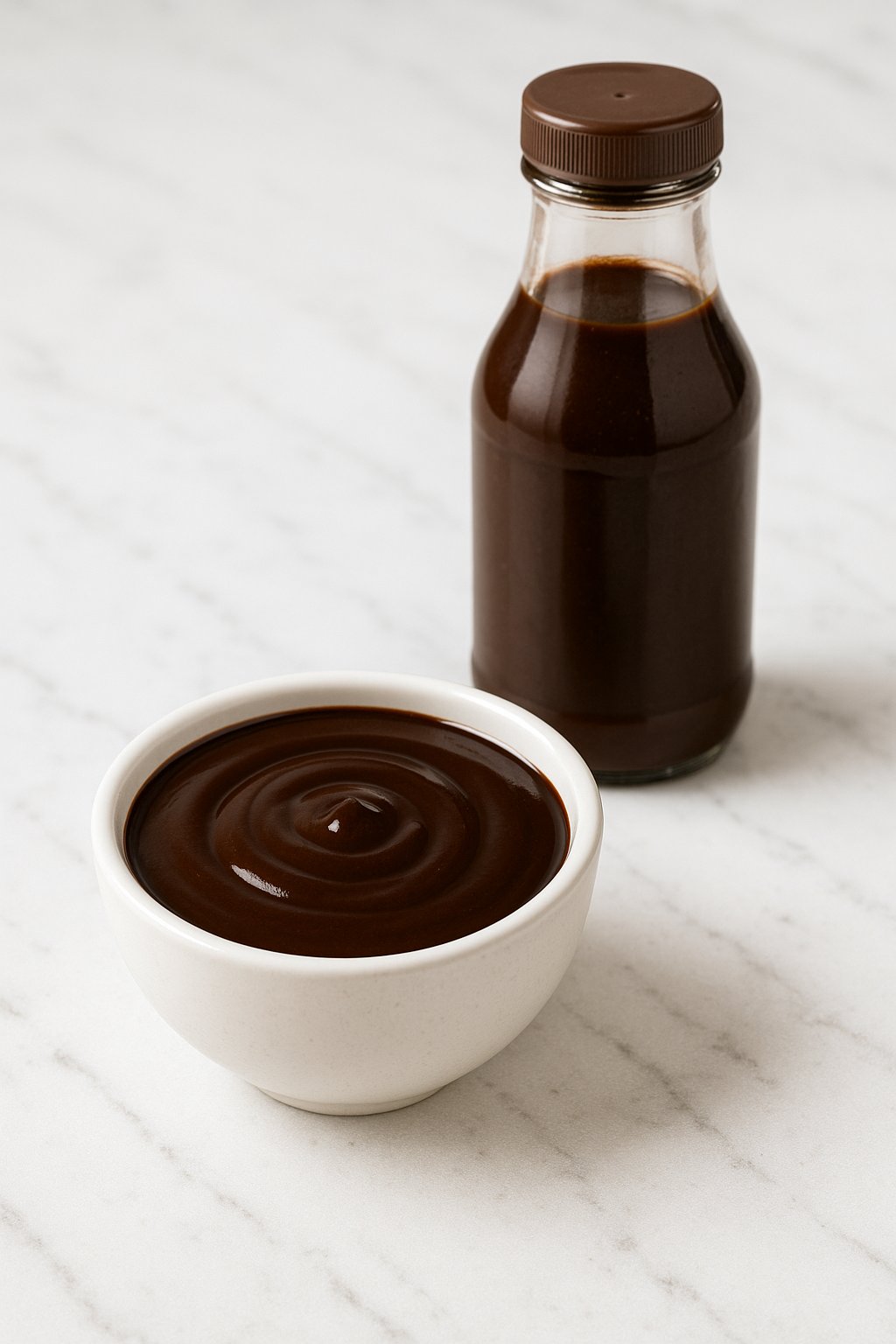
Dark chocolate sauce in a small bowl
I have a secret weakness: chocolate sauce. For me it is one of the small wonders in the kitchen, because with few ingredients it can create so much warmth, comfort and seduction. With the first spoonful a familiar scent rises immediately, reminding me of Sundays, improvised desserts and the kitchen of my childhood. I still remember how, as a teenager, I secretly scraped the leftovers from the pot with a wooden spoon while the rest of the family was still waiting for the ice cream.

What I love about chocolate sauce is its versatility. It is the bridge between a simple dessert and great confectionery art. A colleague of mine always brings it to the office kitchen when it's his birthday, and suddenly even the most sober cups become little celebrations. Whether over vanilla ice cream, pancakes or freshly grilled bananas – it makes everything better.

My basic rule when making it myself: good chocolate, patience and the right consistency. I usually use dark couverture or good cocoa powder, some cream, butter and a pinch of salt.
Don't stir at too high heat; rather warm slowly and add more liquid as needed until the sauce falls silky.

Practical use ideas and variations:

  • Over ice cream, panna cotta or crêpes
  • As a filling for cakes or tarts
  • Flavored with espresso, chili or orange zest
  • Thinned as chocolate milk for cold days
I increasingly pay attention to the origin of the chocolate, because sustainability and fair trade make a real difference in taste. Small experiments are worthwhile: a drop of rum, a hint of cinnamon or toasted nuts give the sauce character.

In the end, chocolate sauce for me is less a recipe than an invitation: it invites you to try, share and enjoy. When I taste a spoonful of it on a rainy evening, I immediately feel a little reconciled with the world.

Availability & types

Availability and types of chocolate sauce – that means: where it comes from, where you can buy it and which different varieties exist? Chocolate sauce is a popular ingredient often used on ice cream, pancakes or in beverages. It is available in many shops and comes in a wide range of forms to suit every taste.

Origin and growing regions
The most important ingredient for chocolate sauce are cocoa beans. These grow on cocoa trees in warm regions of the world. The largest production areas are:

  • West Africa – countries like the Ivory Coast and Ghana supply very many cocoa beans. You can imagine large plantations where the cocoa trees stand in rows.
  • South America – countries like Ecuador, Brazil and Peru also have a long tradition with cocoa. There often grows particularly aromatic cocoa.
  • Central America and the Caribbean – smaller growing areas with special beans that have distinctive flavors.
  • Southeast Asia – countries like Indonesia also produce cocoa used in many chocolate products.
After the beans are harvested, they are fermented, dried and roasted. From them cocoa powder or chocolate is then produced, which is further processed into the liquid chocolate sauce we know.

Available varieties and variants
Chocolate sauce exists in many different types. Here is a simple overview:

  • Liquid chocolate syrups (squeeze bottles) – thin and pourable. Ideal for ice cream sundaes or milkshakes.
  • Hot Fudge – thicker and richer, stays warm longer and sticks nicely to ice cream. You can eat it with a spoon.
  • Ganache – a mixture of chocolate and cream often used for cakes. It is creamier and somewhat firmer when cooled.
  • White, milk and dark chocolate – the sauce can be made from dark (bitter), milk (sweeter) or white chocolate. Each tastes different, almost like different kinds of juice.
  • Vegan and lactose-free – for people who don't eat dairy, there are plant-based variants (for example with oat or soy milk).
  • Flavor variants – with hazelnut, caramel, mint or chili. It's like chocolate with a little extra flavor.
  • Homemade vs. industrial – you can make chocolate sauce yourself from cocoa powder, sugar and milk, or buy ready-made products in the supermarket.
Where to get chocolate sauce
In most supermarkets you can find several varieties in the sweets or baking aisle. Ice cream parlors, bakeries and cafés also often have their own sauces. Online there are special brands, organic or Fairtrade products. Packaging varies: squeeze bottles, jars or tubes. Sometimes there are also small single-serve packets used for takeaway.

In short: chocolate sauce is easy to get almost everywhere and comes in many variants – from thin syrups to thick fudges. That way everyone finds their favorite type, whether they like it sweet, intense, vegan or with a special flavor.
Details & nutrition

Property Value
Unit g
Calories per 100 310
Protein per 100 2.0
Carbohydrates per 100 72.0
Sugar per 100 66.0
Fat per 100 3.5
Saturated fat per 100 2.1
Monounsaturated fat 1.0
Polyunsaturated fat 0.4
Fiber per 100 1.5
Vitamin C (mg) per 100 0
Vitamin D (IU) per 100 0
Calcium (mg) per 100 60
Iron (mg) per 100 1.2
Nutri-Score E
CO₂ footprint 2.5 kg CO2e/kg
Origin Varies (commonly EU/non-EU; cocoa often from West Africa)
Gluten-free Yes
Lactose-free No
Nut-free Yes
Vegan No
Note Nutritional values and allergens can vary significantly depending on brand and recipe; often high in sugar.

Technical & scientific information

Chocolate sauce is a ready-to-use liquid ingredient based on cocoa derivatives, sugar, fat and water, used in gastronomy and at home for coating, decorating or flavoring. Technically speaking it is usually an emulsified or pourable dispersion whose sensory properties (gloss, flow behavior, taste) are controlled by composition and processing parameters.

Composition and ingredients
Typical ingredients are cocoa powder or cocoa mass, sugar (sucrose or sweeteners), a fat fraction (cocoa butter, vegetable oils or milk fat), water as well as additives such as emulsifiers (e.g. soy lecithin), thickeners (e.g. modified starch, xanthan, carrageenan) and preserving additives (e.g. sorbates). Milk chocolate sauces also contain milk components (milk powder, whey concentrates); vegan variants omit these.

Chemical and physical characteristics
Cocoa components primarily supply fat (mainly triglycerides of cocoa butter), cocoa solids with polyphenolic compounds (flavonoids), proteins and minerals. Sugar dominates as the dissolved solids fraction and influences the water activity (aw), and thus microbiological stability. Emulsifiers reduce the interfacial tension between fat and water phases and stabilize the dispersion. Thickeners produce a smooth, often shear-thinning flow behaviour that appears thin during pouring but forms a more cohesive layer on the surface.

Rheology and microstructure
The viscosity of chocolate sauce is determined by particle size (cocoa powder, sugar crystals), fat content and polymer systems. Many sauces exhibit pseudoplastic behaviour: viscosity decreases under shear, which facilitates pouring and spreading. Fat separation, sedimentation or texture changes can occur if the emulsion system is not adequately stabilized.

Processing methods
Manufacturing steps include mixing the dry components, dispersing in water and fat, homogenization and heating for gelation or pasteurization. Industrial processes use high-pressure homogenizers, scrapers and continuous agitators to achieve fine particle distribution and a stable emulsion. For shelf-stable bottled products UHT treatments, aseptic filling or addition of preservatives are used.

Nutritional values (approx. per 100 g)
Typical values vary with recipe, e.g.: energy 250–350 kcal, carbohydrates 40–60 g (of which sugars 35–55 g), fat 8–18 g (saturated fatty acids 5–10 g), protein 1–4 g and small amounts of minerals. Sugar-rich variants are energy-dense, whereas reduced-sugar/light formulations use sweeteners or polyols.

Health aspects
Chocolate sauce is calorie-dense and provides mainly sugar and fat; therefore excessive consumption is problematic from a nutritional point of view. On the other hand, the cocoa-containing fraction provides polyphenolic antioxidants, the amount of which can be greatly reduced in highly processed sauces. Allergens are mainly milk and soy lecithin, possibly traces of nuts. For sugar-free variants warnings about possible laxative effects of sugar substitutes should be noted.

Shelf life, storage and labelling
Stability depends on water activity, pH, preservation and packaging. Kept cool, dry and protected from light many pastes keep for several months. Labelling requirements include ingredients list, allergens, nutritional information and, where applicable, notes on sweeteners or preservatives.

Overall, chocolate sauce combines technological challenges of emulsion and rheology stabilization with nutritional compromises between taste, shelf life and calorie density. Recipe and process optimization aim to reconcile sensory quality, safe shelf life and desired flow properties.

Wiki entry for: chocolate sauce
Active now: 18 visitors of which 2 logged-in members in the last 5 minutes