Menu & categories

Potato chips

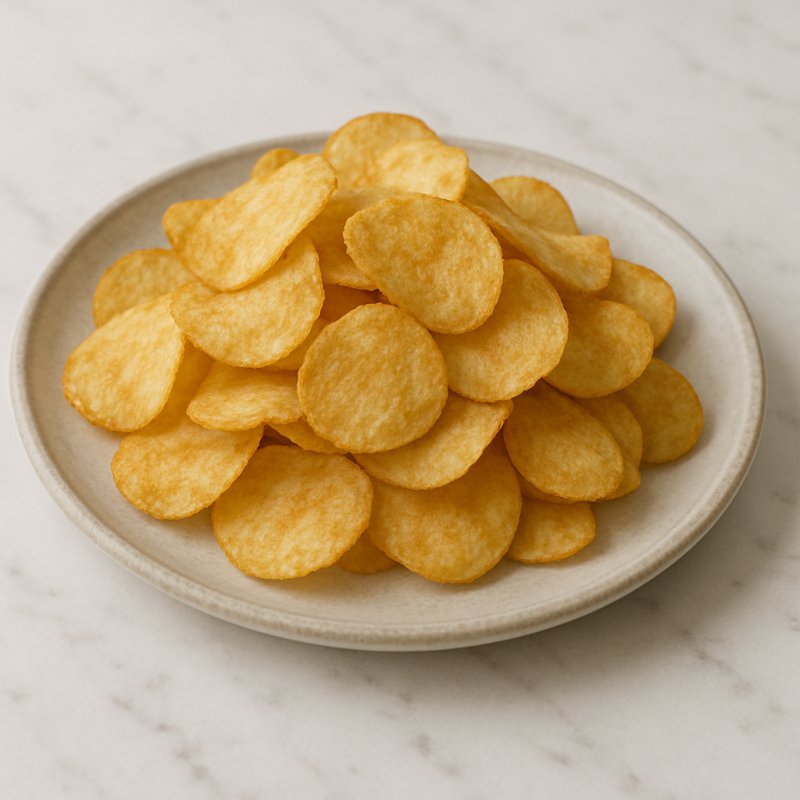
Crispy potato chips as a savory snack

Wiki about chip Nutri-Score D Vegan Yes Gluten-free Yes Lactose-free Yes Nut-free Yes
NUTRITION / 100 g
535 kcal 6.5 g Protein 52 g Kohlenhydrate 34 g Fett

Introduction

Bowl of crispy potato chips
I still remember exactly the afternoon I first really thought about chips: I was sitting with friends on the balcony, a bag between us, and suddenly it became clear how much culture, consumption and small rituals are packed into that crispy slice. Chips are not just a snack; they are an acoustic experience, a mood maker, a comforter and sometimes the secret star of a dinner. I have often observed how a simple bowl of chips opens conversations, evokes nostalgia or gets a party going.

For me chips connect several worlds: the artisanal, when they are wafer-thin and lovingly salted; the industrial, when crispy texture and long shelf life are required; and the experimental, when spices and unusual flavors come into play. I remember a market visit where a vendor offered freshly cut potato chips with rosemary and lemon zest — a small luxury that showed me how versatile this seemingly simple product can be.

What chips can do:

  • Crispiness as a sensory experience: the crunchy sound simply belongs.
  • Versatility in pairing: from dips to delicate salads, they work everywhere.
  • Cultural significance: in some countries they are part of celebrations, in others rather everyday companions.
A colleague once brought chips to a picnic that tasted of truffle and sea salt. We tried them skeptically at first, then ended up discussing how such flavors can turn classic recipes on their head. Encounters like these teach me to stay open: chips can be simple and modest, but also bold and innovative. I also appreciate the different textures — some are more airy little clouds, others have a substantial bite that integrates excellently into dishes.

Whether as an accompaniment to movie nights, as a crispy contrast to creamy dishes, or as a base for creative recipes: chips are a flexible, emotional and often underestimated part of our food culture. Next time I open a bag, I will look not only for flavor but also for the little story it tells — be it artisanal care, an innovative seasoning or simply the desire for togetherness and enjoyment.

Availability & types

Availability and types

When we talk about chips, we usually mean thin, crispy slices of potatoes or other plants that are fried, baked or browned. Chips are available almost everywhere: in supermarkets, at gas stations, in kiosks and often also in vending machines. Some people buy large family packs, others take small bags for on the go. Availability depends on where you live – cities usually have a larger selection, in rural areas sometimes fewer brands or varieties.

Origin
The classic potato chip idea originally comes from regions where potatoes are cultivated, for example Europe, North America and parts of Asia and Latin America. Potatoes were originally domesticated in South America (especially in the Andes) and were then brought to many countries. Today potatoes for chips are grown in many countries, often where the climate is suitable for the potato harvest – not too hot and sufficiently moist, but also with periods when the fields dry so that the tubers can be harvested.

Growing regions
The potatoes for chips grow in large fields. Important growing regions are:

  • Europe: Countries such as Germany, France, the Netherlands and Poland grow many potatoes.
  • North America: Especially the USA and Canada produce a lot for large manufacturers.
  • Asia: Some regions, such as China and India, also grow large quantities of potatoes.
  • Latin America: Since the potato originally comes from the Andes, many traditional varieties grow there.
Farmers choose varieties that have robust skins and store well. For chips it is important that the potato becomes nicely crispy when fried and does not remain too soft or oily.

Available types and variants
Chips come in many variants – almost like ice cream in many flavors. Here are the main types you'll find in stores:

  • Potato chips: The classics. Thin slices of potatoes that are fried or baked. They come in many flavors like salt, paprika, cheese or sour cream.
  • Sweet potato chips: Made from sweet potatoes. They are often a bit sweeter in taste and have an orange color.
  • Vegetable chips: Chips from beetroot, parsnip, carrot or other vegetables. They look more colorful and taste different from potato chips.
  • Corn chips (tortilla chips): Made from corn, often crunchy and thicker pieces. They pair well with dips like salsa or guacamole.
  • Rice or lentil chips: Lighter variants made from rice or legumes. They are often somewhat airier and sometimes gluten-free (that means they do not contain a particular cereal protein that some people cannot tolerate).
  • Baked vs fried chips: Some chips are baked instead of fried – that means they are made crispy in the oven and often have somewhat less fat.
  • Organic and regional varieties: There are chips from certified organic farming (organic) or from small producers who use local potato varieties. These packages are sometimes more expensive because production is smaller and more sustainable.
In summary: chips are available almost everywhere and in many forms. Whether crispy from potatoes, colorful from vegetables or airy from rice – there is a suitable variety for almost every taste. If someone prefers something specific, they can try different types and find which variety tastes best.
Details & nutrition

Property Value
Unit g
Calories per 100 535
Protein per 100 6.5
Carbohydrates per 100 52
Sugar per 100 0.8
Fat per 100 34
Saturated fat per 100 3.0
Monounsaturated fat 16
Polyunsaturated fat 12
Fiber per 100 4.5
Vitamin C (mg) per 100 8
Vitamin D (IU) per 100 0
Calcium (mg) per 100 15
Iron (mg) per 100 1.2
Nutri-Score D
CO₂ footprint 2.3 kg CO2e/kg
Origin Varies by manufacturer, mostly Europe
Gluten-free Yes
Lactose-free Yes
Nut-free Yes
Vegan Yes
Note Nutritional information for classic salted potato chips; flavored varieties may contain additional allergens such as milk, gluten, or soy.

Technical & scientific information

Chips are thinly sliced and usually fried or baked slices from starchy raw materials that are widespread as savory snacks worldwide. The most common form is made from Solenum tuberosum (potatoes), there are however also variants from corn, rice, vegetables or legumes. Technologically, chips primarily consist of carbohydrates in the form of starch, complemented by water, small amounts of protein, fat and mineral components as well as added flavors and preservatives.

Chemical composition and constituents
Potato chips contain predominantly polysaccharides (starch), which partially gelatinize after heating. Furthermore, simple sugars (glucose, fructose) are present in small amounts, proteins (approx. 5–8% in fresh potatoes, significantly lower after industrial processing due to fat enrichment), lipids (mainly from frying oil), as well as minerals such as potassium and sodium. Sodium content is often elevated due to added table salt. Aromatics and flavor enhancers (for example glutamates) as well as colorants can additionally influence the composition.

Nutritional values
The energy density of chips is high; typical potato chips provide about 500–550 kcal per 100 g. Fat often makes up 30–40% of the weight, with the proportion of saturated fatty acids depending on the oil used. Carbohydrates are usually 50–60 g/100 g, proteins 5–8 g/100 g. Salt content varies, but often lies between 1 and 2 g/100 g or higher in strongly seasoned variants.

Processing methods
Industrial production includes several steps: washing and peeling the raw material, precise cutting into slices (thin for classic chips), washing or blanching treatment to remove excess starch, drying to reduce water content, frying in hot oil (typical 160–190 °C) or alternatively baking/hot-air treatment for lower-fat products, cooling, salting or seasoning and packaging. Complex chemical processes occur during frying, including Maillard reactions between amino acids and reducing sugars, which lead to the formation of aroma and color compounds, as well as lipid oxidation, which affects flavor and shelf life.

Technological and sensory aspects
The texture of chips depends on slice thickness, residual moisture and frying conditions; a crispy structure is created by rapid dehydration of cell walls and formation of a porous crust. Color and aroma are the result of thermal reactions; undesirable darkening can be promoted by high sugar or amino acid content of the raw material. Choice of oil influences smoke point, flavor neutrality and fatty acid profile, which in turn determines nutritional and sensory properties.

Health aspects
Regular consumption of fatty, heavily salted chips can contribute to increased energy intake, weight gain, elevated blood pressure and unfavorable blood lipid values. At high frying temperatures, undesirable by-products can also form, for example acrylamide, a potentially carcinogenic substance that is mainly formed in starchy foods at high temperatures. Manufacturers minimize acrylamide through raw material selection, correction of processing parameters and special pretreatments. Furthermore, oil quality is relevant: repeatedly used or oxidized oil can form increased secondary oxidation products that are potentially problematic for health.

Variants and innovations
Besides classic potato chips, numerous alternatives have established themselves, including chips from corn (tortilla chips), vegetable chips (beetroot, sweet potato, parsnip), protein- or fiber-enriched products and air-baked variants with reduced fat content. Technical innovations aim to reduce fat, salt and acrylamide, improve shelf life without strong additives and use sustainable raw materials or recyclable packaging.

From a nutritional science perspective, chips are a highly processed food with high energy density; they can be consumed as part of a balanced diet, but should be enjoyed in moderation due to fat and salt content as well as potential processing by-products. Scientific and technological advances focus on recipe optimization, process control and raw material selection to maintain sensory quality and minimize health risks.

Wiki entry for: chip
Active now: 15 visitors of which 2 logged-in members in the last 5 minutes