Menu & categories

Chinese cabbage

Crisp mild cabbage for salads, wok and soups

Wiki about Chinese cabbage Nutri-Score A Vegan Yes Gluten-free Yes Lactose-free Yes Nut-free Yes
NUTRITION / 100 g
16 kcal 1.2 g Protein 2.2 g Kohlenhydrate 0.2 g Fett

Introduction

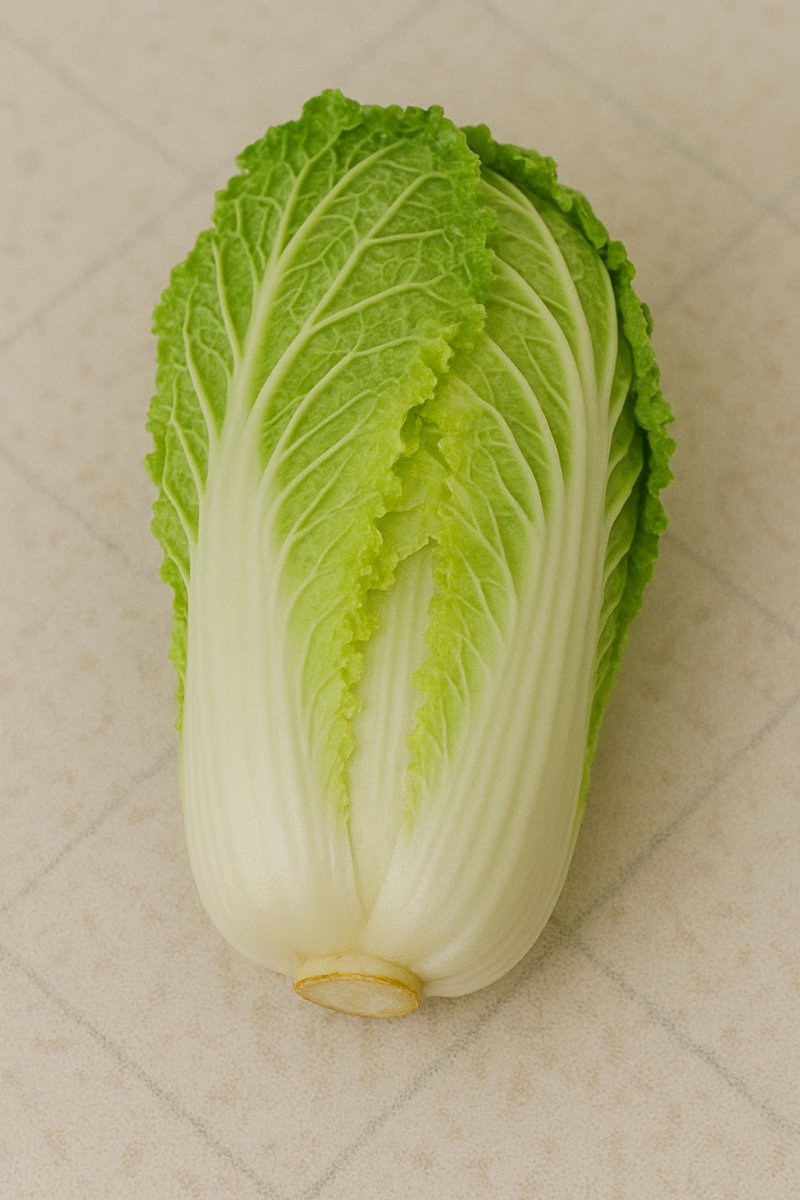
Fresh Chinese cabbage halved
Napa cabbage is for me one of those ingredients that sneaks quietly into the kitchen and then becomes indispensable. As a 35-year-old European editor I discovered it years ago by chance at a weekly market, in a crate next to winter vegetables that smelled more of hearty stews. The vendor smiled and said, “Try it raw, it's more tender than it looks.” He was right. Since then napa cabbage has accompanied me through seasons, dietary phases and recipe experiments – from quick wok dishes to light salads, from aromatic fermentation to soups that warm on cold days.

Botanically napa cabbage (Brassica rapa subsp. pekinensis) belongs to the mustard family (Brassicaceae). Its elongated, densely ruffled leaves are pale green to yellowish, the leaf ribs juicy-crisp. Unlike white cabbage it is milder and less sulfurous in taste, which is why it also works excellently raw. A colleague of mine who normally avoids raw vegetables now swears by thinly sliced napa cabbage as the base for an Asian slaw with lime, sesame oil and roasted peanuts. He says he feels “light but full” afterwards — and that exactly captures the special quality of this cabbage.

In European cuisine napa cabbage has gained popularity in recent years. Reasons are its versatility, the good tolerability and its nutrient-rich profile. It provides vitamin C, vitamin K, folate and potassium while remaining low in calories. I particularly reach for it in winter when crunchy greens are missing. At the same time it fits modern diets: vegetarian, vegan, low-carb, healthy family cooking — all no problem. And those interested in fermentation find in napa cabbage the ideal base for kimchi, which can be varied according to taste and spice level.

Preparation is uncomplicated. After removing outer leaves I halve the head lengthwise, rinse carefully and let the leaves drain well. Fine strips are achieved with a sharp knife or a vegetable slicer. For quick preparations

Availability & types

Napa cabbage is a popular vegetable, mild in taste, crisp and used in many cuisines around the world. When we talk about availability and types we mean where napa cabbage comes from, when you can buy it and which varieties exist. This section explains it step by step in an easy-to-understand way so that even children from about 12 years old can follow well.

Origin and history
Napa cabbage originally comes from East Asia, mainly China. It has been cultivated there for centuries and is a staple in many dishes. Through trade routes it reached Japan and Korea (there it is called “Baechu”) and later Europe and North America. Today napa cabbage is widespread worldwide because it is robust, grows well and is very versatile in the kitchen.

Availability through the year
Napa cabbage is available in many countries almost year-round, but there are typical main seasons:
- In Central Europe the best season is usually autumn to winter (roughly September to February). In this period it often comes from regional cultivation and is particularly fresh and affordable.
- In spring and summer napa cabbage often comes from protected cultivation (greenhouses) or is imported, for example from southern Europe or Asia.
- In Asia napa cabbage is cultivated in multiple cycles, so it is frequently available fresh there year-round.

Where can you buy napa cabbage?
You can find napa cabbage:
- In supermarkets and weekly markets
- In Asian markets, often with a larger selection of varieties
- In vegetable box schemes or directly from the farm, especially during the local season

How to recognise fresh napa cabbage?
Look for:
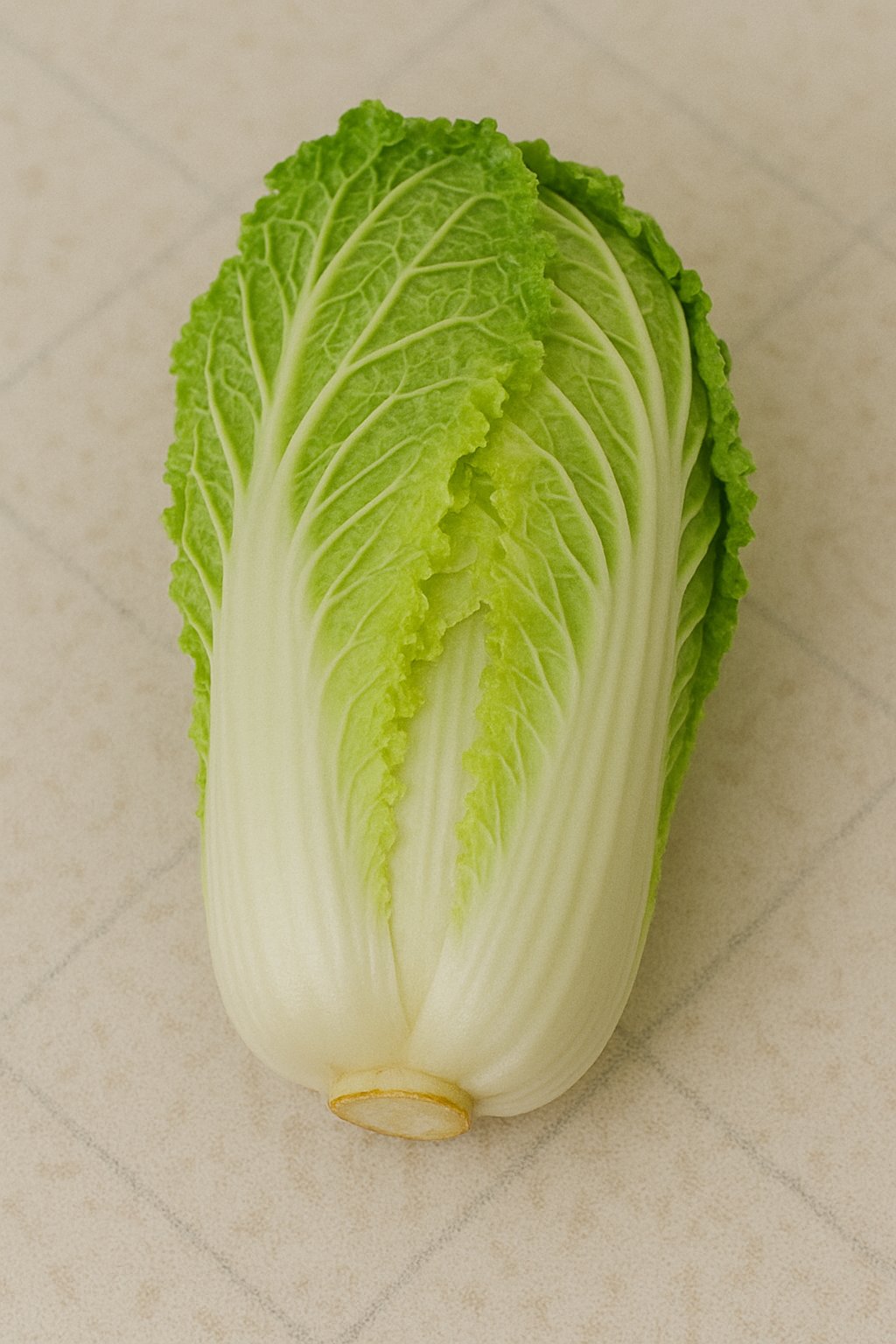
- Crisp, firm leaves without brown spots
- Fresh, light green to yellow-green foliage
Details & nutrition

Property Value
Unit g
Average weight per piece 900
Calories per 100 16
Protein per 100 1.2
Carbohydrates per 100 2.2
Sugar per 100 1.5
Fat per 100 0.2
Saturated fat per 100 0.03
Monounsaturated fat 0.02
Polyunsaturated fat 0.09
Fiber per 100 1.2
Vitamin C (mg) per 100 27
Vitamin D (IU) per 100 0
Calcium (mg) per 100 77
Iron (mg) per 100 0.8
Nutri-Score A
CO₂ footprint 0.2 kg CO2e/kg
Origin China, Spain, Netherlands
Gluten-free Yes
Lactose-free Yes
Nut-free Yes
Vegan Yes
Note Mild flavor, usable raw or cooked; stays fresh for several days when kept cool.

Technical & scientific information

Napa cabbage (Brassica rapa subsp. pekinensis) is a cultivated leafy vegetable from the mustard family (Brassicaceae), characterized by tender, elongated heads, pale, crunchy leaf ribs and a mild-sweet aroma. Botanically napa cabbage belongs to the species Brassica rapa and is closely related to pak choi, turnips and fodder turnips. The cultivated form originated in East Asia, was selected in China over centuries and is today established globally in vegetable horticulture. Typical features are the densely layered leaves, which vary from yellow-green to light green depending on the variety, and the high suitability for raw consumption and fermentation.

Botany and morphology: Napa cabbage forms rosette-like seedlings that develop into compact, cylindrical to barrel-shaped heads. The leaf tissue is tender, with pronounced, juice-conducting midribs. The plant is biennial, with vegetative growth and head formation dominating in the first year; in the second year, after vernalization, flowering follows with yellow, four-part flowers — typical for Brassicaceae. The roots are fibrous with a shallow, wide-reaching system, which requires precise water supply.

Origin, cultivation and varieties: Historical sources place domestication in northern China; from there cultivation spread to Korea and Japan. Modern breeding differentiates between short- and long-stemmed types, autumn and spring forms and variety-specific resistances to clubroot (Plasmodiophora brassicae). Napa cabbage prefers cool temperatures (optimal growth 15–20 °C), even soil moisture and nutrient-rich, well-drained loamy soils (pH 6.0–7.2). Excessive day length or cold shocks promote bolting; appropriate variety choice and sowing dates are therefore central. Integrated pest management includes crop rotation (at least 3–4 years without brassicas), hygiene measures and pest control against cabbage fly, flea beetles and aphids.

Nutritional value and constituents: Napa cabbage is energy

Wiki entry for: Chinese cabbage
Active now: 11 visitors of which 2 logged-in members in the last 5 minutes