Menu & categories

Chestnuts

Mildly sweet chestnuts — filling and versatile in savory and sweet dishes.

Wiki about chestnut Nutri-Score B Vegan Yes Gluten-free Yes Lactose-free Yes Nut-free No
NUTRITION / 100 g
245 kcal 3.2 g Protein 53.0 g Kohlenhydrate 2.2 g Fett

Introduction

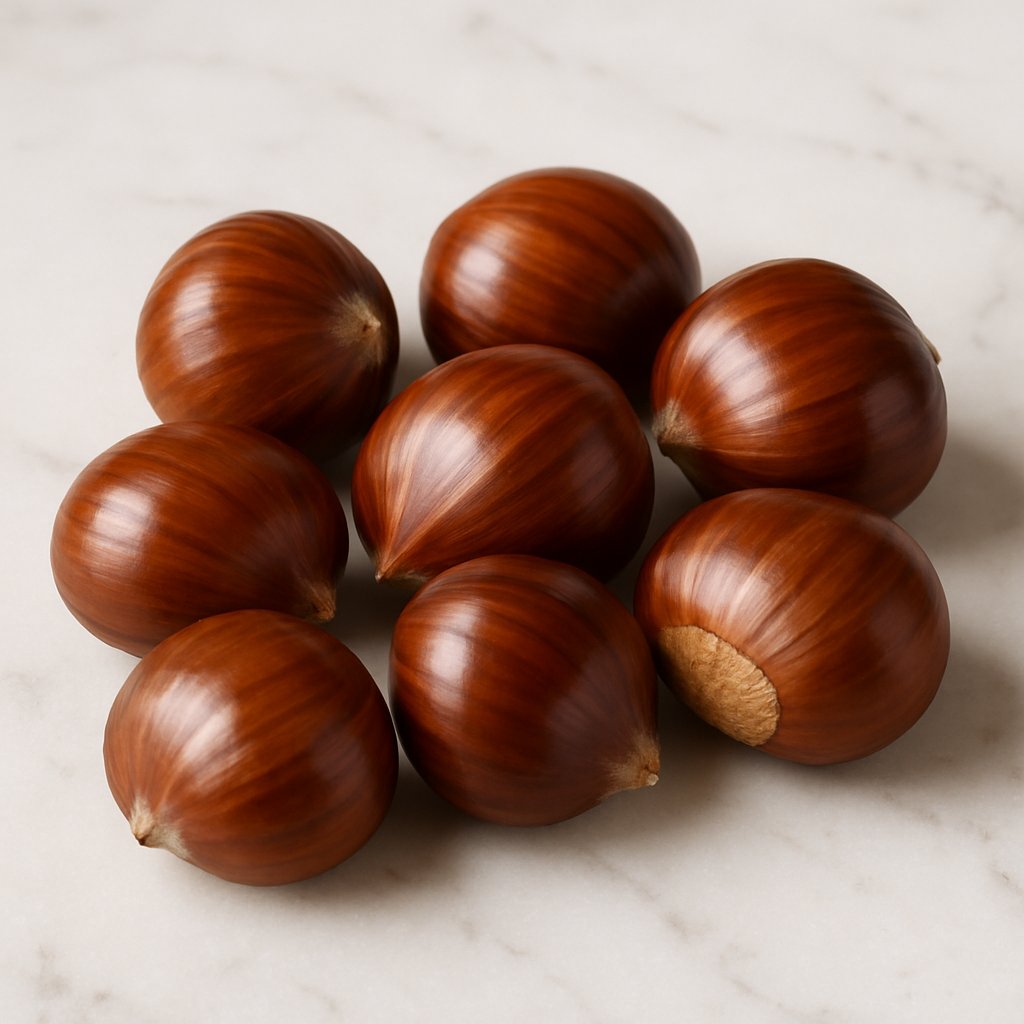
Fresh chestnuts with shell

When I think of chestnuts, that warm, sweet aroma immediately rises to my nose, evoking autumn markets and rainy Sundays. I love the moment when the shell splits slightly during roasting and you use a knife to free the inside: the nutty, buttery texture is simply unrivaled. Chestnuts are not ordinary nuts but the edible fruits of chestnut trees, and their taste ranges between sweet and earthy, with a velvety texture that shines in both savory and sweet dishes.

Once on a train journey I bought a bag of freshly roasted chestnuts from a street stall; the seller handed me a piece and jokingly said it was the best anti-blues remedy for November gray. I couldn't disagree. Since then I like to experiment at home with chestnuts: puréed as an accompaniment to game, in risotto for an extra dose of comfort, or caramelized as a small indulgence with coffee.

It's important to select and prepare chestnuts correctly. Look for heavy, shiny fruits without cracks or holes. Before cooking, be sure to cut a cross in them so they don't burst. You can roast them in the oven, boil them, or steam them. Each method yields a slightly different texture: roasted ones are more aromatic, boiled ones become more tender and are easier to purée.

  • Roasting: 200 °C, 20–30 minutes, score, shake occasionally.
  • Boiling: 20–30 minutes, then peel, ideal for purées.
  • Storage: Cool and airy, consume as fresh as possible or freeze.
  • Caution: Horse chestnuts are not edible — only edible chestnuts.
I recall a Christmas dinner where chestnuts stole the whole show: a velvety soup to start, a stuffing for the roast and to finish Marrons glacés as a sweet farewell. Dishes like that create memories, and that's exactly what makes chestnuts so special to me: they are simple, versatile and surprisingly elegant at the same time. If you find a bag next autumn, try them freshly roasted and treat yourself to that little warm luxury.

Availability & types

Availability and types of chestnuts

Chestnuts are the edible nuts of the chestnut tree, most enjoyed hot from the market or Christmas stall in autumn and winter. They originate from Europe and the Mediterranean but have also been cultivated in Asia and North America. They are often called sweet chestnuts to distinguish them from horse chestnuts (also called buckeyes), which are not edible and can be toxic. A simple way to tell them apart: chestnuts feel heavy and moist when tapped, horse chestnuts are dry and somewhat lighter.

Growing regions
Chestnuts grow on chestnut trees. In Europe well-known producing areas include:

  • Italy – especially regions like Tuscany and islands with mild climates.
  • France – famous for, for example, chestnuts from the Ardèche.
  • Spain and Portugal – also important producers.
  • Turkey – supplies many chestnuts to Europe.
  • China – is one of the world's largest producers, especially for processed products.
Fresh chestnuts are usually available only in autumn and early winter (about September to December). After that they are rare in fresh form but are often available processed year-round.

Available varieties and formats
There are different varieties and processing methods so everyone can enjoy them in their own way. Here are some easy-to-understand examples:

  • Fresh chestnuts – still in the shiny shell or in the spiny husk. They must be scored before cooking so they don't burst when heated.
  • Regular vs. Marrons – in trade you sometimes hear "Marron" (a single nut in the husk), which usually denotes larger, particularly nice and easy-to-peel specimens. They are like the VIP version of the chestnut.
  • Cooked and peeled chestnuts – ready-prepared, often vacuum-packed or frozen. Very practical when you want to prepare something quickly.
  • Marrons glacés – these are candied chestnuts, very sweet and especially popular as a Christmas specialty. They are like a sugar-glazed gift.
  • Chestnut purée and flour – processed into purée or flour used for baking or soups. The purée is like the chestnut interior, made very fine.
  • Roasted chestnuts – roasted at market stalls or in the oven, slightly crisp outside and soft inside. A bit like popcorn, only much more substantial.
When shopping look for firm, shiny shells and avoid holes or soft spots. Fresh chestnuts smell slightly nutty and not musty. If you crave chestnuts out of season, vacuum-packed or frozen variants are a good choice because they are almost always available.

Chestnuts therefore come in many forms: fresh, prepared, sweet or ground — and they combine origin and tradition with practical kitchen variants. That way everyone can find the right way to enjoy them.
Details & nutrition

Property Value
Unit g
Average weight per piece 12
Calories per 100 245
Protein per 100 3.2
Carbohydrates per 100 53.0
Sugar per 100 11.0
Fat per 100 2.2
Saturated fat per 100 0.4
Monounsaturated fat 0.8
Polyunsaturated fat 0.7
Fiber per 100 5.1
Vitamin C (mg) per 100 15
Vitamin D (IU) per 100 0
Calcium (mg) per 100 30
Iron (mg) per 100 1.0
Nutri-Score B
CO₂ footprint 0.04 kg CO2e pro 100 g
Origin Europe (e.g. Italy, France, Spain)
Gluten-free Yes
Lactose-free Yes
Nut-free No
Vegan Yes
Note Nutritional values refer to the edible portion (typically roasted/cooked).

Technical & scientific information


Chestnuts (sweet chestnuts, botanically mostly Castanea sativa) are the edible seeds of deciduous trees of the genus Castanea. Unlike the botanically unrelated horse chestnuts, chestnuts are culinary and are characterized by a high starch content, a fine, mildly sweet flavor and a soft, mealy texture after cooking. Morphologically, chestnuts consist of an outer shell, a thin bitter skin (pellicle) and the farinaceous endosperm, which is eaten.

Chemical composition and macronutrients
Compared with other "nuts", chestnuts are unusually rich in carbohydrates and low in fat. The main macronutrient-related features are:

  • Carbohydrates: The main component is starch, supplemented by soluble sugars (e.g. glucose, sucrose) and to a lesser extent resistant starch. The starch granules are relatively small and influence the texture during cooking.
  • Fat: Chestnuts contain only small amounts of lipids (typically much lower than hazelnuts or almonds). The fatty acids present are predominantly unsaturated.
  • Protein: Protein content is moderate and contains essential amino acids, though at lower concentrations than many legumes.
  • Water and fiber: Fresh chestnuts have a high water content; they also provide soluble and insoluble fiber that affects digestion.
Micronutrients and secondary plant compounds
Chestnuts are a notable source of vitamin C, an unusual feature for nuts or seeds. They also contain minerals such as potassium, magnesium, iron and trace elements. Regarding secondary plant compounds, polyphenols (e.g. gallic acid derivatives and ellagic acid compounds) and tannins are found in the pellicle, contributing to bitter taste and astringency and possessing antioxidant properties.

Technological properties and processing methods
Typical processes for chestnut processing include:

  • Roasting: Leads to flavor development through Maillard reactions and caramelization, moisture loss and changed texture.
  • Boiling/blanching: Softens the endosperm, eases removal of the pellicle and inactivates enzymes like polyphenol oxidase that would otherwise cause browning.
  • Drying and candying: For production of flour (chestnut flour) or candied products (e.g. Marrons glacés) gentle drying and sugar-preservation processes are used.
  • Grinding: Dried chestnuts are milled into a smooth flour used in gluten-free and aromatic baked goods.
Physiological and health aspects
Chestnuts provide relatively readily available energy from their starch, can moderately delay postprandial glycemia due to higher fiber content and contribute to satiety. Vitamin C and polyphenols support antioxidant functions. Because of the low fat content chestnuts are lower in calories than classic nuts and suit balanced diets. However, people with fructose or starch intolerance should pay attention to the carbohydrate content.

Safety, storage and distinction
Fresh chestnuts are susceptible to microbial spoilage and mold growth because of their high moisture content; therefore refrigeration and prompt processing are recommended. It is important to clearly distinguish horse chestnuts (Aesculus hippocastanum), which contain toxic saponins such as aesculin and are not suitable for consumption.

Overall, chestnuts are from a nutritional and technological perspective a versatile ingredient: they offer a starch-based energy source with accompanying vitamins, minerals and secondary plant compounds, can be processed by classical and modern methods and have distinct functional properties in food production due to their unique composition.

Wiki entry for: chestnut
Active now: 51 visitors of which 2 logged-in members in the last 5 minutes