Menu & categories

Celeriac

Aromatic root vegetable for soups, stews and raw dishes

Wiki about celeriac Nutri-Score A Vegan Yes Gluten-free Yes Lactose-free Yes Nut-free Yes
NUTRITION / 100 g
42 kcal 1.5 g Protein 9.2 g Kohlenhydrate 0.3 g Fett

Introduction

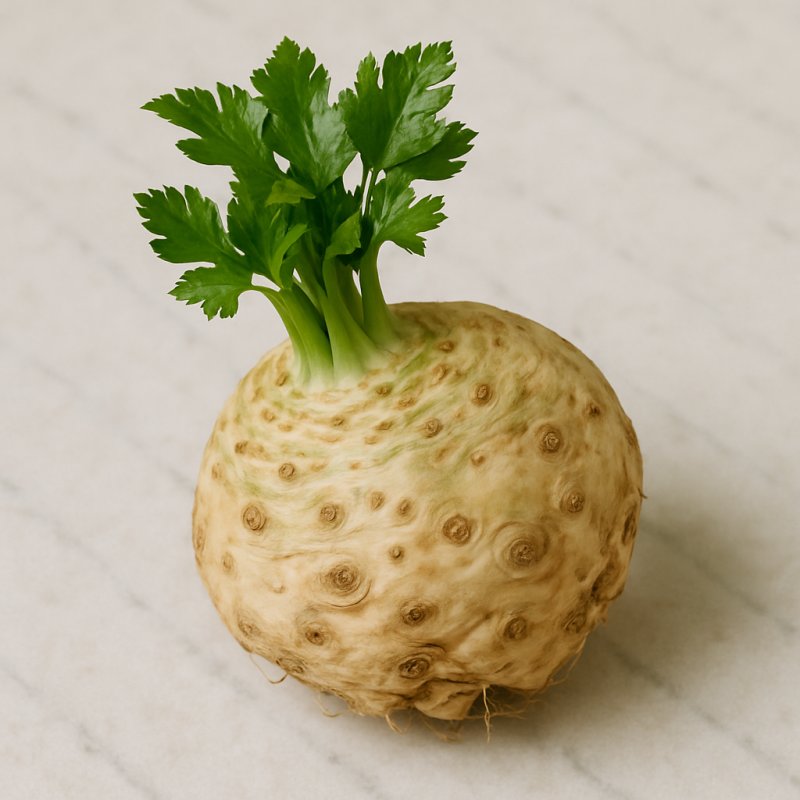
Fresh celeriac with greens
Celeriac – just the word evokes childhood memories of soups, stews and Sunday kitchens for many people. As a 35-year-old editor from Europe, however, I only learned to love celeriac again in recent years. In my family it was long known only as a flavoring, finely diced in the soup base alongside carrot and leek. Today I know: celeriac is far more than a supporting role. It is an aromatic leading player, a seasonal treasure and a versatile ingredient for modern, healthy and creative cooking.

The scent of a freshly cut celeriac is unmistakable: earthy, spicy, with a subtle sweetness. This complex aromatic structure makes it so valuable – in broths, purées, ragouts, vegetarian roasts and even in baked goods. A colleague of mine swears by breaded, crispy celeriac cutlets that he serves with a lemon-parsley sauce. A friend, on the other hand, roasts the celeriac in the oven until its edges caramelize and the inside becomes creamy. What fascinates me is that: this root combines rustic down-to-earth character with culinary elegance.

In the European annual cycle celeriac reliably appears as a seasonal anchor – especially in autumn and winter. While tomatoes and courgettes have ended their season, root vegetables come into their own. Celeriac allows us to cook regionally and diversely even in the cold season. I think that's not only climate-friendly but also inspiring: a single root provides several meals – from the aromatic base for soups to a creamy, vegan alternative to mashed potatoes.

Many underestimate how well celeriac can be prepared. With a sharp knife I generously peel off the dense, gnarled skin and cut the root into slices, cubes or sticks. If the pieces are roasted with a little olive oil, salt and pepper at high temperature, a nutty, almost truffle-like aroma develops. For a silky purée I cook celeriac together with potatoes and purée everything with a little butter or olive oil. The adventurous combine celeriac with apple

Availability & types

Availability and types of celeriac

Celeriac, often simply called “root celery”, is a root vegetable with a thick, rounded tuber and an aromatic, slightly spicy taste. It belongs to the Apiaceae family, so it is related to carrots, parsley and parsnips. For many soups, stews and salads it is an important flavor carrier. In this section you will learn in an easy-to-understand way when and where celeriac is available, where it comes from, which varieties and types exist and how they differ.

Origin and growing regions

The origin of celery lies in the Mediterranean region. Wild celery species that grew on coasts and in marshy areas were already known in antiquity. From these wild forms the cultivated varieties of today were bred over many generations. Today celeriac is grown in many regions of Europe, especially in Germany, France, the Netherlands, Italy and Poland. It also grows well in North America, particularly in cooler temperate zones.

Celeriac prefers nutrient-rich, moist soils and a rather cool climate. Too much heat does not suit it well, which is why it is popular in more northern regions. Because the plant grows relatively slowly (often 120 to 180 days), farmers plan cultivation carefully.

Availability throughout the year

  • Main season: autumn and winter. From around September to March there is plentiful fresh produce from regional cultivation.
  • Stored produce: celeriac stores well, which is why it is often available until late spring. In storage it remains fresh for a long time in cool, slightly humid rooms.
  • Year-round: in many supermarkets you can find celeriac all year round because stocks and imports fill the gaps. In summer, however, supplies can be scarcer.
Practically this means: you don't have to wait for a particular season to buy celeriac. If, however, you want especially aromatic and affordable produce, then the
Details & nutrition

Property Value
Unit g
Average weight per piece 600
Calories per 100 42
Protein per 100 1.5
Carbohydrates per 100 9.2
Sugar per 100 1.8
Fat per 100 0.3
Saturated fat per 100 0.05
Monounsaturated fat 0.07
Polyunsaturated fat 0.12
Fiber per 100 1.8
Vitamin C (mg) per 100 8
Vitamin D (IU) per 100 0
Calcium (mg) per 100 40
Iron (mg) per 100 0.7
Nutri-Score A
CO₂ footprint 0.25 kg CO2e/kg
Origin Europe, seasonal from autumn to winter
Gluten-free Yes
Lactose-free Yes
Nut-free Yes
Vegan Yes
Note Can be used raw, cooked or roasted; in sensitive individuals celeriac can cause allergic reactions.

Technical & scientific information

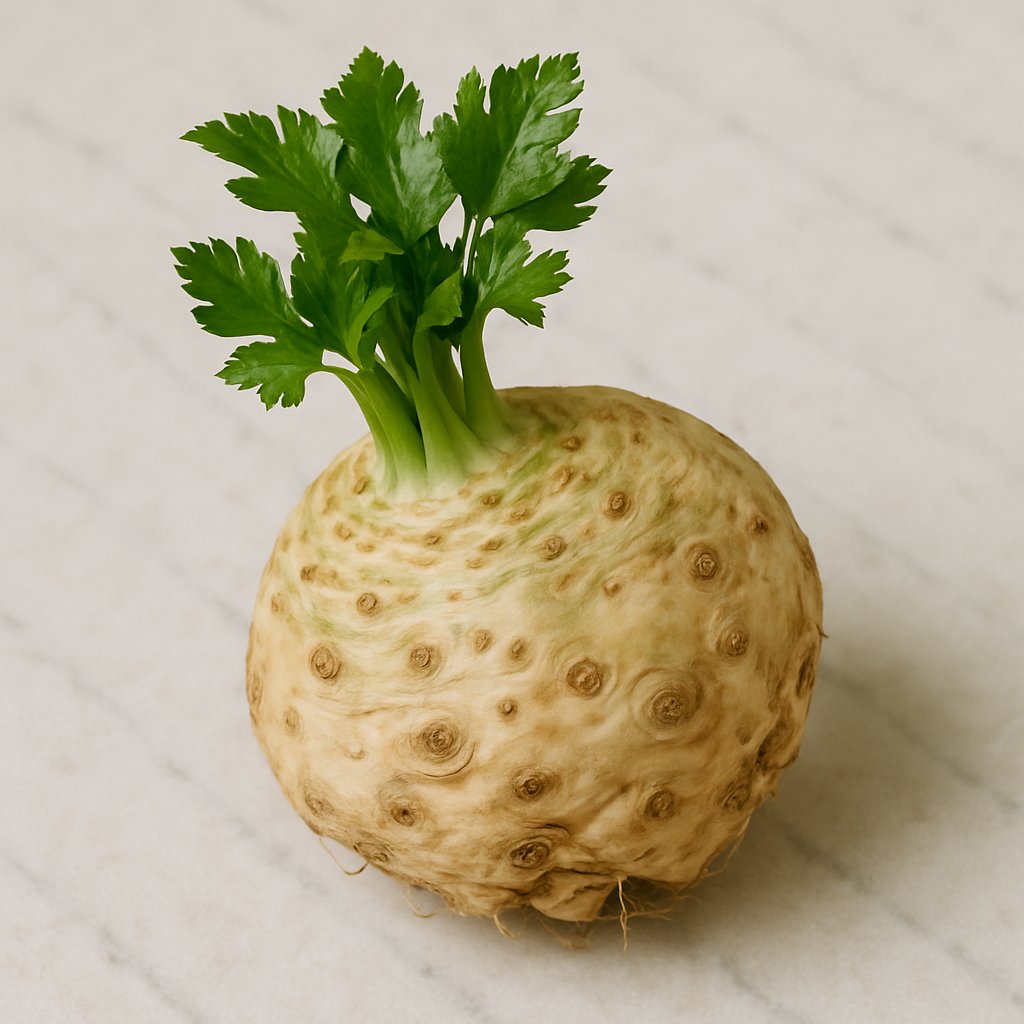
Celeriac (Apium graveolens var. rapaceum): Celeriac, also called root celery, is a biennial cultivated form of the species Apium graveolens in the Apiaceae family. In the first growing year it forms a strongly thickened hypocotyl and root tuber that serves as a storage organ, and bolts to flower in the second year. Botanically characteristic are a coarse-corky, beige-brown outer skin, a firm-fleshed, cream-white to yellowish internal structure with a fine arrangement of vascular bundles, and an intense aromatic scent profile attributable to a high content of phthalide compounds and terpenes. The tuber is used worldwide as a vegetable, seasoning component and raw snack and is an integral part of classic soup bases such as mirepoix and soup greens.

Botany and morphology: The plant shows pinnate, glossy leaves with well-developed petioles, which are, however, less used compared to celery stalk. The tuber forms by enlargement of parenchyma and deposition of reserve substances. The vascular tissue is radially arranged; the surface shows numerous secretory canals that contain essential oils. The flowers are typical umbels with inconspicuous greenish-white corolla parts; pollination is mainly entomophilous. The seeds are brown, small, ribbed and rich in essential oils.

Origin, breeding and varieties: Originally from the Mediterranean region, celery was cultivated already in antiquity. Modern cultivars are selected for uniform tuber shape, reduced internal cavities, decreased secondary root formation and disease resistance. Well-known cultivar types are smooth-skinned, round calibers for the fresh market and robust storage varieties with thicker cork layers. Breeding goals also include reduction of nitrate accumulation, improved storability and a balanced aroma profile.

Constituents and nutritional value: Celeriac is low in energy (typically 30–45 kcal per 100 g) and rich in water. Main components are carbohydrates, dominated by inulin</

Wiki entry for: celeriac
Active now: 15 visitors of which 2 logged-in members in the last 5 minutes