Menu & categories

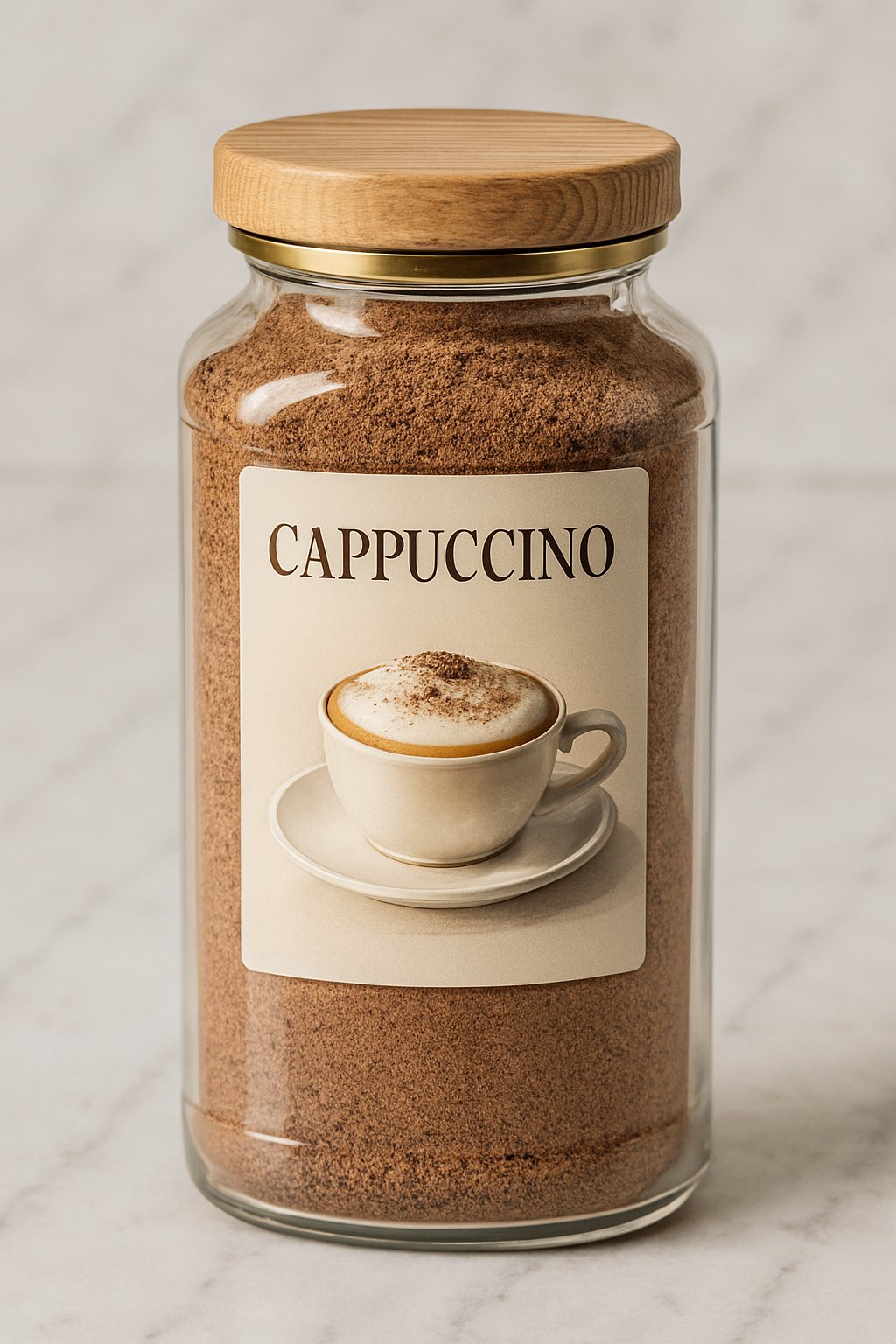
Cappuccino powder

Instant powder for quick preparation of a creamy cappuccino

Wiki about cappuccino powder Nutri-Score D Vegan No Gluten-free No Lactose-free No Nut-free Yes
NUTRITION / 100 g
420 kcal 8 g Protein 70 g Kohlenhydrate 10 g Fett

Introduction

Cappuccino powder in a bowl next to a cup of cappuccino
I still remember well the first cup I prepared with cappuccino powder: steaming, velvety and with a touch of nostalgic coffee-bar atmosphere, even though I only had a small kitchenette back then. Cappuccino powder for me is that convenient bridge between the ritual of a freshly brewed cappuccino and the quick, enjoyable moment when mornings get a bit hectic. It combines coffee, milk and foam aromas in an almost magical dry mix that in my experience is a faithful companion in many households.

What I particularly appreciate about cappuccino powder is its versatility. It is suitable not only for the classic preparation with hot water or milk, but also for creative experiments: in desserts, as a flavor in rice pudding or whipped up for a quick layer of ice cream. A colleague of mine swears by mixing the powder into chocolate cookies — a surprisingly delicious contrast that I now bake regularly myself.

Practical aspects are also part of my fondness for cappuccino powder. It stores well, is easy to portion and ideal when you expect guests or are on the go and don't want to miss a creamy coffee. Of course quality varies; I have learned to check ingredient lists and to prefer products with natural milk and coffee content. Sometimes I find small specialty blends with spices like vanilla or cocoa that give the powder a personal touch.

When I mix a cup with cappuccino powder, it's less about perfection and more about enjoyment: the aroma, the first sip, the short pause between the to‑do list and everyday life. Those moments are what make the product an everyday hero for me. For beginners I recommend experimenting with small portions and trying the powder once with hot milk instead of water — that often makes the crucial difference.

  • Versatile in preparation and use
  • Practical for travel and guests
  • Notice quality differences
In the end, cappuccino powder remains for me a straightforward source of pleasure that makes small coffee moments in everyday life special.

Availability & types

Availability and types

Cappuccino powder is a ready-mixed powder that lets you quickly prepare a creamy cappuccino. It is easy to find in many supermarkets, drugstores and online. You often find it in small tins, large bags or as single‑serve sachets that you can pour directly into a cup. Imagine it being available like cocoa or instant coffee — on shelves next to other hot beverages.

Origin
Cappuccino powder is made from several ingredients that can come from different parts of the world. The most important ingredient is usually instant coffee, meaning coffee that is first brewed and then dried into a powder. Coffee is mainly grown in countries around the equator, such as Brazil, Vietnam, Colombia and parts of Africa. Another important component is milk powder or a milk substitute, derived from dairy or plant-based ingredients. Sugar, cocoa powder or flavorings (e.g. vanilla) are often added from various regions. The factory where cappuccino powder is blended and packaged, however, can be located anywhere in the world.

Growing regions
The plants that end up in cappuccino powder grow in very different places:

  • Coffee: Grown in warm countries with highlands, mostly in South America, Africa and Asia. Altitude, climate and soil influence the flavor — like apples, which taste different depending on where they grow.
  • Cocoa: If the powder has chocolate or cocoa notes, the cocoa powder typically comes from West Africa, South America or Southeast Asia.
  • Milk: Milk powder often comes from countries with many dairy farmers, e.g. EU countries, the USA or New Zealand. Plant-based milk powders (e.g. from soy or oats) are produced where those crops are grown.
Available types and variants
Cappuccino powder comes in many different variants to suit different tastes. Here are the most common types, explained simply:

  • Classic cappuccino: This is the standard powder with coffee, milk flavor and sugar. Add hot water or milk and you get a frothy, sweet coffee.
  • Extra-creamy: These powders contain more milk components or additives that make the foam particularly fluffy — almost like clouds in the cup.
  • Decaffeinated: For people who do not want the stimulating effect of caffeine. The coffee portion has been treated to remove caffeine while preserving the flavor.
  • Flavored: Vanilla, hazelnut, chocolate or caramel are often added. It’s like ice cream: you choose a flavor you especially like.
  • Sugar-free or low-calorie: For people who want less sugar, there are variants with sweeteners or reduced sugar.
  • Plant-based / Vegan: Instead of milk powder, oat, soy or almond powders are used. This is for people who cannot tolerate milk or do not consume animal products.
  • Single‑serve sachets: Small packets with the right amount for one cup — convenient for travel or when you only want one serving.
Although the composition varies by brand, the principle is the same: mix the powder with hot water or milk and you quickly get a creamy hot beverage. Labels help when shopping: they indicate whether the product is, for example, vegan, low in sugar or decaffeinated. That way everyone can find the cappuccino powder that suits their preferences.
Details & nutrition

Property Value
Unit g
Calories per 100 420
Protein per 100 8
Carbohydrates per 100 70
Sugar per 100 60
Fat per 100 10
Saturated fat per 100 8
Monounsaturated fat 1
Polyunsaturated fat 1
Fiber per 100 1
Vitamin C (mg) per 100 0
Vitamin D (IU) per 100 0
Calcium (mg) per 100 200
Iron (mg) per 100 0.3
Nutri-Score D
CO₂ footprint 3.5
Origin Depending on the manufacturer, often EU
Gluten-free No
Lactose-free No
Nut-free Yes
Vegan No
Note Values refer to a typical sugared instant cappuccino powder containing milk components; exact nutritional values may vary by brand and recipe.

Technical & scientific information

Cappuccino powder refers to a processed mixed ingredient primarily used for the quick preparation of cappuccino‑like beverages. Typically it consists of a powder blend containing soluble coffee or coffee extract, milk powder (whole or skim), sugar and flavoring additives such as cocoa, vanillin or vegetable fats. The composition varies by manufacturer and intended use; industrial powders are formulated to disperse quickly in hot or cold liquids and produce a foamy, creamy texture.

Chemical composition and ingredients

  • Proteins and milk components: Milk powder provides casein and whey proteins, which contribute to body and foam formation upon dispersion.
  • Carbohydrates: Sucrose or glucose syrups are commonly used as sweeteners. Lactose and starch may also be present as fillers.
  • Fats: Milk fat or hydrogenated vegetable fats (e.g. palm or coconut fat) provide flavor richness, creaminess and emulsion stabilization.
  • Soluble coffee/coffee extract: Contains caffeine, chlorogenic acids, melanoidins and aroma precursors that deliver the typical coffee character.
  • Additives: Emulsifiers (e.g. lecithins), stabilizers (e.g. carrageenans, guar gum), anticaking agents (e.g. silicon dioxide) and flavor extracts are used to ensure shelf stability and solubility.
Nutritional values

Nutritional values depend on the product. Typical values per 100 g are approximately 350–450 kcal, 8–15 g protein, 10–20 g fat and 40–70 g carbohydrates, with sugars making up a large proportion of the carbohydrates. Serving sizes of 10–20 g provide around 35–90 kcal. The content of vitamins and minerals is usually low unless the product has been specifically fortified.

Processing methods

  • Drying: Milk components are turned into powder by spray drying; soluble coffee is produced by spray drying or freeze drying of coffee extract.
  • Granulation and mixing processes: Components are homogenized and sometimes granulated to improve flowability and doseability.
  • Microencapsulation: Sensitive aromas or fats can be microencapsulated to reduce oxidation and increase aroma stability.
  • Homogenization: Emulsions are homogenized before drying to obtain uniform particle sizes and good solubility.
Sensory and physical properties

Cappuccino powder is formulated to rapidly take up water or milk, swell and form a creamy structure. Moisture sensitivity and lumping are technical challenges that are minimized by anticaking agents and appropriate packaging. Aroma profiles range from strongly coffee‑forward to sweet‑vanilla or cocoa‑dominant, depending on the coffee extract content and added flavorings.

Health aspects

From a nutritional standpoint, cappuccino powder provides calories, sugars and saturated fats if milk fat or hydrogenated fats are used. Caffeine content is product dependent and may cause sleep disturbances or palpitations in sensitive individuals. Many variants are unsuitable for people with lactose intolerance or milk protein allergy; however, lactose‑free or plant‑based milk powder alternatives exist. In addition, additives such as emulsifiers, thickeners or flavorings can trigger intolerances, so people with allergies should check the ingredient list.

Shelf life and storage

Due to the hygroscopic nature of milk and sugar components, cappuccino powder should be stored cool, dry and airtight. Moisture ingress promotes spoilage and microbial growth. Appropriate packaging with barrier properties and, if necessary, protective gas packaging extend stability.

Cappuccino powder is thus a technically optimized convenience product whose properties depend on raw material selection and manufacturing processes. It combines soluble coffee with milk components, sweeteners and functional additives to quickly produce a foamy, flavored hot or cold beverage, with nutritional and allergenic aspects to consider when selecting a product.

Wiki entry for: cappuccino powder
Active now: 17 visitors of which 2 logged-in members in the last 5 minutes