Menu & categories

Cane sugar

Unrefined to partially refined sugar from sugarcane – ideal for sweetening and baking.

Wiki about cane sugar Nutri-Score E Vegan Yes Gluten-free Yes Lactose-free Yes Nut-free Yes
NUTRITION / 100 g
400 kcal 0.0 g Protein 100.0 g Kohlenhydrate 0.0 g Fett

Introduction

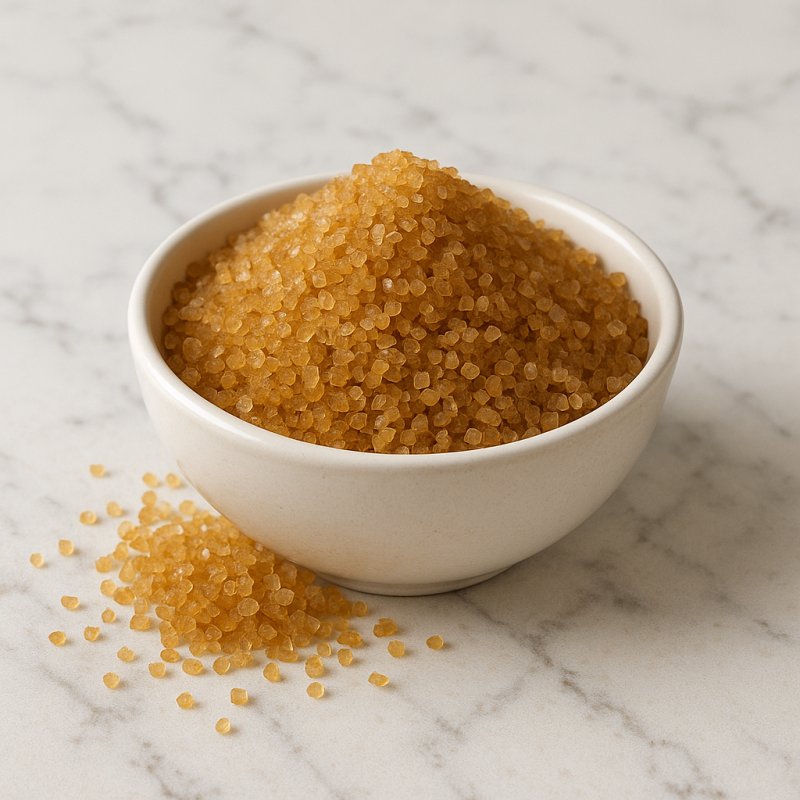
Light cane sugar in a bowl
I have a soft spot for ingredients that tell more than just calories, and cane sugar is definitely one of them. When I think of its amber granularity, I immediately picture jam jars, a warm kitchen and the smell of caramel wafting through the house while baking.
Cane sugar comes from the sugarcane plant that grows in tropical regions, and differs from industrial refined sugar mainly by its residual molasses content. It is this molasses that gives it its colour, moisture and slightly caramel-like flavour.

I still remember a coffee break when a colleague asked in surprise why I always use muscovado instead of white sugar. I handed him the spoon, he tasted it – and suddenly we were both convinced that a hint of molasses gives even simple desserts character.

Practically speaking, cane sugar is versatile. It is excellent for:

  • Cookies and pastries, because it retains moisture and thus provides tender, juicy textures.
  • Sauces and glazes, as its caramel notes add depth.
  • Cocktails and hot drinks, such as a caipirinha or a spiced tea.
  • Raw food variations, where the less refined sugar suits the flavour.
There are different types like muscovado, demerara or turbinado, which vary in colour, crystal size and molasses content. In most recipes cane sugar can be substituted 1:1 for white sugar, but it noticeably changes texture and flavour. Cane sugar is hygroscopic, so store it airtight to prevent clumping.

As for sustainability, sugarcane cultivation is not without issues; I therefore often look for Fair Trade or organic labels when I buy it. Nutritionally it's still sugar: energy, but no miracles. Nevertheless this simple ingredient has a wonderful ability to connect memories and flavours, and sometimes that's exactly why I always have a jar within reach.

Availability & types


Availability and types of cane sugar

Cane sugar comes from the sugarcane plant, a tall grass species that grows in warm countries. You can imagine sugarcane as thick, juicy stalks – the sweet juice is pressed from them, cooked and dried until small crystals form. Cane sugar is found in many forms and colours in stores, from white sugar to dark, sticky sugar with lots of flavour.

Origin and growing regions
Sugarcane loves sun, warmth and plenty of water. That is why it grows mainly in tropical and subtropical regions. Important growing regions include, for example:

  • Brazil – one of the largest countries for sugarcane.
  • India – many people grow sugarcane there.
  • Thailand and other countries in Southeast Asia.
  • Australia, the Caribbean and parts of Africa.
  • There are also smaller growing areas in South and Central America, where traditional varieties are often processed.
Although sugarcane is harvested only at certain times, cane sugar is available year-round. This is because the sugar can be dried and stored after harvest and because countries trade sugar with each other – much like shipping apples or bananas.

Available varieties and versions
Cane sugar comes in many variants. You can think of it like different kinds of chocolate: all are sweet, but they taste slightly different. Here are the most common types and what makes them special:

  • White granulated sugar – very fine and white, usually fully refined. It is neutral in flavor and is often used in baking and beverages.
  • Gelling or powdered sugar – ground very finely, almost like flour, good for icings and dusting cakes.
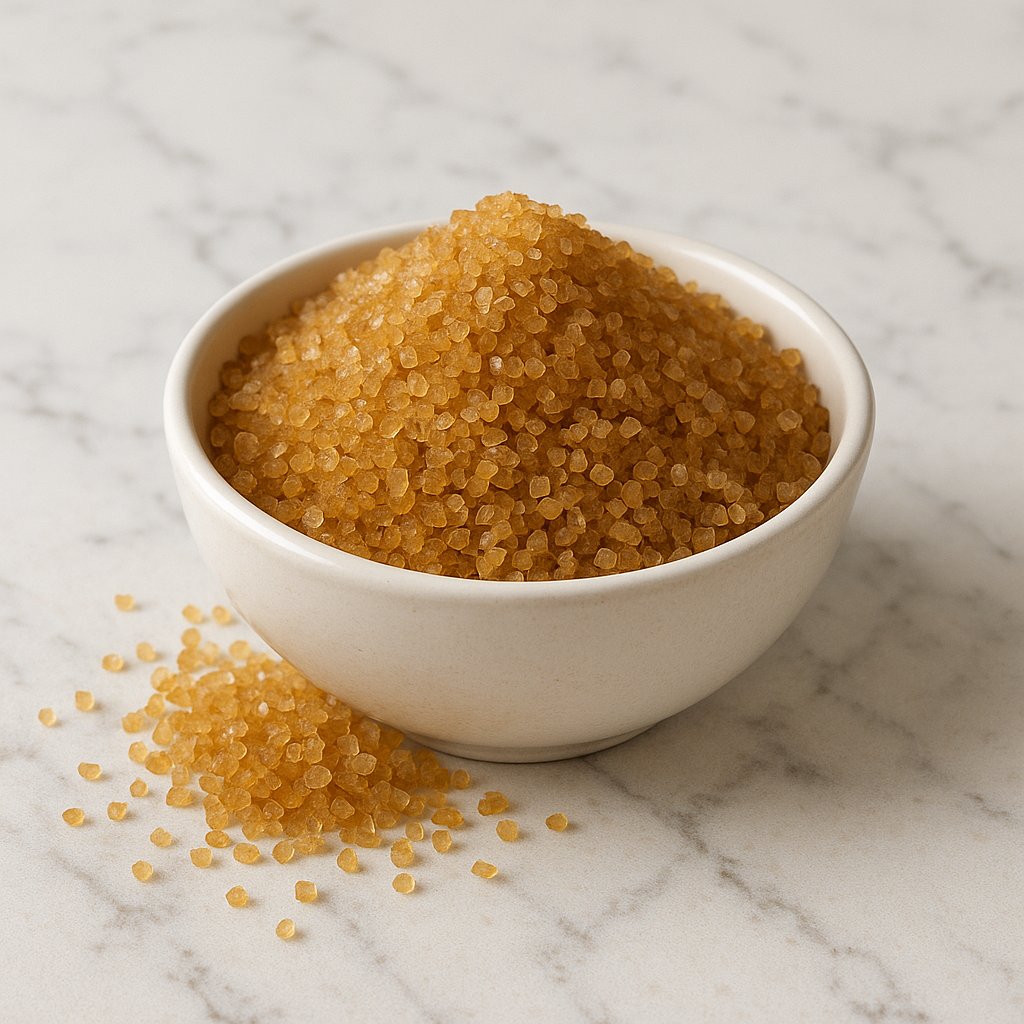
  • Raw/golden sugar (e.g. Demerara, Turbinado) – light brown crystals with a mild caramel flavor. The crystals are larger and crack slightly between the teeth.
  • Muscovado – dark brown, sticky and very aromatic, because it still contains a lot of molasses (the dark, syrupy by‑product). It pairs well with cookies and marinades.
  • Panela / Piloncillo – sold in many countries in the form of a small cone or block. Very natural and full-flavored, often found at markets.
  • Cane sugar syrup and molasses – liquid forms used in cooking or drinks, similar to honey but with their own flavour.
Where to find cane sugar
You can buy cane sugar almost everywhere: in supermarkets, health food stores, natural food shops, at the weekly market or online. Some varieties are constantly available in large supermarkets, while special types like muscovado or panela are more often found in specialty stores or online. Look for labels such as "Organic" or "Fair Trade" if environmental protection or fair pay for farmers matters to you – they indicate that certain rules were followed in cultivation and trade.

In summary: cane sugar is flexible, tasty and available in many variants. From fine white sugar to dark, aromatic types – there is a suitable variety for every taste and application. That way you can always find the right type, whether you're baking a cake, sweetening tea or trying a special recipe.
Details & nutrition

Property Value
Unit g
Calories per 100 400
Protein per 100 0.0
Carbohydrates per 100 100.0
Sugar per 100 100.0
Fat per 100 0.0
Saturated fat per 100 0.0
Monounsaturated fat 0.0
Polyunsaturated fat 0.0
Fiber per 100 0.0
Vitamin C (mg) per 100 0.0
Vitamin D (IU) per 100 0
Calcium (mg) per 100 1
Iron (mg) per 100 0.1
Nutri-Score E
CO₂ footprint 0.08
Origin Sugarcane (depending on product, e.g. South America, the Caribbean, or Asia)
Gluten-free Yes
Lactose-free Yes
Nut-free Yes
Vegan Yes
Note Nutritional values may vary slightly depending on the degree of refinement; the main component is sucrose.

Technical & scientific information


Cane sugar is sugar obtained primarily from the juice of the sugarcane plant (Saccharum spp.). Chemically, the main component is the disaccharide sucrose with the molecular formula C12H22O11. In pure, refined forms cane sugar is present as sucrose at over 99 %; unprocessed or partially processed products additionally contain water, small amounts of reducing sugars (glucose, fructose), minerals and residual molasses that influence colour and flavor.

Physical and chemical properties: Sucrose is a crystalline, white to yellow‑brown powder, depending on the molasses content. Cane sugar is highly water‑soluble, and solubility increases with temperature. Sucrose is a non‑reducing sugar, meaning it does not react directly in redox tests as long as the glycosidic bond is intact. Under heat exposure caramelization occurs (starting at about 160 °C) and under acidic or enzymatic hydrolysis it splits into glucose and fructose ("invert sugar"), which are sweeter and more hygroscopic than sucrose.

Manufacturing processes:

  • Harvesting and crushing of the stalks to obtain the raw juice.
  • Clarification of the juice by heating and adding lime (liming) to precipitate impurities; followed by clarification and filtration.
  • Concentration by evaporating the excess liquid and crystallization of sucrose.
  • Separation of the crystals from the syrup phase by centrifugation; refining to further remove molasses and impurities yields white sugar.
  • Alternative local methods (e.g. panela, muscovado) deliberately allow higher molasses content and produce a brown, more aromatic product.
Nutritional values and composition: Cane sugar provides primarily usable energy in the form of carbohydrates. The energy value is approximately 4 kcal per gram, corresponding to roughly ca. 400 kcal per 100 g. Protein, fat and fibre are practically absent. Minerals and vitamins are negligible in refined sugar; in less refined varieties small amounts of potassium, calcium, magnesium and iron from the molasses are present but are nutritionally of little relevance.

Physiological effects and health aspects: Sucrose is hydrolysed in the small intestine into glucose and fructose. Glucose raises blood glucose levels and provides immediately available energy; fructose is metabolised mainly in the liver and can, with excessive consumption, contribute to de novo lipogenesis, increased triglyceride levels and elevated uric acid production. Excessive sugar consumption is associated with an increased risk of dental caries, overweight and metabolic diseases such as type 2 diabetes. Health recommendations advise limiting free sugar intake to well under 10 % of daily energy intake, ideally nearer to 5 %.

Storage and practical notes: Cane sugar is hygroscopic and tends to clump in humid environments. To maintain flowability dry, airtight storage is recommended. In food technology different sugar types have specific applications; the choice between white, brown or partially refined cane sugar affects flavour, colour and moisture retention of baked goods and confectionery.

In summary, cane sugar is a technically readily available, energy‑rich carbohydrate source with well‑defined chemical properties and a production process that ranges from extraction to refining. Its nutritional effects depend primarily on the amount consumed, while differences between highly refined and less refined products mainly concern flavour and micro‑mineral aspects.

Wiki entry for: cane sugar
Active now: 6 visitors of which 2 logged-in members in the last 5 minutes