Menu & categories

Cake batter (creamed)

Classic basic cake batter made from flour, sugar, fat and eggs.

Wiki about cake batter Nutri-Score D Vegan No Gluten-free No Lactose-free No Nut-free Yes
NUTRITION / 100 g
330 kcal 6 g Protein 45 g Kohlenhydrate 14 g Fett

Introduction

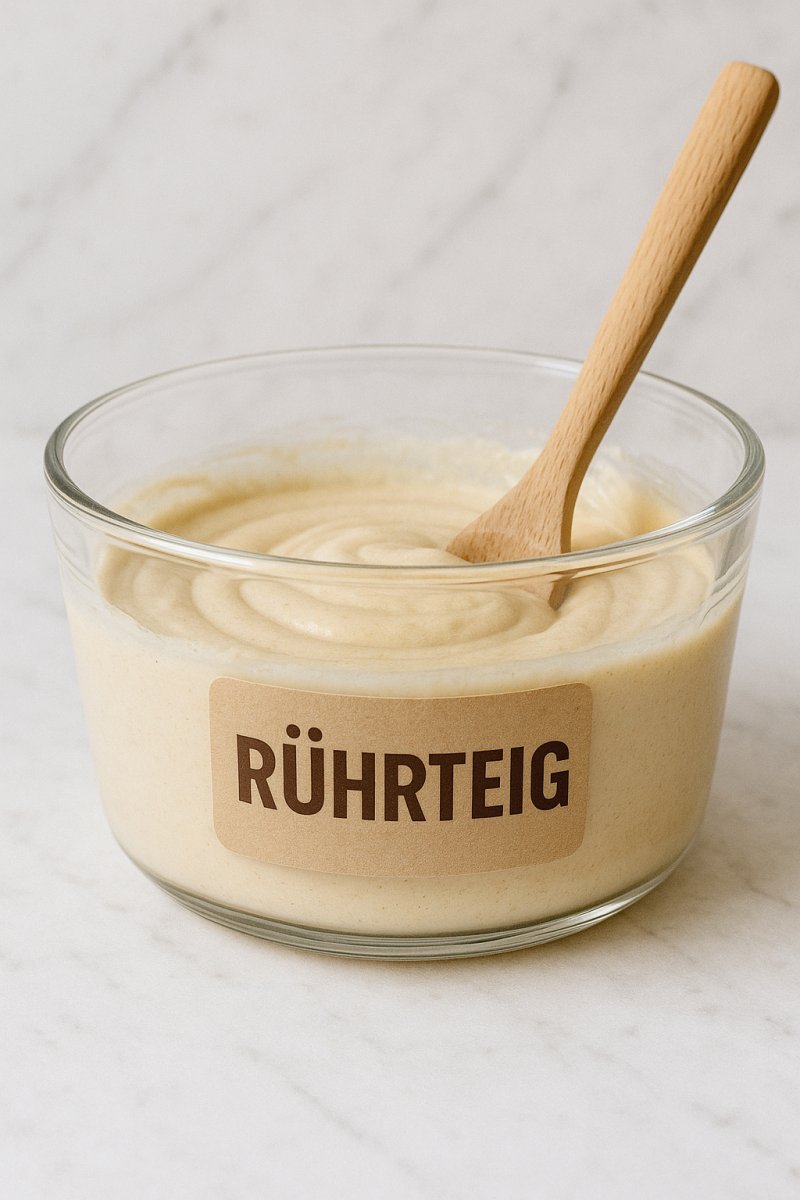
Bowl with light cake batter and mixing spoon
I love creamed batter because it is as reliable as a good friend on a rainy Sunday afternoon. For me creamed batter is the basis of many childhood memories: the scent of freshly baked cake filling the stairwell, and the little ritual when butter and sugar are beaten together until fluffy. I still remember how, as a novice in a holiday kitchen, I first had to learn the difference between a tender creamed batter and an airy sponge cake batter and how by overmixing I almost made an entire bowl of flour runny again.

What is creamed batter?
Creamed batter is a moist batter in which fat (usually butter or margarine) is beaten with sugar until frothy and then eggs, flour and leavening agents are gradually incorporated. Unlike sponge cake, creamed batter includes fat in solid form, which gives it its dense, moist structure.

I have experimented with many variations. A colleague of mine swears by yogurt in the batter to get an extra moist crumb, while a friend grates vanilla directly into the sugar so the aroma develops better. Both methods work. The important principle is: incorporate air into the butter-sugar mixture and fold in the flour gently.

I'm happy to share a few practical tips that make baking easier for me:

  • Bring butter and eggs to room temperature so they combine homogeneously.
  • Measure baking powder or baking soda carefully — too much alters the flavor, too little affects the texture.
  • Do not overmix the flour, otherwise the cake will become tough.
  • Preheat the oven and check doneness with the skewer test.
Creamed batter is versatile: from marble cake to lemon cake to quick muffins. For me it remains the uncomplicated heart of every Sunday baking session, pleasing both beginners and experienced bakers.

Availability & types

What is creamed batter and where does it come from?
Creamed batter is not a single plant or spice, but a type of batter used for baking cakes, muffins or loaf cakes. Typically flour, sugar, eggs, fat (like butter or oil) and a leavening agent such as baking powder are mixed. Creamed batter has found its place especially in European baking tradition because simple ingredients like flour and eggs have long been available there. You can think of creamed batter like a modular kit: depending on which parts and how much you use, a different cake is produced.

Origin of the main ingredients
The raw materials for creamed batter come from different regions of the world:

  • Flour: Mostly wheat flour. Wheat is grown in many countries – large areas include Europe (e.g. France, Germany), North America (USA, Canada), Russia, China and Australia. Flour is, so to speak, the "skeleton" of the batter.
  • Eggs: Come from hens, which are kept almost everywhere. Eggs give the batter structure and help make it light.
  • Sugar: Can come from sugarcane (grown in warm countries like Brazil, India) or sugar beet (grown in cooler regions like Europe). Sugar sweetens the batter and helps with browning.
  • Fat (butter or oil): Butter comes from milk (cows in many countries), vegetable oils like sunflower or rapeseed are produced from crops in Europe and the Americas.
  • Baking powder: A small powder that produces gases during baking and makes the batter light. It is a technical ingredient manufactured in factories, not something that grows in the field.
Available types and variants
Creamed batter exists in many forms. You can make it yourself at home with supermarket ingredients or buy ready-made baking mixes. Here are some simple variants you might know:

  • Classic butter creamed batter: With butter, eggs, sugar and flour – it is rich and moist, good for loaf cakes.
  • Oil creamed batter: Uses oil instead of butter. The batter often stays fresh longer and is easier to mix.
  • Moist batter with buttermilk or yogurt: These liquids make the cake particularly moist.
  • Chocolate or cocoa batter: With cocoa or melted chocolate – the flavor often originates from West Africa (cocoa growing regions).
  • Fruit and nut variants: With berries, apples, nuts or almonds – you simply mix in pieces or purée.
  • Vegan creamed batter: Without eggs and milk; substitutes like applesauce, ground flaxseeds or soy yogurt provide moisture and binding.
  • Gluten-free variants: With flours from rice, corn, almond or buckwheat for people who cannot tolerate gluten.
Where can you get creamed batter?
You can obtain creamed batter in different ways: make it yourself with ingredients from the supermarket, buy a ready baking mix, or purchase cakes from the bakery. Supermarkets offer many types of baking mixes – from simple vanilla cake to special gluten-free or vegan variants. Bakers offer freshly baked cakes based on creamed batter.

In summary: creamed batter is very versatile, builds on ingredients from many parts of the world and is easy to adapt. Whether classic with butter, as a vegan or gluten-free version, or with fruit and chocolate – there is a suitable variant for every taste and region.

Details & nutrition

Property Value
Unit g
Calories per 100 330
Protein per 100 6
Carbohydrates per 100 45
Sugar per 100 25
Fat per 100 14
Saturated fat per 100 8
Monounsaturated fat 4
Polyunsaturated fat 1.5
Fiber per 100 1.5
Vitamin C (mg) per 100 0
Vitamin D (IU) per 100 20
Calcium (mg) per 100 60
Iron (mg) per 100 1.5
Nutri-Score D
CO₂ footprint 3.5
Origin EU (typical ingredients: wheat, eggs, dairy products)
Gluten-free No
Lactose-free No
Nut-free Yes
Vegan No
Note Nutritional values are indicative for classic creamed cake batter; depending on the recipe (e.g. more butter/sugar, plant-based alternatives, additions) the values may vary.

Technical & scientific information


Creamed batter denotes one of the most fundamental batter types in baking and is not a single food but a processed mixture of several ingredients homogenized by mechanical mixing. Typical applications include sponge cakes, loaf cakes, muffins and many base mixtures for fine pastries. Characteristic features are a fine-porous crumb and a soft, uniform texture achieved by the interplay of proteins, starch, fat, sugar and air.

Composition and ingredients:

  • Flour: Mainly starch (amylose, amylopectin) and proteins (glutenin, gliadin), which form an elastic gluten network when water is added and the dough is worked.
  • Sugar: Sucrose is common; sugar acts hygroscopically, increases browning through Maillard and caramelization reactions and delays protein coagulation and starch gelatinization.
  • Eggs: Provide proteins, water, lipids and emulsifiers (lecithin). Eggs stabilize air bubbles and contribute to structure through coagulation when heated.
  • Fat: Butter or vegetable oil reduce gluten cross-linking, keeping the crumb tender; fat affects flavor, volume and shelf life.
  • Leavening agents: Chemical leavening agents (e.g. baking powder) or mechanical air inclusion during mixing generate volume.
  • Liquid and additives: Milk, water, salt and flavorings (vanilla, lemon zest) influence hydration, flavor and batter stability.
Physical-chemical processes during preparation:

  • Emulsion and rheology: Creamed batter is often an oil-in-water emulsion, stabilized by proteins and lecithin. The viscosity of the batter influences air incorporation and pore distribution.
  • Air incorporation: Mechanical mixing forms air bubbles that expand during baking. The stability of these bubbles depends on proteins, sugar and fat.
  • Heat-induced changes: During baking, starch gelatinization, protein denaturation and network formation, and fat melting occur. These processes set the structure permanently.
  • Browning: Maillard reactions between amino acids and reducing sugars as well as caramelization produce the color and aroma of the crust.
Nutritional values and health aspects:

Creamed batters are energy-dense foods high in carbohydrates (starch, sugar) and, depending on the recipe, significant amounts of fat. The protein portion comes mainly from flour and eggs. Typical health aspects include allergens such as gluten, egg and milk components. High sugar and fat content increases calorie density and, with excessive consumption, can lead to weight gain and an increased risk of metabolic disorders. Choosing wholegrain flours, reducing sugar, replacing saturated fats with unsaturated fats or using egg replacements can provide nutritionally relevant improvements.

Practical processing methods:

  • Creaming method: Fat and sugar are beaten until fluffy to incorporate air; eggs and dry/liquid ingredients are then added.
  • All-in-one: All ingredients are mixed in one step; suitable for quick preparations, depends heavily on mixing technique.
  • Stirring vs. whipping: For recipes that gain volume from beaten egg whites, whipping the whites separately is useful; classic creamed batters instead use mechanical emulsification.
From a technological perspective creamed batter is a well-studied system in which small variations in formulation or mixing procedure have noticeable effects on texture, volume and shelf life. For specific dietary requirements there are numerous substitutions and process adjustments available without changing the fundamental physical-chemical principles of creamed batter.

Wiki entry for: cake batter
Active now: 18 visitors of which 2 logged-in members in the last 5 minutes