Menu & categories

Applesauce

Fruity apple purée – mild, sweet and versatile.

Wiki about applesauce Nutri-Score A Vegan Yes Gluten-free Yes Lactose-free Yes Nut-free Yes
NUTRITION / 100 g
52 kcal 0.2 g Protein 13.7 g Kohlenhydrate 0.1 g Fett

Introduction

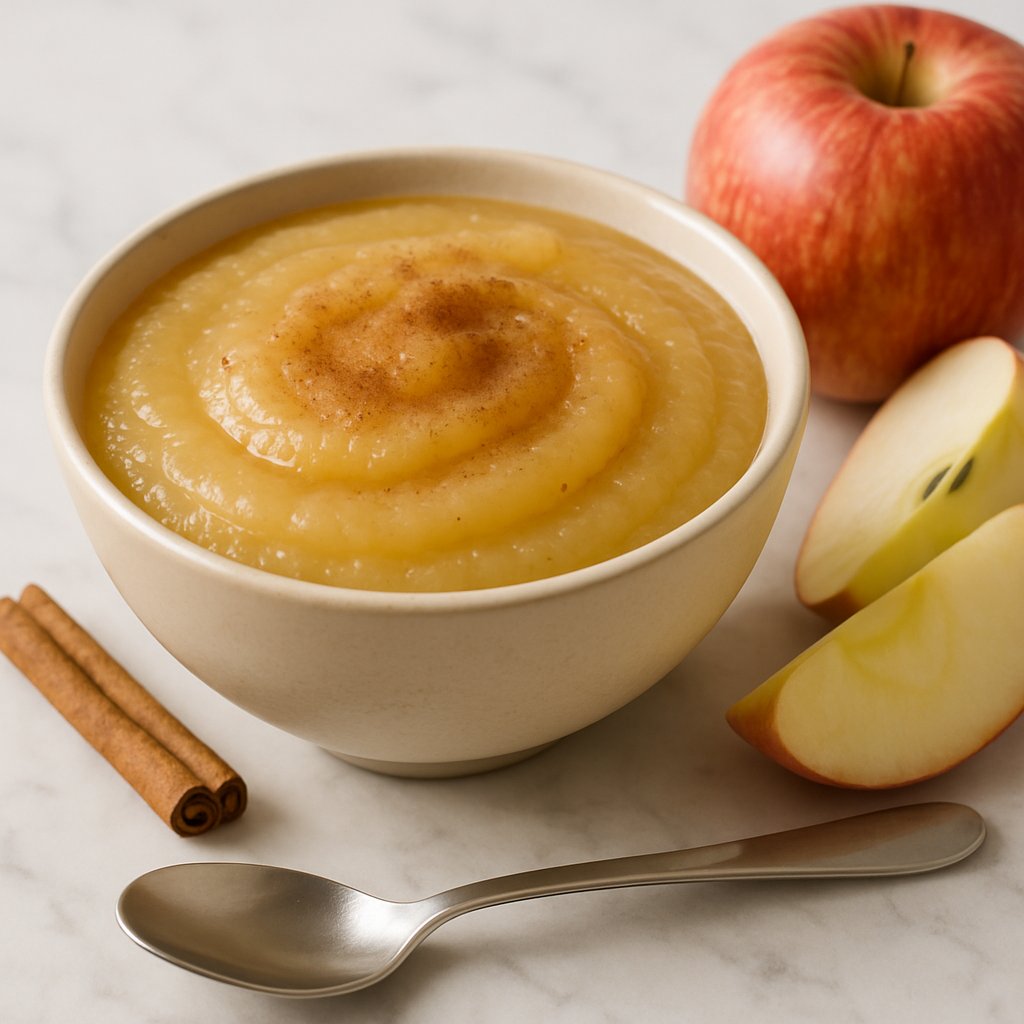
Bowl of applesauce
I still remember the aroma that came from the kitchen of my childhood when a pot of applesauce was slowly simmering on the stove. That scent connects warmth, pragmatism and a certain sobriety for me that only a simple, well-made applesauce can radiate. I find it fascinating how something so versatile can arise from just a few ingredients.

At its core, applesauce is nothing more than softly cooked, pureed apples that are, depending on region and preference, refined with sugar, lemon juice or spices like cinnamon. I prefer a slight acidity in the sauce because it keeps the flavor fresh. A colleague of mine swears by a chunky sauce with bits of peel because it conveys "more authenticity," while I sometimes prefer a silky, sieved sauce for desserts.

Versatility is one of the reasons I love applesauce. It can serve as a classic companion to pancakes, act as a fat and sugar substitute in baking, or pragmatically serve as a quick baby food substitute. Once I tried applesauce with a touch of hot mustard on fried sausages and was surprised how well the combination worked.

  • For baking: applesauce replaces oil or butter in some cake recipes and makes baked goods moister.
  • As a side: classic with mashed potatoes or bratwurst, but also surprisingly good with fried fish.
  • As a dessert base: with yogurt, nuts and honey you quickly get an elegant, light dessert.
  • Storage: fresh applesauce keeps for a few days in the refrigerator, when canned several months.
I recommend trying different apple varieties. A tart Boskoop yields a robust sauce, while a sweet Elstar is milder. The best thing about applesauce is its honesty: it needs no elaborate techniques, just good apples, some time and a dose of curiosity. I love it because it evokes memories and every spoonful is a little culinary homecoming.

Availability & types

Availability and types

Applesauce is a very common ingredient that can be found easily in many countries. Availability here means where and when you can buy or make applesauce. Fresh applesauce is naturally available in season, when apples are harvested. Most supermarkets, however, offer preserved or bottled applesauce year-round. This is because applesauce is made shelf-stable, i.e. processed so that it keeps longer – similar to jam.

Origin and growing regions
Applesauce comes from apples, and apples grow almost everywhere that is not too hot or too cold. Major growing regions in Europe include countries like Germany, France, Italy and Poland. In Germany regions such as the Alte Land or the Rhineland are known for many apple trees. Many apples are also grown in North America, New Zealand and parts of Asia. If you buy a jar of applesauce, the label often indicates the country where the apples come from.

Available varieties and flavors
Applesauce is available in different variants – similar to ice cream or yogurt, meaning there’s something for every taste. Here are the main types, simply explained:

  • Plain: simply cooked and pureed apples, usually without sugar. Tastes mild and fruity.
  • Sweetened: applesauce with sugar or fruit syrup. Sweeter and reminiscent of apple pie.
  • Spiced: often with cinnamon or vanilla. Cinnamon makes it warm and cozy, like a small apple pie in a jar.
  • Chunky (also: "with pieces"): still contains small apple pieces, giving more bite and texture.
  • Finely sieved: very smooth sauce, almost like pudding. Good for babies or when you want a uniform consistency.
Special variants
There are also special types for different needs:

  • Organic applesauce: made from organically grown apples, without synthetic pesticides. Organic means farmers rely more on natural methods.
  • Sugar-free: for people who want to avoid sugar. Often contains only the natural fruit sugars of the apples.
  • With other fruits: apple-pear or apple-raspberry – mixes different flavors.
  • Baby food: extra fine and often without additives, made specifically for infants.
Packaging and practical tips
You’ll find applesauce in glass jars, plastic cups or in squeeze pouches. Jars are good for storage; squeeze pouches are handy for on the go. If you make applesauce yourself, you can choose the apple variety: tart varieties give a refreshing sauce, sweet varieties make it milder.

In summary: applesauce is easy to obtain because apples are grown almost everywhere. There are many varieties – from plain and chunky to spiced or organic – so there’s something for every preference. Whether you like it as a dessert, for baking or as a snack, applesauce is versatile and easy to use.
Details & nutrition

Property Value
Unit g
Average weight per piece 100
Calories per 100 52
Protein per 100 0.2
Carbohydrates per 100 13.7
Sugar per 100 11.0
Fat per 100 0.1
Saturated fat per 100 0.0
Monounsaturated fat 0.0
Polyunsaturated fat 0.0
Fiber per 100 1.3
Vitamin C (mg) per 100 1.0
Vitamin D (IU) per 100 0
Calcium (mg) per 100 4
Iron (mg) per 100 0.1
Nutri-Score A
CO₂ footprint 0.4 kg CO2e/kg
Origin EU (commonly Germany)
Gluten-free Yes
Lactose-free Yes
Nut-free Yes
Vegan Yes
Note Nutritional values refer to unsweetened applesauce; sweetened varieties can contain significantly more sugar/calories.

Technical & scientific information

Applesauce is a processed fruit spread made from cooked and crushed apples, used as an ingredient in the kitchen and marketed as a finished product. Technically, it is a thermo-chemically treated fruit puree whose sensory properties and shelf life are controlled by the selection of apple varieties, the amount of added sweetener, acidification and the manufacturing process.

Chemical composition and nutritional values

  • Typical macronutrients per 100 g: energy 60–85 kcal, carbohydrates 14–20 g (of which sugars 10–15 g), fiber 1–3 g, protein 0.2–0.6 g, fat <0.5 g.
  • Water content: 75–85 %; accordingly water activity (aw) is high, usually 0.95–0.99, which influences microbiological aspects.
  • Vitamins and minerals: low amounts of vitamin C (variable, often 1–5 mg/100 g after processing), potassium about 70–130 mg/100 g. Content of secondary plant compounds such as flavonoids and polyphenols strongly depends on peel content and variety.
  • Functional components: pectin (gelling polysaccharide), free organic acids (e.g. malic acid), soluble and insoluble fibers.
Physicochemical properties

  • pH: typically 3.2–4.0. Acidification (citric acid, ascorbic acid) lowers pH to improve flavor and shelf life.
  • Viscosity and texture are determined by mechanical breakdown, pectin content and temperature during cooling.
  • Enzymatic reactions: polyphenol oxidase leads to browning when cell structures are disrupted; this reaction is inhibited by heating and acidification.
Processing methods

  • Raw material preparation: washing, peeling and coring, although the peel can be partially retained to increase pectin and polyphenol content.
  • Heating and pureeing: cooking at 80–95 °C inactivates enzymes and reduces microbial load; subsequent pureeing produces the desired smoothness.
  • Additives: sugar, acids and commercial pectin can be used to adjust flavor and texture. For preservative-free products, aseptic filling or pasteurization is required.
  • Preservation: hot filling, pasteurization or aseptic processing extend shelf life; refrigeration is recommended for fresh variants.
Microbiology and safety

At a pH < 4.6 applesauce is considered an acidic food, relatively safe against spore-forming anaerobes such as Clostridium botulinum. However, high water activity promotes yeasts and molds if preservation is inadequate. Thermal treatment and airtight packaging are central measures to reduce spoilage.

Health aspects

Applesauce provides quickly available energy in the form of sugars, but also contains soluble fiber and plant secondary compounds that can have positive effects on bowel function and antioxidant capacity. For infants and young children unsweetened applesauce is suitable because of easy digestibility and moderate acidity. Products with high added sugar or preservatives should be limited within a balanced diet.

Culinary and technological use

Applesauce is used as an ingredient in baked goods, sauces, marinades and as a fat or sugar substitute in recipes. Industrially, applesauce is also used as an intermediate for beverages, fruit fillings and baby food. Choice of apple variety and processing parameters largely determine aroma, texture and nutrient retention.

Wiki entry for: applesauce
Active now: 14 visitors of which 2 logged-in members in the last 5 minutes