Menu & categories

Ajvar

Pepper paste made from peppers and eggplants, seasoned mild or hot

Wiki about ajvar Nutri-Score B Vegan Yes Gluten-free Yes Lactose-free Yes Nut-free Yes
NUTRITION / 100 g
120 kcal 1.5 g Protein 8 g Kohlenhydrate 8 g Fett

Introduction

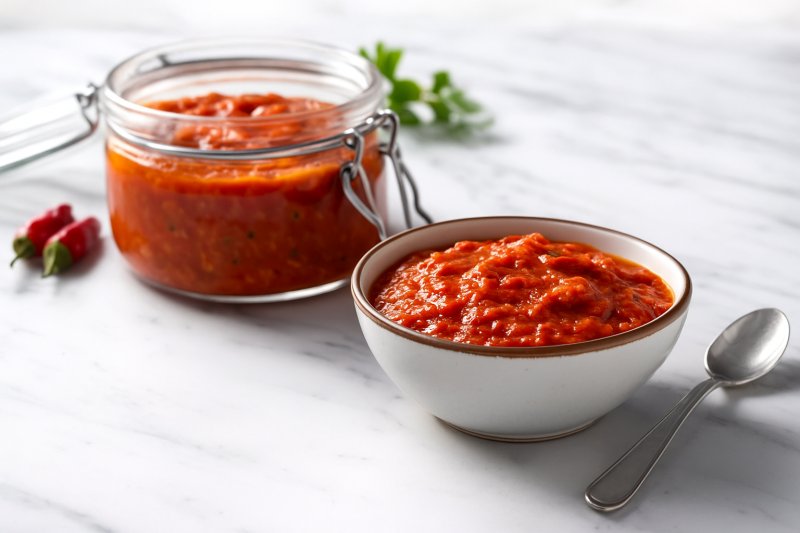
Bowl with red ajvar pepper paste
I still remember the first spoonful of Ajvar I tasted on a dusty table in a small Balkan kitchen: a deep-red, velvety dip that was at once sweet, smoky and a little cheeky. Ajvar has for me that rare gift of turning simple ingredients into something that tells stories. Since then a jar of it is always in my pantry, because bread with Ajvar and some goat cheese quickly turns any tired evening meal into a little celebration.

Ajvar is essentially a paste made from roasted red peppers, often accompanied by eggplant, garlic and sometimes chili. Preparation varies from region to region: sometimes the peppers are roasted more intensely until they are almost caramelized, sometimes the texture remains chunkier. Once I watched in a large kitchen as someone roasted the peppers over an open fire, and the smoky scent that spread through the entire room was simply irresistible. The result was an Ajvar with a slight smoky note that I've loved ever since.

When I think of Ajvar, these uses come to mind immediately:

  • As a spread: On fresh country bread with a drizzle of olive oil.
  • As a side: With grilled meat or vegetables, instead of the usual sauces.
  • As an ingredient: In sandwiches, stews or as a flavor carrier in sauces.
An anecdote: A colleague once brought a jar of homemade Ajvar to the office and insisted I try the recipe. I was skeptical because I thought it was just another pepper paste. After the first bite I was converted. We briefly argued whether a dollop of Ajvar couldn't actually replace any pasta sauce before the reality of lunch break pulled us back.

What makes Ajvar special to me is the balance between simplicity and depth. The ingredients are humble, but the way roasting and seasoning transform the flavors feels almost alchemical. I like to store my Ajvar in jars and use it not only for the taste but also for the reminder of how versatile and connecting food can be. It is an ingredient that is affordable, storable and yet surprisingly elegant — a little red bit of magic in my kitchen repertoire.

Availability & types

Availability and types

What is Ajvar? Ajvar (also written "Ajvar" or in some countries "Aivar") is a spicy paste made from roasted red peppers and often mixed with eggplant. You can think of it as a thick spread that can be served warm or cold with many dishes. It originates from the Balkans, a region in Southeast Europe that includes countries such as Serbia, North Macedonia, Bosnia and Herzegovina and Croatia.

Where does Ajvar come from exactly? Ajvar has its roots in the Balkans. It used to be made at home in large quantities, especially after the pepper harvest in late summer and autumn. Families would roast, peel and process the peppers together — it was a kind of communal celebration and a way to preserve a bountiful harvest. Because it tastes good and keeps well, Ajvar later spread to supermarkets and other countries.

In which regions are the peppers for Ajvar grown? The main ingredient, red peppers, grows in many warm regions. In the Balkans they are mainly cultivated in rural areas. But peppers for Ajvar now also come from other countries with warm climates, for example Turkey, Spain, Italy or even home gardens in Central Europe. What matters is that the peppers are ripe and sweet, because that determines the taste of Ajvar.

What variants of Ajvar exist? There are different types of Ajvar, similar to the various ketchup or mustard variants. The best known are:

  • Mild (non-spicy): This variety is sweeter and won't scare anyone trying it. Children and people who do not like spicy foods prefer it.
  • Spicy: Chili pepper or hot pepper is added here. It has a warming heat, like a small fire on the tongue.
  • With eggplant: Some recipes mix roasted eggplant in. This makes the spread creamier, almost like a purée with a velvety texture.
  • Coarse or smooth: Some Ajvar varieties are chunky and contain small pieces of pepper, others are very finely puréed and smooth — it's like applesauce: chunky or smooth.
  • Homemade vs industrial: Homemade Ajvar is often made with care and without additives, tastes fresh and can vary easily. Industrial Ajvar from the supermarket keeps longer and often has a uniform flavour.
How to find Ajvar in the store? Today Ajvar is available in many supermarkets, delicatessens or Balkan shops. In larger cities there are specialty stores with Eastern European products, where you often find a wider selection. In the supermarket Ajvar is usually in jars in the spreads or international food section. If you look for "mild" or "spicy", that is usually clearly indicated on the label.

Make it yourself or buy it? Many families make Ajvar at home because it's fun and allows you to control the flavour. Those who prefer convenience buy ready jars. When buying, it's worth checking the ingredients: shorter ingredient lists without strange terms usually mean fewer additives. And a jar with a strong, bright red colour often indicates that many ripe peppers were used.

In summary: Ajvar is a versatile, easy-to-find paste made from roasted peppers, offered in various variants — mild, spicy, with eggplant, coarse or smooth. Whether homemade or from the supermarket, Ajvar brings the taste of the Balkans to the table and can be prepared in many countries with ingredients from different growing regions.
Details & nutrition

Property Value
Unit g
Calories per 100 120
Protein per 100 1.5
Carbohydrates per 100 8
Sugar per 100 6
Fat per 100 8
Saturated fat per 100 1.2
Monounsaturated fat 5
Polyunsaturated fat 1.8
Fiber per 100 2.5
Vitamin C (mg) per 100 40
Vitamin D (IU) per 100 0
Calcium (mg) per 100 15
Iron (mg) per 100 0.8
Nutri-Score B
CO₂ footprint 1.2
Origin Southeastern Europe
Gluten-free Yes
Lactose-free Yes
Nut-free Yes
Vegan Yes
Note Values refer to commercially available ajvar made from peppers, eggplants, vegetable oil, vinegar and spices; variations may occur depending on the recipe.

Technical & scientific information

Ajvar is a traditional paste or spread from the Balkan region, made predominantly from roasted red peppers and often supplemented with ingredients like eggplant, garlic and oil. Typically Ajvar is used both as a side for meat and vegetable dishes and as a bread spread. The exact recipe varies regionally; there are mild and spicy variants, with spiciness regulated by adding hot pepper varieties or chili peppers.

Composition and constituents
The main components of Ajvar are red peppers (Capsicum annuum) and vegetable oil (often sunflower or olive oil). Secondary ingredients include eggplant (Solanum melongena), garlic, vinegar and salt. Chemically, peppers provide mainly water, carbohydrates (including soluble sugars and fiber), small amounts of protein and fat, and a range of phytonutrients:

  • Carotenoids: Predominantly capsanthin, capsorubin and beta-carotene, responsible for the red colour and antioxidant properties.
  • Vitamin C: Red peppers are a rich source of ascorbic acid, which is heat-sensitive but can still be present in relevant amounts in preserved or lightly heated form.
  • Flavonoids and phenolics: Secondary plant compounds with antioxidant activity, whose content depends on variety and processing.
  • Fat-soluble components: Through the oil, fat-soluble vitamins and carotenoids become more bioavailable, as lipids promote absorption in the gut.
Nutritional values (typical figures, variable by recipe)
Due to the high water and vegetable content, Ajvar has a moderate energy density. Per 100 g typical values can be about 100–200 kJ (25–50 kcal), 2–6 g carbohydrates, 1–3 g fiber, 0.5–2 g protein and 1–5 g fat. The oil content significantly affects calorie and fat levels; homemade versions with a lot of oil are more energy-dense than lower-oil variants.

Processing methods
Classic preparation includes several technical steps: selection and roasting of the peppers, removal of the skin, deseeding, and subsequent puréeing or chopping. Roasting causes physico-chemical changes such as cell wall breakdown, Maillard reactions on the surface and the release of aromatic compounds. Peeling after roasting reduces bitter components and increases flavour purity. Ingredients like oil, vinegar and spices are then mixed in and often simmered slowly to reduce water and increase microbiological stability. For preservation, salt, vinegar and heat-inactivating steps (pasteurization or sterilization in industrial production) are used.

Microbiology and shelf life
The pH of Ajvar typically lies in the neutral to slightly acidic range, depending on the amount of vinegar. Low water activity due to oil addition and sufficient salt and acidity reduce the risk of bacterial growth. Industrial Ajvar products are often heat-treated and filled sterilically to ensure a long shelf life. For homemade preservation, hygienic preparation, airtight filling and refrigeration are crucial to prevent spoilage and mold formation.

Health aspects
From a nutritional perspective Ajvar primarily supplies micronutrients and phytochemicals from peppers and mono- and polyunsaturated fatty acids from the oils used. The antioxidants (carotenoids, vitamin C, phenolics) can reduce markers of oxidative stress in the body and are generally considered health-promoting. Limitations arise from high salt or oil content in some recipes, which should be considered in cases of hypertension or calorie restriction. In sensitive individuals, spicy variants can cause gastrointestinal irritation due to capsaicin.

Nutritional classification and applications
Ajvar is a versatile food that increases vegetable content in meals and provides a source of fat-soluble micronutrients. It is suitable for vegetarian and vegan diets and can serve as a flavourful alternative to richer or saltier spreads when composition is appropriately adjusted. Culinarily, the roasted aroma enhances sensory appeal and can help increase acceptance of vegetable dishes.

Wiki entry for: ajvar
Active now: 17 visitors of which 2 logged-in members in the last 5 minutes