Menu & categories

Whole milk

Creamy cow's milk with 3.5% fat – versatile for coffee, cooking and baking.

Wiki about whole milk Nutri-Score B Vegan No Gluten-free Yes Lactose-free No Nut-free Yes
NUTRITION / 100 ml
64 kcal 3.3 g Protein 4.8 g Kohlenhydrate 3.5 g Fett

Introduction

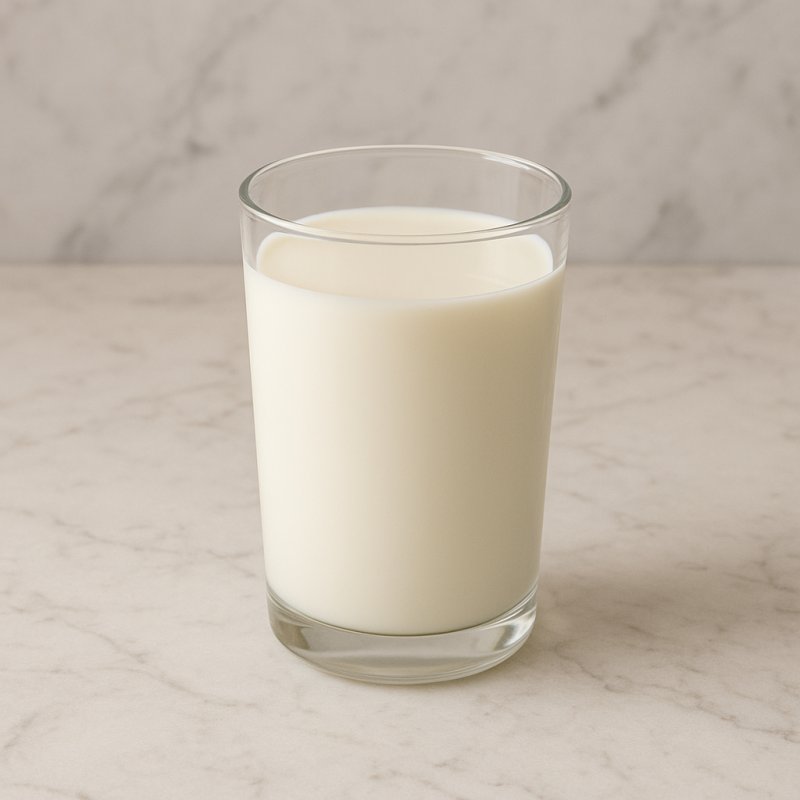
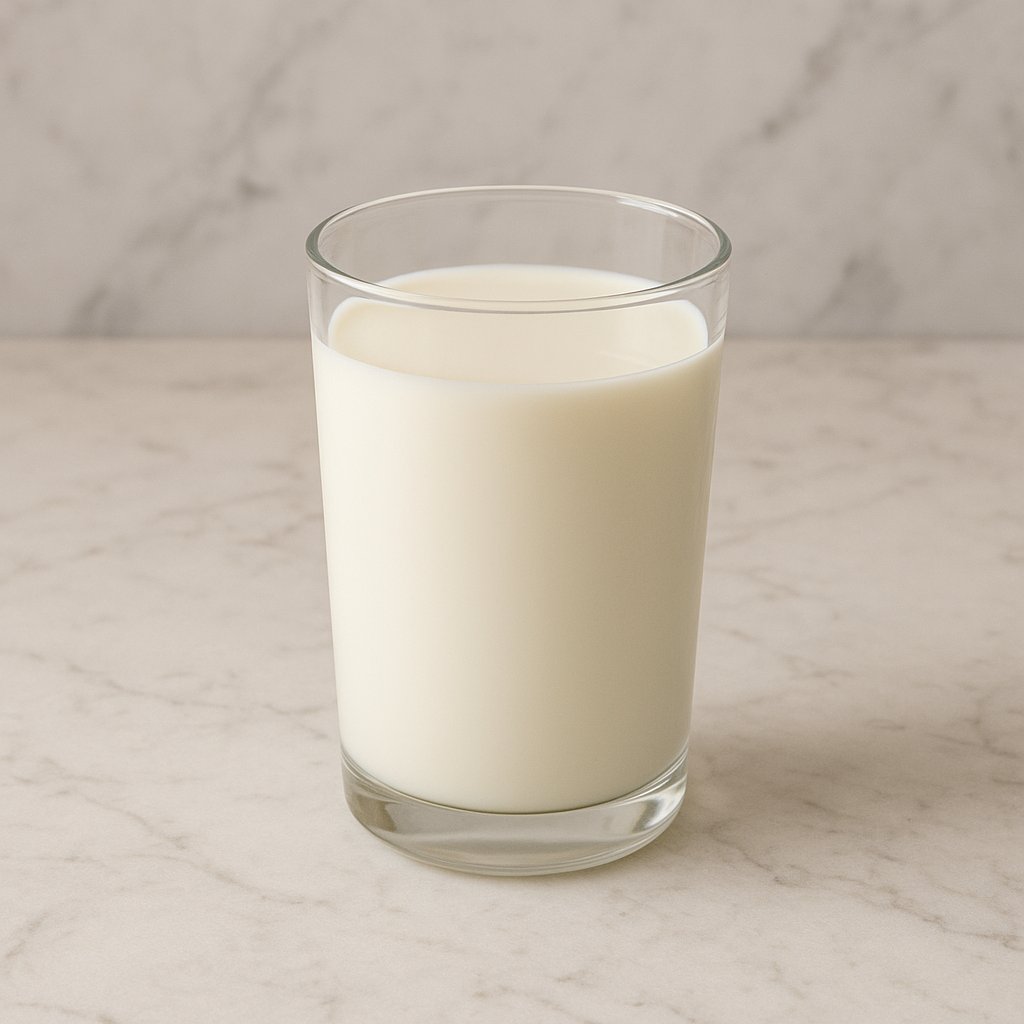
Glass of whole milk
I have a particular fondness for simple ingredients, and whole milk 3.5% definitely belongs to that category. For me it's not just a basic product in the fridge, but a small guarantee of flavor: creamy, rounded and reliable. I still remember a Sunday morning when I wanted to try a spread and the milk was the missing link that held everything together and gave the result warmth.

Whole milk with 3.5 percent fat feels rich on the tongue without being heavy. It is wonderfully versatile and useful in many situations. A colleague of mine swears by adding a splash of whole milk to his coffee because it mellowed the acidity without diluting the coffee. For me it often provides the silky texture in sauces, soups and puddings.

In short: what characterizes this milk can be summarized as follows:

  • Fat content: About 3.5 percent, providing a pleasant creaminess.
  • Nutrients: Protein, calcium and fat-soluble vitamins such as A and D.
  • Use: Ideal for cooking, baking, as a drink and for coffee variants.
  • Taste: Mild, slightly sweet and full-bodied.
I'm happy to share practical tips: when simmering sauces, a splash of whole milk can save the consistency, and in baking it ensures a tender crumb. When I make fresh porridge, I pour warm whole milk over it at the end — it's my little luxury moment in the morning. Of course this milk contains lactose; those who are sensitive should be aware or choose lactose-free variants.

For storage I prefer chilled, pasteurized milk from a trusted source and check the expiration date and smell. Ultimately whole milk 3.5% is for me one of those unassuming ingredients that can elevate recipes without making a fuss, and that's exactly what I find so likable about it.

Availability & types


Whole milk 3.5% is ordinary cow's milk with about 3.5 percent fat. This fat makes the milk a bit creamier than lower-fat versions. The milk comes from cows living on farms. It is milked, cleaned and processed before it reaches the supermarket. You can imagine it a bit like someone making freshly pressed fruit juice: the raw material (here the milk) is collected, tested and then packaged in bottles or cartons.

Origin
Whole milk is produced in many countries around the world. In Europe much milk comes from countries with large green areas for cows, for example Germany, Austria, Switzerland, the Netherlands, Denmark or Ireland. In warmer countries there are also dairy farmers, but the way cows are kept can differ. Important: many milk packages show which country or even which region the milk comes from. That way you can see whether the milk is "regional" — i.e. from near where you live.

Production areas
There are no cultivation areas for milk like for vegetables, but there are regions with particularly many cows and lush meadows. In the mountains, for example in Bavaria or Switzerland, cows often graze on alpine meadows in summer. Such milk is sometimes called alpine milk or hay milk when the cows mainly eat dried grass (hay). In grass-rich areas in northern Germany or Ireland cows also graze readily. These differences can have a small influence on the taste and quality of the milk, similar to how wine tastes different in different regions.

Available types and variants
Whole milk 3.5% is available in many variants. Here are the most important ones, explained simply:

  • Fresh whole milk: Sold chilled and consumed quickly. It's like a fresh slice of bread — best eaten soon.
  • UHT milk (long-life): This milk has been heated very briefly to high temperatures so it lasts longer, even unrefrigerated. Imagine heating something briefly to make it last longer.
  • Organic whole milk: Comes from farms with organic farming. The cows have more space, usually receive organic feed and no artificial additives. It's like organic vegetables: different rules for cultivation and feeding.
  • Lactose-free whole milk: For people who do not tolerate milk sugar (lactose) well. An enzyme (a processing aid) breaks down the lactose so the milk is easier to digest.
  • Pasture- or hay-fed milk: Indicates that cows spent a lot of time outside on pasture or were fed mainly hay. Some people find this milk particularly flavorful.
  • Packaging types: Glass bottles, plastic containers or cartons — glass preserves flavor well, cartons are practical, and some farms even offer fresh milk from vending machines.
Where to get whole milk 3.5%?
You can find it in almost every supermarket, farm shop, weekly market or sometimes at milk vending points on farms. Buying regional often supports local farmers and means shorter transport routes.

Overall whole milk 3.5% is a very common ingredient available in many regions and in different variants — from fresh and regional to longer-lasting UHT milk and organic types, so there's something to suit almost every taste and need.
Details & nutrition

Property Value
Unit ml
Average weight per piece 100
Calories per 100 64
Protein per 100 3.3
Carbohydrates per 100 4.8
Sugar per 100 4.8
Fat per 100 3.5
Saturated fat per 100 2.3
Monounsaturated fat 1
Polyunsaturated fat 0.2
Fiber per 100 0
Vitamin C (mg) per 100 0
Vitamin D (IU) per 100 0
Calcium (mg) per 100 120
Iron (mg) per 100 0.03
Nutri-Score B
CO₂ footprint 0.13
Origin EU (commonly Germany, depending on the bottling facility)
Gluten-free Yes
Lactose-free No
Nut-free Yes
Vegan No
Note Nutritional values are typical averages per 100 ml for whole milk (3.5% fat). CO2 footprint is a rough guideline in kg CO2e per 100 ml; it may vary depending on origin and production methods.

Technical & scientific information

Whole milk 3.5% refers to cow's milk with a fat content of about 3.5 weight percent and represents the common commercial type of drinking milk in many countries. Chemically, whole milk consists mainly of water (about 87–88 %) and soluble as well as colloidal solids, collectively described as dry matter. Key components include lactose (carbohydrates), milk proteins (caseins and whey proteins), milk fat (predominantly triacylglycerols), minerals and fat-soluble as well as water-soluble vitamins.

  • Composition (typical per 100 g): Energy 60–70 kcal, fat 3.5 g, of which saturated fatty acids approx. 2.0–2.5 g; protein 3.2–3.4 g; carbohydrates (as lactose) 4.6–5.0 g; calcium about 110–125 mg. These values can vary slightly depending on feed, season and milk supplier.
  • Proteins: Caseins make up about 80% of the protein and occur as casein micelles whose structure is stabilized by colloidal calcium phosphate. Whey proteins such as β-lactoglobulin and α-lactalbumin are more heat-sensitive.
  • Fat: Milk fat is a mixture of fatty acids, mainly palmitic acid, oleic acid and myristic acid, contained in fat globules whose membrane includes natural phospholipids and proteins.
  • Other components: Vitamins A, D (sometimes fortified), B2, B12 and minerals such as phosphorus, potassium and trace elements. The pH typically lies around 6.6–6.8.
Processing and preservation: After milking, raw milk is filtered, cooled and can be standardized to the desired fat content. The common thermal processes are pasteurization (e.g. HTST: 72 °C for 15 seconds) to reduce microbial load and UHT treatment (approx. 135–150 °C for fractions of a second) for long-life milk. Homogenization breaks down fat globules under high pressure to prevent creaming and to uniform the texture. The degree of heat treatment affects enzymes such as alkaline phosphatase, which is used as an indicator of adequate pasteurization.

Biochemical stability: Milk is a complex colloidal system. Lipolysis and proteolysis by enzymes or microorganisms can affect flavor and shelf life. At higher temperatures or with prolonged storage, Maillard reactions between lactose and amino acids can occur, leading to changes in color and aroma. Spore-forming microorganisms and heat-resistant enzymes may persist after some treatments, which is why refrigeration and hygienic processing are important.

Nutritional and health aspects: Whole milk provides high-quality proteins with a good amino acid balance, bioavailable calcium and vitamin-supporting nutrients. It is a nutritious component of balanced diets, but can cause gastrointestinal symptoms in people with lactose intolerance and provoke severe immunological reactions in those with cow's milk allergy. The relatively high share of saturated fatty acids is often viewed cautiously in cardiovascular dietary recommendations, although epidemiological evidence is nuanced. Residues of antibiotics, hormones or environmental contaminants are subject to strict legal limits and are minimized through control measures.

In summary, whole milk 3.5% is a technically well-studied food with defined composition and established processing methods. Its nutritional significance is based on dense micronutrient and protein contents, while hygienic production, correct storage and individual tolerance profiles are important aspects for safe and appropriate use.

Wiki entry for: whole milk
Active now: 18 visitors of which 2 logged-in members in the last 5 minutes